
Of the roughly 290,000 people who are affected by spinal cord injury (in the US alone), about 12% result in full paralysis, which doctors refer to as complete tetraplegia. As devastating as this life-changing condition is, there is now hope for partial recovery thanks to a team of Australia-based surgeons and their research with nerve transfers. They have managed to restore the function of upper limbs in 13 young adults in a recent clinical trial who had become paralyzed as a result of traffic accidents or sports-related injuries.
Surgical interventions to restore the function of the hands and arms have traditionally involved tendon transfer surgery. The team of scientists from Austin Health in Melbourne, Australia, led by Dr. Natasha van Zyl, were looking into the potential of combining “traditional tendon-based techniques with nerve transfers” for restoring “upper limb function.” The results have been published in the journal The Lancet.
Dr. Zyl said in a press release:
For people with tetraplegia, improvement in hand function is the single most important goal. We believe that nerve transfer surgery offers an exciting new option, offering individuals with paralysis the possibility of regaining arm and hand functions to perform everyday tasks, and giving them greater independence and the ability to participate more easily in family and work life.
In tendon transfer surgery, healthy, functional muscles that have a less important role are relocated to replace the muscles that sustained damage as a result of the injury. In nerve transfer surgery, nerves are relocated to in a similar manner to reanimate (reinnervate) the damaged muscle. It could be an alternative to tendon transfer and may possess several advantages. For instance, nerve transfers allow for the reanimation of several muscles at a time, and the recovery time after surgery is much shorter.
The study by the Australian scientists involved 16 young adults (average age of 27 years) who reported on their progress up to 2 years after surgery. All participants suffered from a loss of movement in all four limbs (tetraplegia) and they all underwent a nerve transfer surgery, whereby doctors connect functioning nerves with injured nerves to restore power to their muscles.
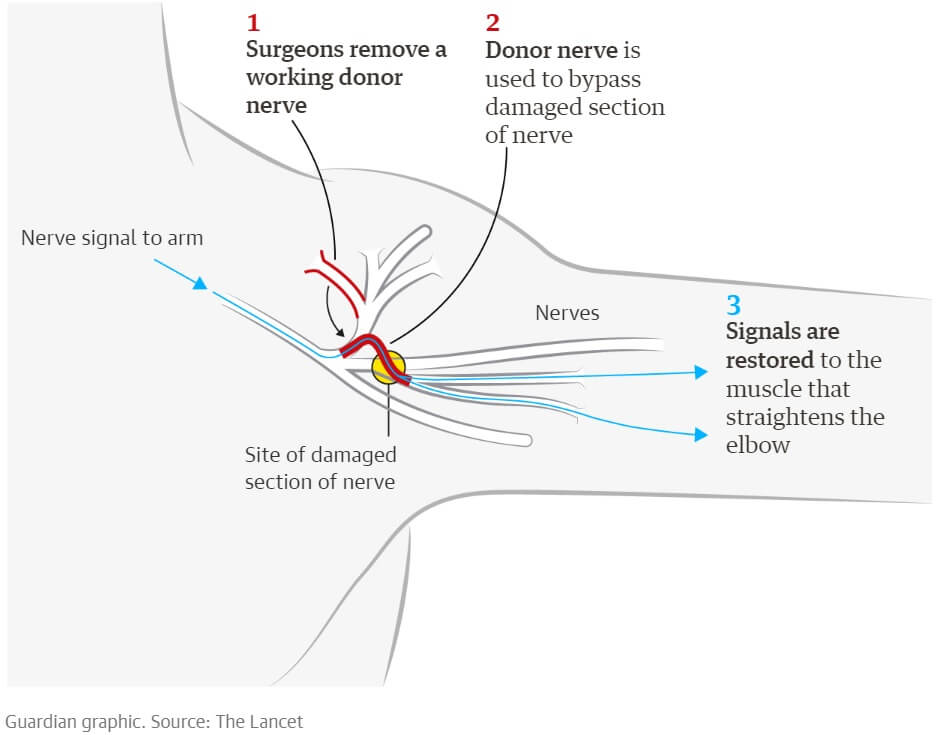
The procedure took nerves that are still hooked up to the spinal cord above the region of injury (typically the nerve supplying the teres minor muscle in the upper arm and shoulder) and rerouted it to the paralyzed muscle itself. The participants followed up the therapy with years of intensive therapy. Part of what helped with the positive outcome was that the injury had occurred less than 18 months before the study. It is important to get the surgery as soon as possible following the injury.
In total, 59 nerve transfers were completed in the 16 participants, with 10 of the cases also receiving a tendon transfer to ease along the process. Four of the nerve transfers failed in three participants. Regardless, 13 patients were left with remarkably well-functioning hand and elbow movement allowing them to carry out everyday tasks independently after 24 months. They can now perform everyday tasks independently such as feeding themselves, brushing teeth and hair, putting on make-up, writing, handling money and credit cards, and using tools and electronic devices.
Van Zyl said:
We have shown that nerve transfers can be successfully combined with traditional tendon transfer techniques to maximize benefits. When grasp and pinch was restored using nerve transfers in one hand and tendon transfers in the other, participants consistently reporting that they liked both hands for different reasons and would not choose to have two hands reconstructed in the same way.
Here are 3 videos released of participants to see the results in action:


