
A team of engineers from the Max Planck Institute for Intelligent Systems (MPI-IS) in Stuttgart, Germany, have created a tiny jellyfish-inspired robot. This robot not only swims but transports objects, mixes fluids and can even bury itself.
The five-millimeter tether-less “Jellyfishbot” could possibly help us understand the survivability of baby jellyfish in changing environments. Although, the potential uses for the tiny aquatic bot go far beyond that.
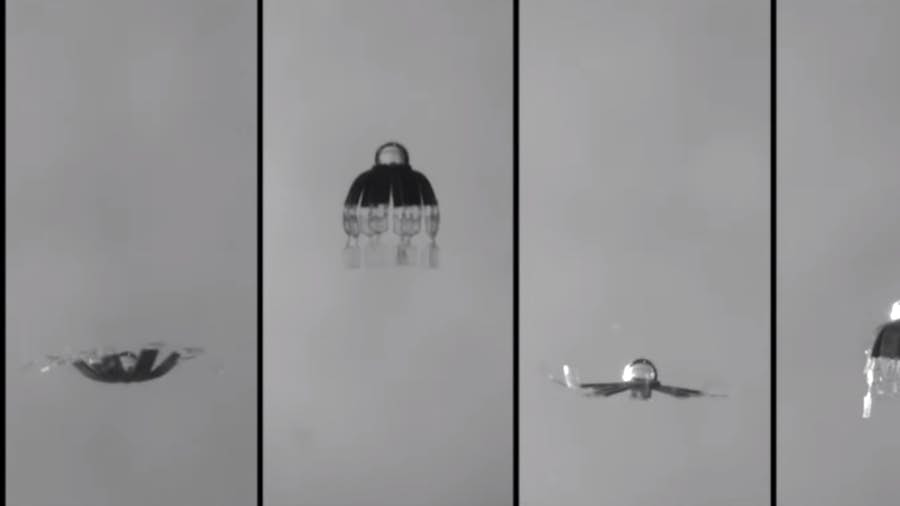
The team, led by Dr. Metin Sitti, was inspired by the juvenile of the most common jellyfish, scyphomedusae ephyra. Despite their small size and simple body structure, these jellyfish are able to control the fluidic flow around their bodies to perform a range of complex tasks.
Since the aquatic environments are changing due to pollutants, temperature, salinity, etc., one of the aims of the research, published in the journal Nature Communications, is to understand more about how those changes are affecting the morphology and kinematics of the jellyfish and therefore their survivability.
How do The Scientists Control And Propel The Jellyfishbot?
The scientists embedded magnetic particles into each of the eight elastomer lappets (the flappy parts), which are articulated when exposed to an external (oscillating) magnetic field.
Jellyfishbot Capabilities
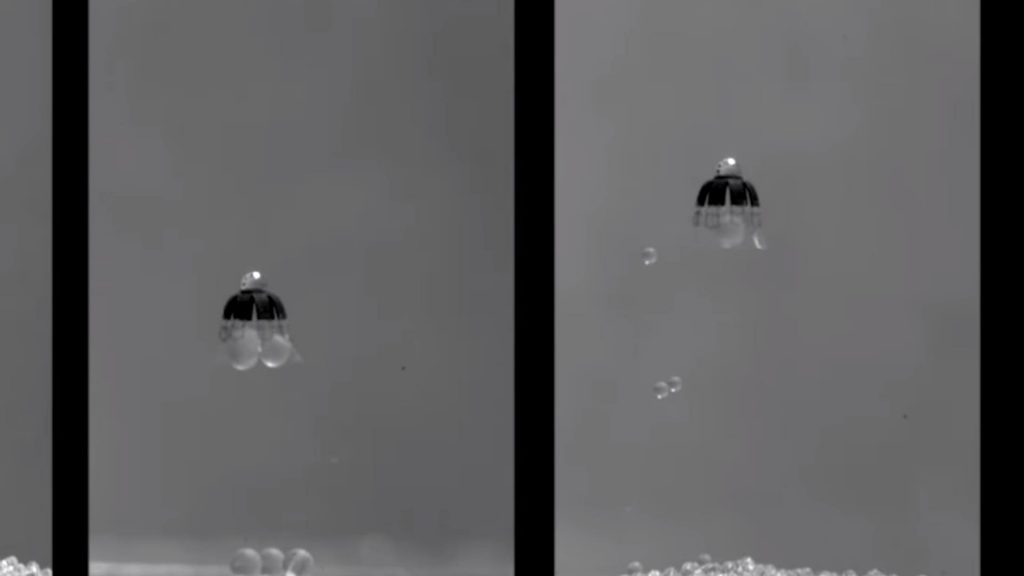
Besides swimming, the jellyfishbot was able to successfully accomplish multiple tasks such as transporting beads of different sizes, food-catching, burrowing to escape predators, mixing of different fluids and creating a chemical path in its wake.
Future Plans
The team has already moved onto the next stage, looking at potential medical uses for even tinier jellyfishbots. This additional work has already been presented at one of the world’s most prestigious robotics conferences, Robotics: Science and Systems, where it won the Best Paper Award. The paper for this specific research has yet to be published in a journal but will be revealed soon.
Xiaoguang Dong, a Ph.D. student in the Physical Intelligence Department at the MPI-IS who participated in the research, said:
A possible application scenario is to control the robot to swim inside the bladder under the guidance of ultrasound imaging, and to patch to a target, such as cancerous tissue, to release the cancer drug for a long time in controlled doses.
Watch the jellyfishbot in action in the video below!


