
Heavy-duty trucking is essential for economic activity, yet it burns significant fuel and releases a large share of road-transport emissions, with trucks and buses responsible for more than one-third of direct road CO₂ according to the IEA’s trucks and buses analysis. For years, most fleets were forced to estimate their footprint using spreadsheets and quarterly averages. Estimation delays decisions.
Real-time data enables action, creating a scenario where connected sensors, edge computing, and modern cellular networks fundamentally change the game. Today’s trucks expose fuel and engine metrics through the vehicle network, while portable emissions systems and onboard sensors validate the results during field campaigns.
Fifth-generation cellular networks provide the bandwidth and reliability to stream those signals continuously. The outcome is a pipeline that converts fuel use into carbon dioxide equivalents in near real time, then turns that information into operational changes that reduce idling, optimize routing, and coach driving style.

Beyond Spreadsheets: Why Trucking Needs 5G and IoT
Standards make the numbers decision-ready. ISO 14083 defines how organizations quantify and report greenhouse gas emissions from logistics across modes, and the Smart Freight Centre’s GLEC Framework aligns corporate reporting with that method. Policy adds urgency. The United States finalized heavy-duty greenhouse gas standards for model years 2027 through 2032, and the European Union adopted staged targets that require steep cuts by 2030, 2035, and 2040. These components now fit together, allowing fleets to measure, manage, and prove reductions.
For context on how autonomy and safety innovations are entering freight operations, connected trucking platforms now pair perception and planning with telematics-driven analytics, including modern autonomous safety stacks for freight operations. These advances rely on the same sensor and connectivity backbone that underpins emissions tracking.
Core Components for ISO 14083 Compliance
- Real-time emissions tracking uses primary activity data from the truck, multiplied by accepted greenhouse gas factors to compute carbon dioxide equivalents per trip and per ton-kilometer. The U.S. Environmental Protection Agency maintains an official Emission Factors Hub that fleets and platforms reference for fuel types and gases via the EPA Emission Factors Hub.
- ISO 14083 provides a harmonized method for logistics emissions accounting. Organizations map their telematics pipeline to this standard so that results are auditable by customers, lenders, and regulators through the ISO 14083 logistics emissions method.
- Smart Freight Centre’s GLEC Framework translates the standard for corporate programs and supplier engagement through the GLEC reporting framework.
- Connectivity tailwinds support continuous telemetry. The U.S. Federal Communications Commission finalized rules that enable cellular V2X in the 5.9 GHz band under the FCC’s C-V2X framework. The U.S. Department of Transportation released a national plan to scale V2X deployments as part of the USDOT V2X plan.
- European transport corridors are investing in 5G connectivity to support cross-border operations and low-latency data services, improving the probability that long-haul trucks remain connected across lanes.
- Real-world validation still matters. Targeted campaigns use Portable Emission Measurement Systems and calibrated onboard sensors to verify model outputs and catch outliers.
The Decarbonization Bottleneck: Moving from Estimation to Action
Why Spreadsheet Estimates Fail
Estimations average away the details that drive waste. Quarterly fuel totals and generic emission factors provide a high-level footprint, yet they rarely single out which depots, corridors, or shifts cause spikes. This lack of detail makes acting with confidence difficult.
When primary data flows directly from powertrain signals, fleets can see the patterns behind excess fuel burn, including:
- Prolonged idle time in yards
- Speeding on grade
- Inefficient shift timing
- Running with suboptimal tire pressure
The Value of Continuous Sensing
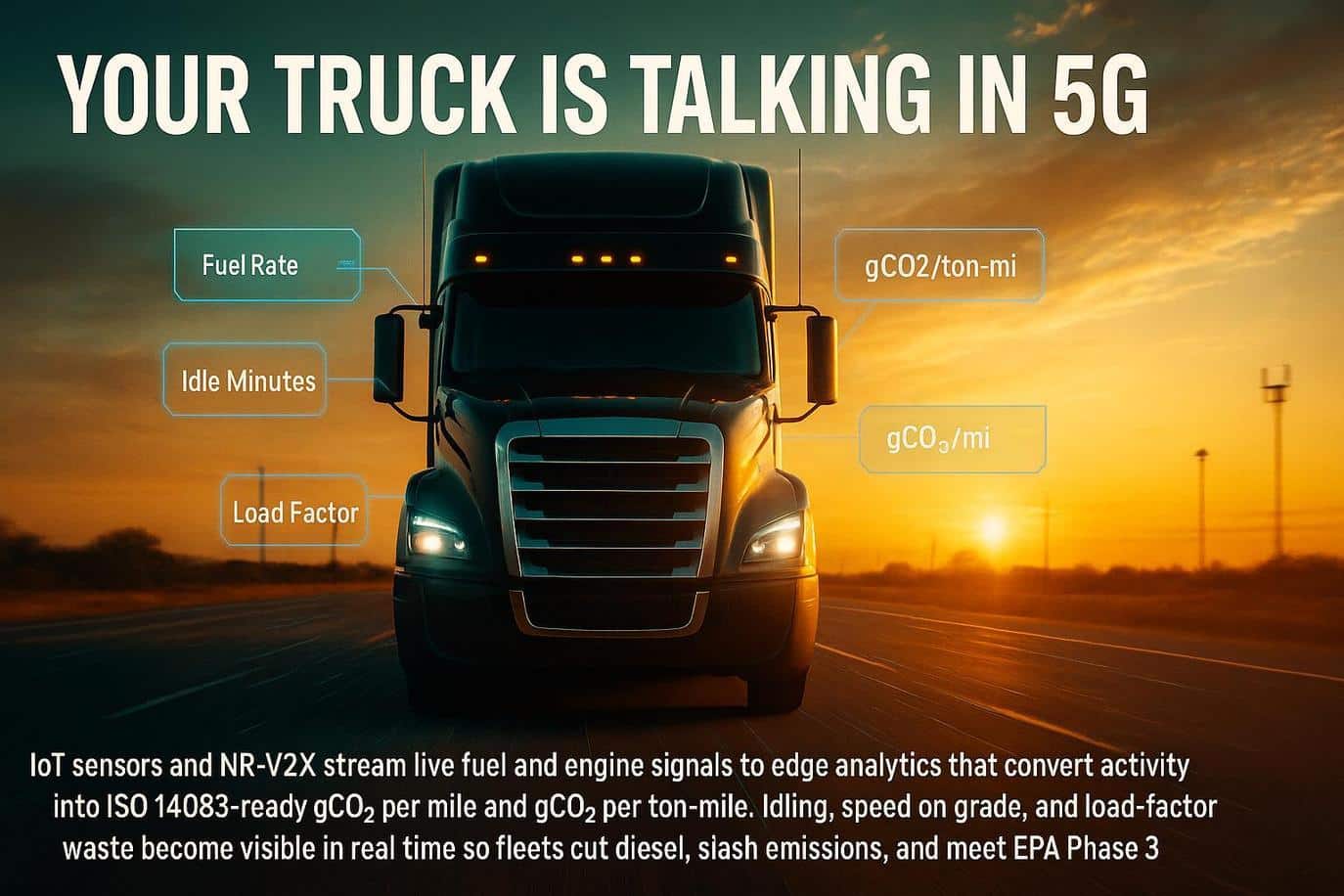
Continuous sensing turns a static inventory into a live map of opportunities. Time-aligned measurements of fuel rate, vehicle speed, payload proxy, road grade, and weather make it possible to compute intensity metrics like grams of CO₂ per mile and per ton-mile for each trip segment.
With these metrics on a dashboard, supervisors can:
- Compare the efficiency of different routes
- Coach drivers on throttle discipline
- Schedule maintenance to fix high-consumption vehicles
Human Factors and Driver Coaching
Connected coaching is most effective when it respects drivers and reduces workload. Fleets pair in-cab feedback with focused training on progressive shifting, right-sizing cruise speeds, and gentle braking. Early adopters of battery-electric tractors also report that smoother torque delivery changes driving style in ways that reduce fatigue and improve consistency, as described in a long-haul driver’s perspective on electric versus diesel.

How the Real-Time IoT and 5G Emissions Stack Works
Data from the Truck
Modern heavy-duty vehicles expose engine and fuel data through the vehicle network, which can be accessed by a certified telematics gateway. Key signals include:
- Fuel used and fuel rate
- Engine load and torque
- Engine speed and vehicle speed
- Idle state and power-take-off (PTO) status
Fleets often supplement these signals with:
- GPS for position
- Elevation data for estimating grade
- Tire pressure data for rolling resistance
For pollutants that vary with duty cycle, fleets use onboard sensors and periodic campaigns with Portable Emissions Measurement Systems to check and calibrate models.
Converting Activity into Emissions
The core calculation is straightforward. A telematics platform aggregates fuel used over a defined segment, multiplies it by accepted emission factors for CO₂, CH₄, and N₂O, then converts to carbon dioxide equivalent using global warming potentials. The result appears as grams per mile and grams per ton-mile, which are easy to compare across routes. The Emission Factors Hub provides the reference values and documentation for this approach at the EPA resource linked in Quick Facts.
The Case for Primary Data
ISO 14083 and the GLEC Framework encourage using the best available data. Primary activity data from the vehicle is preferred over modeled or default values because it reflects how specific engines perform on specific routes with actual loads and weather. When fleets report how much of their results come from actual data compared to estimated data, auditors can assess the quality and track improvements over time. See the standard and framework links in Quick Facts for formal definitions and data-quality tiers.
The Role of 5G, V2X, and Edge Computing
Low-latency cellular networks allow gateways to stream high-frequency data with less dropout along intercity corridors. Cellular V2X was designed for mission-critical applications that require reliable links between vehicles and roadside units. In an emissions context, the system provides several benefits:
- Supervisors can receive near-instant alerts when idle limits are exceeded.
- Alerts can be triggered when vehicles drift from eco-speed windows.
- Notifications are sent when sensors report abnormal readings.
A compact compute module at the edge runs models that detect anomalies and build per-segment metrics before data leaves the vehicle. Edge processing reduces data volume, protects privacy, and keeps coaching features working in areas with weaker coverage. National rulemaking and deployment plans have improved the regulatory footing for these technologies so that large fleets can scale without waiting for bespoke pilots. Rule and deployment context reflect FCC and U.S. DOT guidance cited in Quick Facts. Security considerations should remain front-of-mind, grounded in 5G-era risk patterns in connected systems.
Cloud Analytics for ISO 14083 Reporting
Cloud-based workloads clean and align the data stream, compute intensity metrics, and assemble route-level and fleet-level reports. The results are structured to match ISO 14083 templates so that customers and regulators can compare like for like. Many organizations also align their disclosures with the Smart Freight Centre’s GLEC Framework to provide consistency across suppliers.
Assurance and Audit Trails
Assurance relies on traceability. Effective practice involves several key actions:
- Capturing the chain of custody from raw signal to final metric.
- Storing calibration logs for all sensors.
- Documenting when and how emission factors or models change.
Periodic PEMS campaigns are scheduled on representative vehicles to validate results and correct bias. The audit package shows the mix of primary and modeled data so that reviewers can assess quality.

The New Mandate: Compliance, Connectivity, and 5G Corridors
Regulatory Mandates (EPA and EU)
Regulatory pressure is mounting. The U.S. EPA finalized strict greenhouse gas standards for heavy-duty vehicles (model years 2027-2032), while the European Union adopted staged CO₂ cuts for new trucks, requiring steep reductions by 2030 and 2035.
Data Quality and Disclosure Requirements
This new situation requires better data quality because stakeholders want clear and comparable reports based on actual measurements instead of older estimates. Under corporate sustainability standards, companies must disclose how much of their logistics footprint is based on primary data. This expectation is another reason to invest in the real-time stack.
The 5G, V2X, and Edge Connectivity Solution
The solution relies on connectivity. Continuous, low-latency uplinks are essential for real-time alerts and a high-quality data stream. Both the U.S. and EU are investing heavily in “data corridors” by upgrading 5G and V2X (vehicle-to-everything) infrastructure, which will reduce dead zones on priority lanes. This allows for an efficient “edge-first” architecture, wherein-cab modules compute initial metrics and coaching alerts, then send compact summaries to the cloud.
Security, Infrastructure, and Future Outlook
As this infrastructure, including network cabling for smarter cities, becomes standard, security by design—using encrypted links and strict access controls—becomes a critical engineering requirement. These trends will extend emissions telemetry into depots and intermodal hubs.
Related Operational Compliance
Emissions are not the only compliance dimension. Many fleets pair their decarbonization program with upgraded weight and axle monitoring, maintenance scheduling, and load management, as these steps often reduce risk and fuel burn at the same time. A practical overview of truck weight and overload regimes and fuel cards in fleet management shows how these rules intersect with day-to-day operations.

The Operational Playbook: From CO₂ Reduction to Audit-Ready Reports
Immediate CO₂ Reduction: Idling and Driver Coaching
Fleets can achieve immediate CO₂ reductions by focusing on operational efficiency. The largest gains often come from eliminating idle time, which can be enforced using real-time alerts, clear yard policies, structured operating windows at docks, and en-route triggers. This is paired with data-driven driver coaching on smooth acceleration, efficient shifting, and eco-friendly long-haul trucking tips.
Fleet-Wide Efficiency: Maintenance, Tires, and Routing
Further savings are captured by monitoring tire pressure to reduce rolling resistance (TPMS), optimizing routes for load factor and stop density, and using telematics data to schedule preventive maintenance on underperforming vehicles.
Map Your Data Pipeline to ISO 14083
This same data pipeline is then used to create audit-ready reports. This involves mapping the data flow from the raw sensor signal to the final KPI, defining segment boundaries, aggregation rules, and the equations used to convert activity into greenhouse gas results.
Creating an Audit-Ready Data Package
A complete audit package clearly declares the quality (primary vs. modeled) of the data. It must include calibration records, sensor maintenance logs, factor libraries with version history, and evidence from periodic Portable Emissions Measurement Systems (PEMS) campaigns.
Proactive Stakeholder Reporting
Customers, lenders, and regulators can proactively receive this verified data package through self-service portals, demonstrating compliance and fostering trust.
Build vs. Buy: Key Questions for Your Telematics Platform
Data Rights and Portability
Who owns the raw signals and derived metrics, and how can you export them easily? Ensure contracts spell out access terms for both real-time streams and historical archives.
Factor Libraries and Updates
How are emission factors sourced and updated, and can you freeze versions for year-end reporting while testing new sets in parallel? Ask vendors to show their change logs and impact assessments.
Edge Capabilities and Offline Behavior
What computations run at the edge, and how does the system behave when coverage drops? Look for buffering, resumable uploads, and graceful degradation of in-cab coaching features.
Open Integration and APIs
Can the platform stream metrics into your dispatch, maintenance, and finance systems without custom workarounds? Request examples of webhook events for idle alerts, eco-driving scores, and per-segment intensity results, grounded in IoT technology in smart spaces.
Security and Privacy Controls
Confirm encryption in transit and at rest, credential rotation, and fine-grained permissions. Review how the platform isolates tenants and protects personally identifiable information.
Validation and Field Testing
Ask how the vendor supports PEMS campaigns and third-party validation. Request sample protocols for selecting representative vehicles, routes, and seasons.

Turning Real-Time Truck Data into Actionable Insights
A continuous cycle of improvement is unlocked by real-time signals. This connected stack, IoT sensors measuring fuel, 5G networks carrying the facts, and edge computing translating activity into metrics, gives fleet operators the power to act. Adopting this technology allows fleets to reduce fuel, lower emissions, and build credibility with customers and regulators simultaneously.
As transport networks improve and emissions rules like ISO 14083 become required, switching from estimating every few months to tracking results for each trip is the best way to meet regulations and save money. This real-time data pipeline makes fleet decarbonization an operational reality.
Frequently Asked Questions About Truck Emissions Data
What is ISO 14083?
ISO 14083 is an international standard that provides a consistent, harmonized method for quantifying and reporting greenhouse gas (GHG) emissions for logistics and freight operations. It ensures that data from different carriers and regions can be compared accurately.
How do 5G and IoT reduce truck emissions?
IoT sensors (telematics) on the truck gather primary data like fuel consumption, engine load, and idle time. 5G provides the high-bandwidth, low-latency connection needed to stream this data in real time. This allows fleet managers to make immediate operational changes, like rerouting or correcting idle time, to cut fuel use.
What is the GLEC Framework?
The GLEC (Global Logistics Emissions Council) Framework is a set of guidelines that aligns corporate reporting with standards like ISO 14083. It provides a practical structure for companies to account for and report their logistics emissions in a way that is consistent and auditable.
What is primary data versus modeled data?
Primary data comes directly from the truck’s sensors (e.g., actual fuel burned). Modeled data is an estimate based on averages (e.g., average fuel use for that truck model on that type of route). Primary data is far more accurate and is preferred for ISO 14083 reporting.


