
Urban environments frequently suffer from minor inefficiencies that compound into significant delays: a missed bus connection, a short walk that disrupts a commute, or local streets congested for twenty minutes by preventable vehicle trips. Frequent reliance on private vehicles for journeys that could be faster, cheaper, and cleaner remains a hallmark of the last-mile gap. Shifting these choices requires a sequence of reliable alternatives that feel as convenient as a personal car. Implementing low-cost AI for real-time bike-lane hazard detection helps cyclists feel more secure when navigating the last-mile gap.
Transitioning toward a shared mobility stack represents a fundamental shift in urban planning. Modern transit infrastructure now leverages data-driven insights to synchronize various modes of travel rather than prioritizing private car throughput. Strategic alignment between bike-share docks and subway portals effectively dissolves the ‘last-mile’ barrier that historically discouraged public transit adoption. A collaborative ecosystem of this nature ensures that every leg of a journey remains as frictionless as the first, turning sporadic riders into daily commuters.

Smart City Mobility Essentials: Solving Last-Mile Congestion
Data Analysis: Smart City Mobility by the Numbers
Regional transportation networks have seen a dramatic shift in how residents navigate local streets. Recent growth in shared bike and scooter trips across North America demonstrates a significant shift in how residents manage short-distance travel.
Such growth highlights the effectiveness of station-based solutions:
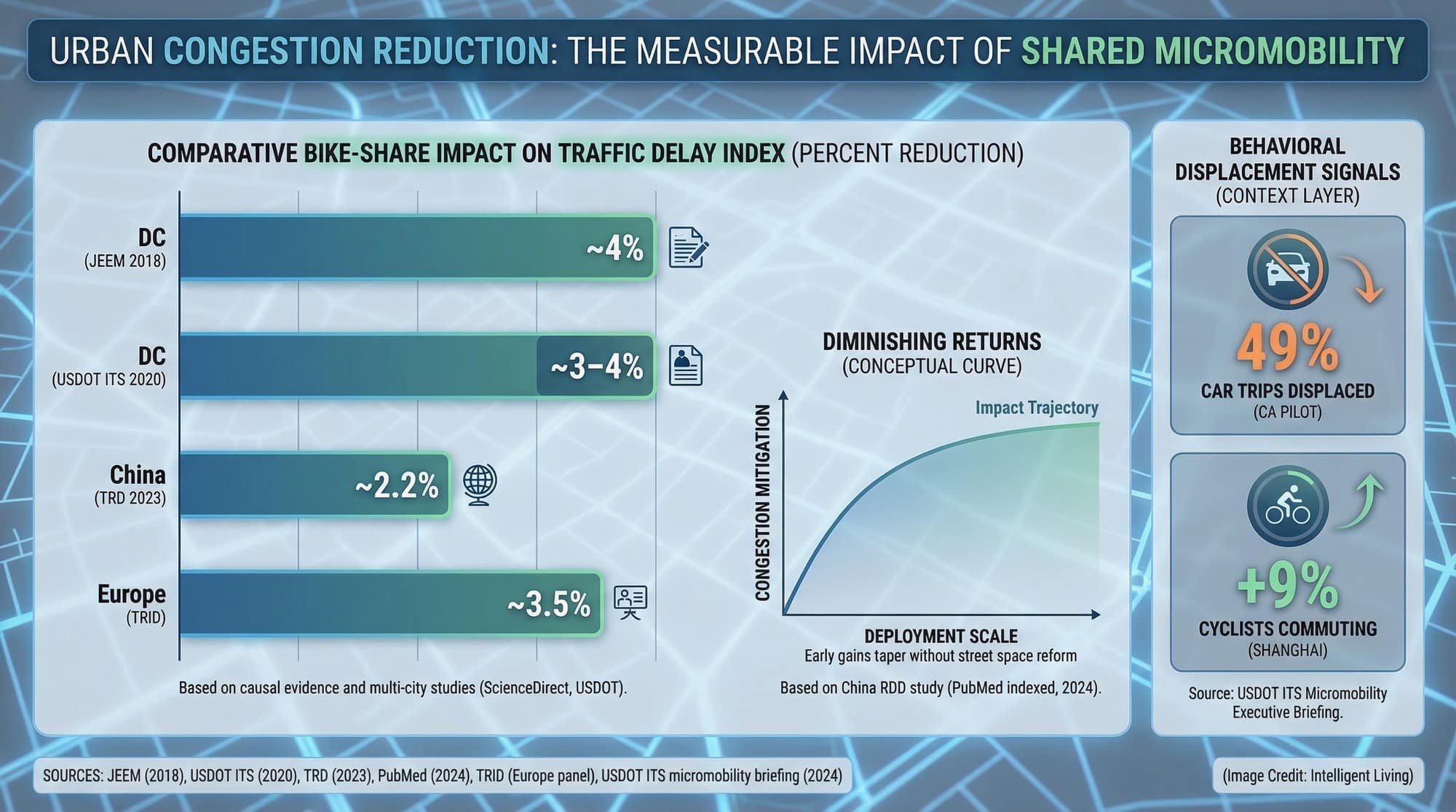
- Neighborhood traffic congestion dropped by roughly three to four percent where bike-share stations cluster near short-trip origins.
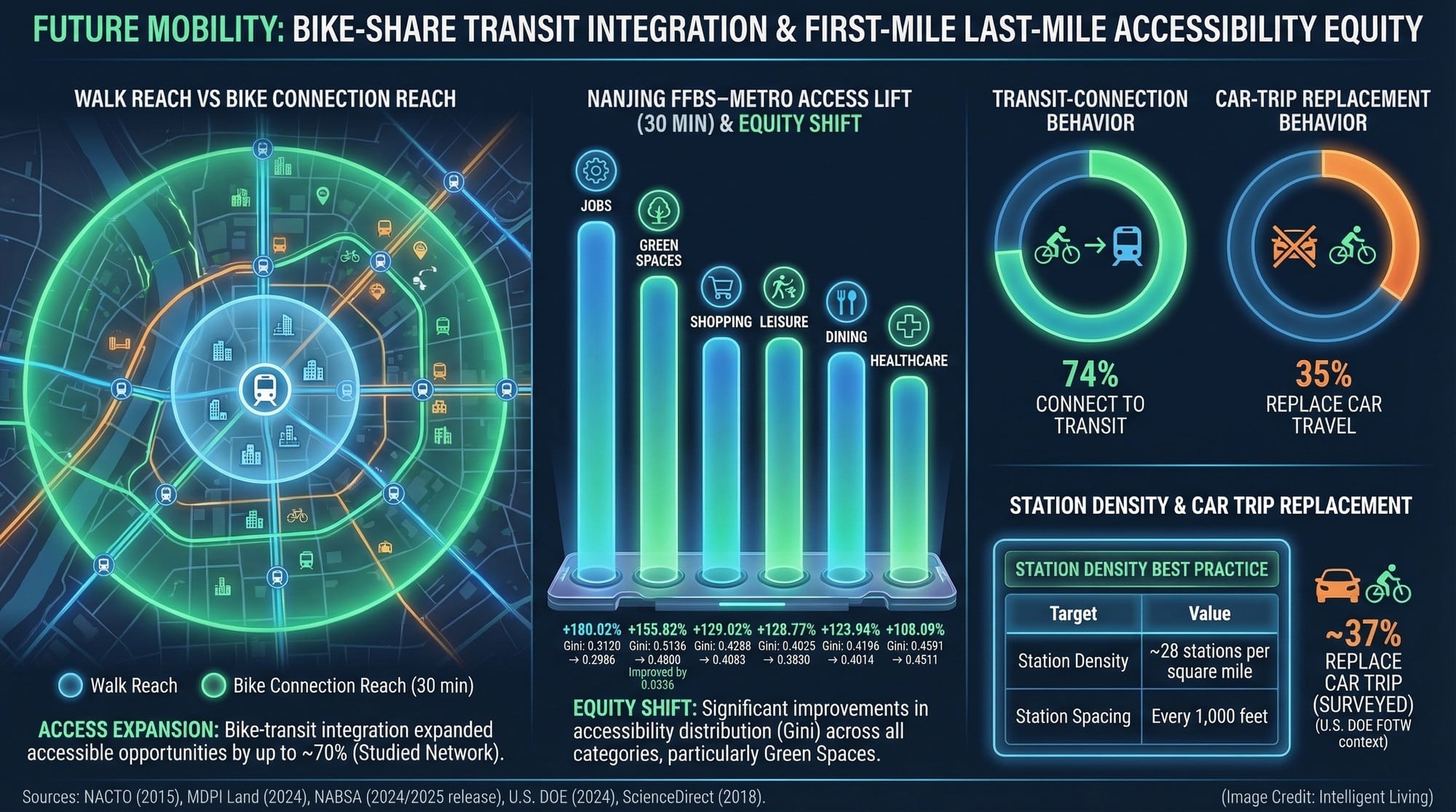
- Free-floating bike-share feeders in Nanjing boosted 30-minute access to job opportunities and green spaces by expanding the transit catchment area.
- Scenario modeling suggests automatically dispatched shared mobility can meet demand with fewer vehicles when strict pooling assumptions are applied.
Optimizing these deployments requires continuous analysis of trip density and curbside pressure to ensure that micromobility remains a reliable alternative to private vehicles.
Primary Drivers of Urban Congestion: Short Journeys and the Last-Mile Gap
Commuters on long highways rarely drive the bulk of urban congestion. Friction stems primarily from a surge in short vehicle trips and slow curbside activity. The U.S. Department of Energy reports that about 37% of surveyed shared micromobility trips replaced a car trip, a shift that significantly impacts traffic and emissions levels as it scales.
Safety and comfort must serve as foundational requirements for short-trip alternatives to become the default choice for daily commuters. Enhancing the physical environment around transit stops removes the psychological barriers to leaving the car behind.
Street layouts that make walking or biking to a stop inconvenient often force the last mile to become a car trip by default. Suburban designs frequently undermine public transit access even when regions invest in more frequent service. Consider a parent who avoids a bus connection because the stop requires a six-block walk with a stroller; a well-placed e-bike or cargo option shrinks that gap and shifts long-term travel habits.
Bike-Share Integration: Transforming Transit Infrastructure Into a Multiplier
Accessibility Gains: Quantifying Transit Integration
Planners who design bike‐share as an explicit complement to transit infrastructure unlock significant measurable gains. A peer-reviewed analysis found that bike-transit integration can expand accessible opportunities by as much as about 70% in the studied network, turning a slow walk into a fast first-mile connection.
An anecdote: a commuter in a mid‐sized city reported moving from a one‐hour door‐to‐door commute by car to a 40‐minute transit plus docked bike trip, freeing up time for a family dinner three nights a week.
Rider Behavior: Impact of Micromobility on Traffic Density
Surveys and industry reporting show a clear pattern: most shared micromobility trips are not joyrides but connections. Short car journeys are frequently replaced by these micromobility connections, which significantly expand the practical catchment area of transit stations. Recent industry reporting suggests that about 74% of riders use shared micromobility to connect to transit, reinforcing the role of bikes and scooters as critical infrastructure.
When parking corrals and charging infrastructure keep pickups and drop-offs predictable, that transit connection becomes easier to repeat day after day.
Infrastructure Design: Unlocking the Mobility Multiplier
Planners must prioritize specific physical and digital interventions to unlock the full potential of the mobility multiplier. Successful systems rely on a combination of infrastructure and user-experience enhancements.
Priority design levers include:
- High station density within a ten-minute ride of major transit hubs.
- Payment integration allowing a single app or card to cover multiple modes.
- Continuous protected bike lanes that offer physical separation from traffic.
- Clear, intuitive wayfinding that guides users between transit and bike stations.
Frictionless payment methods, such as unified ‘tap-to-pay’ systems for bikes and buses, significantly increase public transit adoption. Beyond hardware, these digital links ensure that the mobility multiplier remains accessible to the widest possible audience. In high-throughput systems, biometric fare gates that auto-deduct transit fares demonstrate how technology reduces bottlenecks at station entry.
Measuring Urban Congestion Reduction: The Impact of Shared Micromobility
Localized Congestion Reduction: Case Study Insights
Controlled research indicates that introducing bike-share programs yields measurable, significant drops in local traffic density. One study estimated up to about a 4% neighborhood-level congestion reduction after bike-share expansion, with the biggest gains clustered in already congested areas.
Global Perspectives: Cross-City Comparisons and Regional Nuance
Variable Success Factors in Diverse Urban Settings
Larger observational studies, including analyses from multiple Chinese cities and European city panels, point in the same direction: bike-sharing tends to lower car use and improve delay measures, but effect sizes vary by city form, transit coverage, and the quality of bike networks.
Case Study: Dockless Entry and Network Effects in China
A staggered multi‐city analysis across 98 Chinese cities linked dockless bike‐share entry to roughly a 2.2% drop in a congestion delay index in that dataset, suggesting that early network effects can show up quickly.
Deployment Challenges: Scaling Without Policy Reform
Research involving regression-discontinuity analysis in Chinese urban areas indicates that bike-share introduction mitigated congestion in the short term. However, these benefits often see diminishing returns as deployments scale if street space and parking policies remain stagnant.
European Trends: Multi-City Panel Results
A panel analysis across 113 European urban areas reported an average congestion reduction of about 3.5% after bike-share launches in that study period, reinforcing that small percent changes can still matter at city scale.
Threshold Metrics: Reliability and Mass Adoption
Impact is not linear. Cities where dock counts and trip volumes clear a minimum threshold see more pronounced positive effects on traffic and travel time. A threshold-style analysis suggests that congestion benefits rise as local trip volumes reach a critical mass, proving that coverage and reliability drive success.
The same scaling logic shows up when cities build car-free zones and superblocks that reclaim street space for walking and cycling, reducing the friction that pushes short trips back into cars.
Curbside Management Systems: The Shared Mobility Operating System
The Strategic Value of Curbside Management Systems
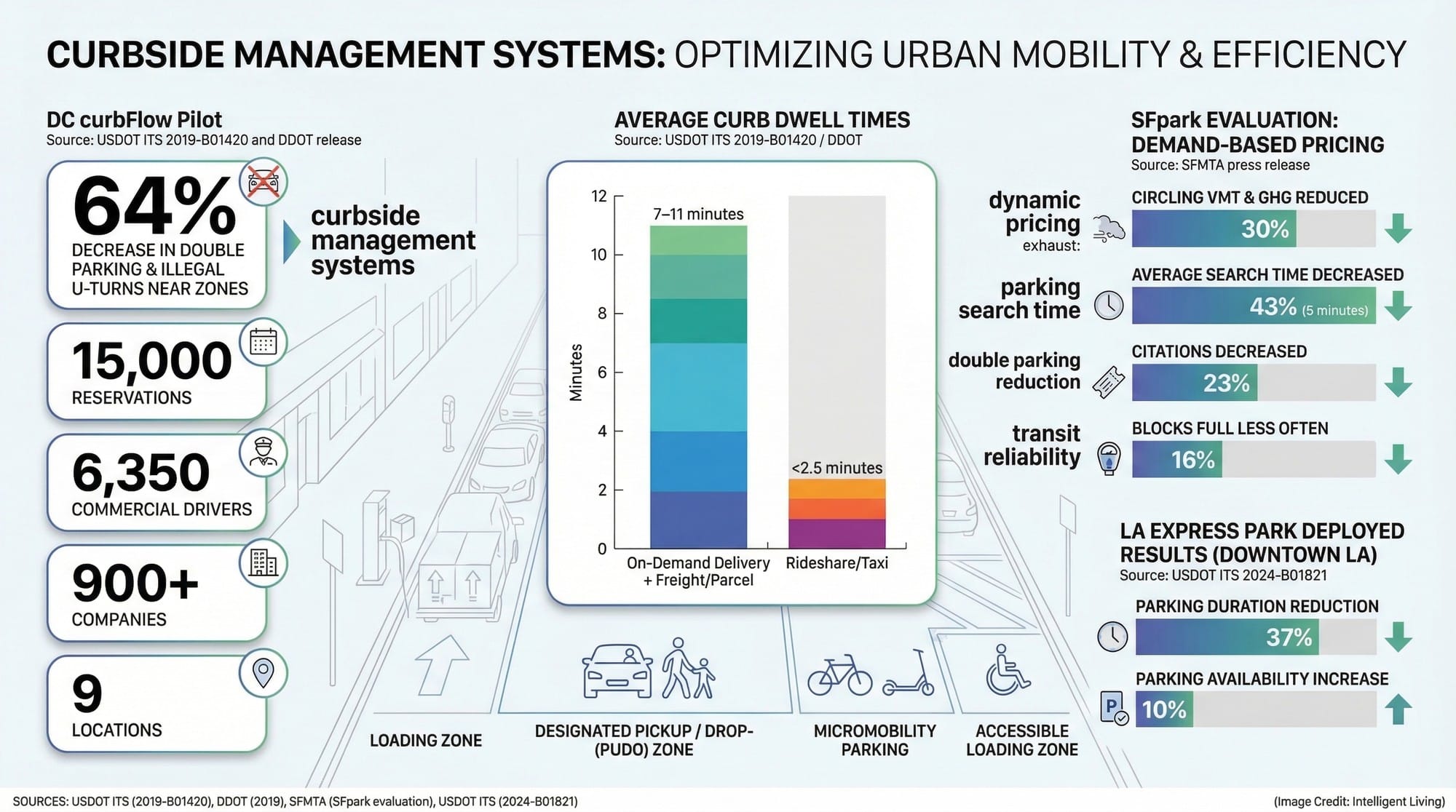
Simultaneous competition for curb space by bikes, ridehail, deliveries, and transit buses frequently causes urban street speeds to plummet. Urban planners utilize data-driven curb space allocation to prevent the double-parking and lane-blocking issues that cause local traffic to spiral.
Regulatory Standards: Digital Curb Policy and Data Integration
Implementing Machine-Readable Curb Regulations
Digitizing curb rules and publishing them in machine-readable formats allows operators to schedule pickups and drops in ways that avoid conflict. Publishing machine-readable curb rules for loading and micromobility allows fleet operators to avoid conflict and improve overall street efficiency.
Conflict Mitigation Through Purpose-Built Street Design
Smart-city prototypes frequently design streets in distinct channels for vehicles, bikes, and pedestrians. Designing streets with dedicated transit and pedestrian channels serves as a robust method for mitigating curbside friction. Street redesigns that turn gray corridors into greener, more walkable boulevards show how shade and pedestrian priority shift travel behavior without requiring heroic user choices.
Operational Efficiency: Reducing Empty Miles Through Parking Policy
Encouraging vehicles to park between rides rather than cruising for fares significantly reduces empty vehicle miles. Argonne modeling suggests that parking between ridehail trips can cut empty miles compared with cruising in simulated scenarios, a lever that grows in importance as fleets scale.

Funding the Shared Mobility Stack: Equity and Autonomous Integration
Sustainable Funding Models for Scaling Micromobility
Rapid exponential growth in micromobility usage across diverse urban centers signifies that street experiments have moved into the mainstream. Permanent infrastructure models are now a necessity. NACTO reports that shared micromobility usage continues to scale, a reality that requires cities to treat these systems as vital public infrastructure.
An everyday snapshot: a neighborhood that once had two shared bikes now sees a fleet of dozens; without predictable procurement and maintenance funding, operators move on, and the network gaps return.
Equitable Access: Station Siting and Safety Standards
Evaluating Equity in Shared Mobility Deployment
Access gains remain significant but unevenly distributed across the urban landscape. When protected lanes and station density are absent, benefits concentrate near the primary transit spine while leaving other neighborhoods isolated.
Significant equity barriers include:
- Infrastructure gaps that blunt bike-transit accessibility gains in neighborhoods with high transit frequency.
- Low station density in underserved areas that discourages consistent usage.
- Prohibitive pricing models that exclude low-income commuters from the mobility stack.
Researchers recommend targeted station siting and subsidized pricing to ensure that safe routes and reliable service are available to every community.
Safety Infrastructure: A Requirement for High Adoption
High adoption rates for active transportation modes depend heavily on perceived and actual safety. Research consistently links protected bike infrastructure with improved safety outcomes, suggesting that comfort and physical protection must precede significant ridership growth. Encouraging habits that help bicyclists reduce crash risk at intersections supports higher ridership during the initial weeks of a mode shift.
Autonomous Vehicle Feeders: Integration Scenarios and Risks
Integrating autonomous vehicles into the shared mobility stack presents both opportunities and risks depending on the regulatory framework. Cities must choose between models that prioritize private convenience and those that favor system efficiency.
Primary integration scenarios include:
- Deadhead Mileage Risks: Naturalistic experiments show that unregulated autonomous vehicle access can increase zero-occupancy miles by as much as 60%.
- Shared Fleet Efficiency: Research analysis indicates that shared mobility systems can deliver high service levels with far fewer vehicles when pooling and pricing favor efficiency.
- Targeted Feeder Shuttles: Establishing autonomous shuttle loops on bounded urban routes or using recyclable electric shuttles for short-range transit addresses specific coverage gaps.
Proactive governance is required to ensure that autonomous technology serves the public good rather than adding to urban clutter. Cities must establish clear operational boundaries, such as pooling incentives and transparent data reporting, to guide the integration of these fleets. Establishing these rules early prevents the ’empty mile’ problem from neutralizing the efficiency gains of autonomy.

Urban Congestion Reduction: Building the Future Shared Mobility Stack
Data reflecting patterns in bikesharing and public transit intersections suggests that placing stations near frequent routes optimizes these outcomes. Successful programs often follow established guidelines for regulating service equity and pricing to ensure broad community benefits.
Scaling a functional transit network requires treating bikeshare as core transit infrastructure by funding station density near major hubs and ensuring payment systems are unified. High-quality urban flow happens when the curb is managed as a programmable public asset with machine‐readable rules that prioritize high-occupancy and active modes. Combined efforts expand access and improve user choice while reducing the short vehicle trips that frequently cause metropolitan areas to grind to a halt.
Effective strategic planning for large-scale shared mobility rollouts ensures that equity and efficiency remain prioritized as services scale. Shifting city fleets toward electric drivetrains through zero-emission bus mandates further reinforces this vision of a cleaner, more efficient urban future.
Smart City Mobility FAQ: Solving the Last-Mile Problem
How does bike-share integration help reduce urban congestion?
Replacing short car trips with cycling links to transit hubs allows cities to reduce the overall volume of vehicles on local streets. This integration ensures that transit becomes a viable door-to-door alternative to driving.
Can autonomous vehicle feeders worsen city traffic?
Unregulated, private AV use may increase vehicle miles traveled. Shared, pooled AV feeders integrated with transit schedules can significantly shrink fleet sizes and lower overall congestion.
Why is data-driven curb management essential for transit?
Curb space is the ‘operating system’ of the street. Programmable curb rules prevent double-parking and lane blockages, ensuring that buses and bikes move without constant interference.
What makes a bike-share program equitable for all neighborhoods?
Equitable systems prioritize station siting in underserved areas and offer subsidized pricing. Success depends on building protected lanes that safely connect these neighborhoods to the primary transit spine.
How do unified payment systems increase public transit adoption?
Frictionless payment removes the ‘transactional barrier’ between modes. Using a single ‘tap-to-pay’ method for bikes, buses, and trains encourages commuters to view the entire mobility stack as one seamless service.


