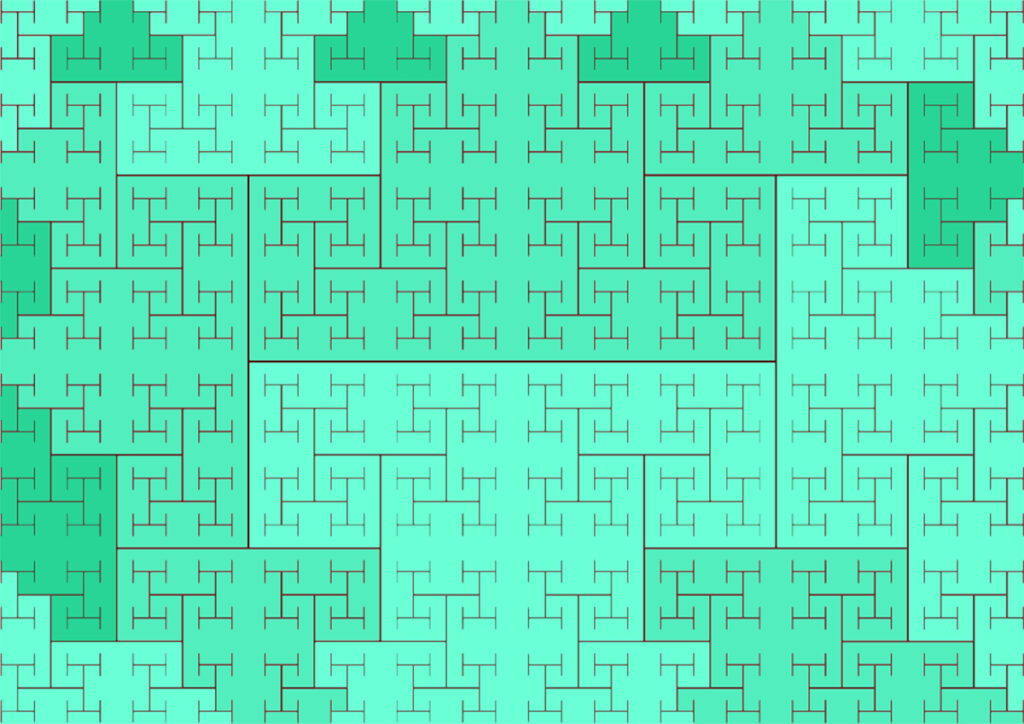
The idea of incorporating nature’s fractal patterns within a solar cell design has long been investigated as a potential solution to maximize the surface area of the photoactive material, to minimize electrical losses and enlarge the interface with the cell’s electrodes.
In theory, this can be achieved by replacing standard busbar electrode patterns with fractal patterns. However, it’s incapable of coping with electrical losses; therefore, this kind of solution is far from mass production.
Now, researchers from the University of Oregon (UO) have resumed the concept of developing fractal solar PV panels, but with a twist. They developed a hybrid electrode pattern that effectively combines both busbar and fractal designs.
The researchers clarified:
The solar industry adopted the busbar because its so-called ‘multi-layered’ approach of intersecting bars and fingers out-performs simpler, single-layer approaches in its capacity to effectively balance the competing factors.
The researchers note that their design maintains the electrical efficiency of the busbar while adding the beautiful aesthetics of the fractal pattern.
The UO team conducted an iterative process of refining the designs based on their two different functions. They carried out several experimental studies to determine preferred fractal over standard busbar patterns. “For each study, participants were asked to select the image on each page that they found to be ‘the most visually appealing’ by clicking a button presented to the left of the chosen image,” the team explained.
The researchers were then able to create what they believe is a visually acceptable electrode pattern with the collected data from the studies. The winning design is based on the fractal tree structure known as T-branching or H tree.

H-tree is a geometric shape consisting of a pattern that repeats the letter “H.” “This choice was based on ease of manufacture, given that the H-tree is closer in design to busbars than the previously researched patterns,” the researchers remarked. The study also claims that, psychologically, the fractal patterns visible on rooftop solar panels could help reduce the stress of people passing by.
The team wrote:
We hope that our approach of iteratively performing experimental aesthetic studies and electrical simulations to validate new electrode patterns will be adopted for a broad range of applications, especially engineering and design.
The UO team published the study, titled “Fractal solar panels: Optimizing aesthetic and electrical performances,” in Plos One.