
Bigger is always better in high-energy particle physics – and a moon is a big place. Hence, a team of researchers started speculating the construction of a colossal hadron collider around the moon’s circumference.
They even dove into the calculations and found that a (roughly) 6,835-mile (11,000-km) Circular Collider on the Moon (CCM) would generate proton-proton center-of-mass collision energy of 14 PeV. That’s an energy level one thousand times higher than CERN’s Large Hadron Collider, assuming a dipole magnetic field of 20 T.
The researchers even presented reflections on siting, construction, machine parameters, and powering, as well as accommodations for building, testing, and operating a hadron collider in the relative vacuum of the lunar surface.
The preprint study said:
Through partnerships between public and private organizations interested in establishing a permanent Moon presence, a CCM could be the (next-to-) next-to-next-generation (sic) discovery machine and a natural successor to next-generation machines, such as the proposed Future Circular Collider at CERN or a Super Proton-Porton Collider in China, and other future machines, such as a Collider in the Sea, in the Gulf of Mexico.
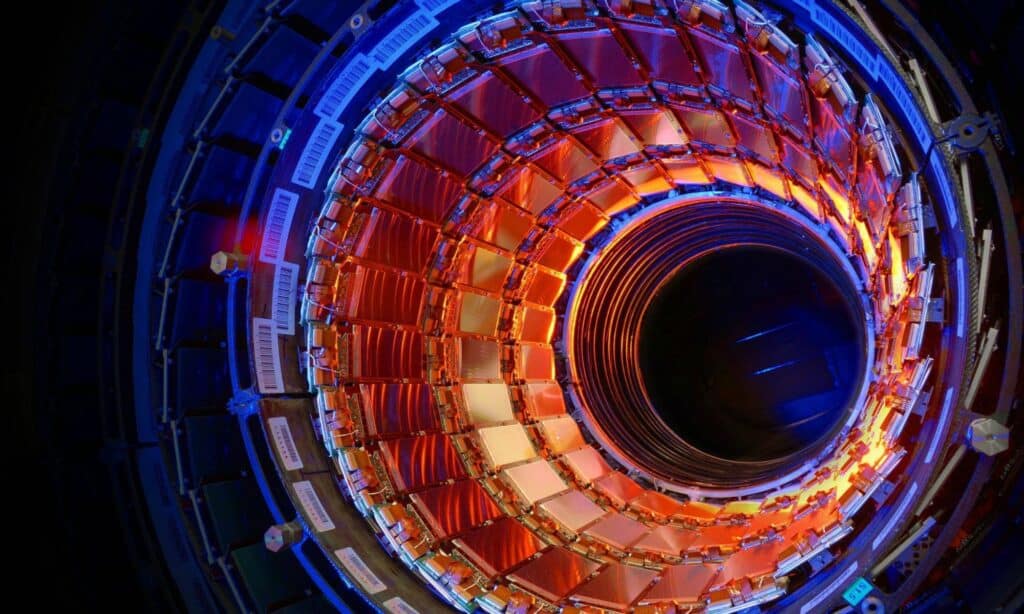
The Higgs boson discovery left scientists with many mysteries. And while a giant hardon collider like the CCM could be the solution to finding answers, the researchers say it’s not something that will anytime soon.
Instead, it will likely take several decades. Nevertheless, if the day ever comes when a CCM is operational, it would serve as a milestone towards a Planck-scale collider sited in our Solar System. And, new particles likely lie in wait!


