
CERN (the European Organization for Nuclear Research) is a research organization that operates the largest particle physics laboratory in the world. It was established in 1954 and is based in Geneva on the Franco-Swiss border. The fascinating scientific work that it produces helps uncover the very core of what the universe is made of and how it works. The researchers there are provided with a unique range of particle accelerator facilities to perform world-class studies in fundamental physics and advance the boundaries of human knowledge.
At CERN, people from all over the world unite to push the frontiers of technology and science for the benefit of all. To do so, they use the most advanced scientific instruments on the planet. Now, the largest of those instruments, the Large Hadron Collider (LHC), is reaching the end of its life. So, what next? They will replace it with an even bigger and better one, of course.
The proposed new particle-smashing machine – dubbed the Future Circular Collider (FCC) – has a 100-kilometer circular tunnel, which is four times the size and six times as powerful as the LHC. It would allow the researchers to chase after particles and other new phenomena at higher energies, and potentially uncover the mysteries of dark matter. It will also enable them to study the Higgs boson with greater precision.
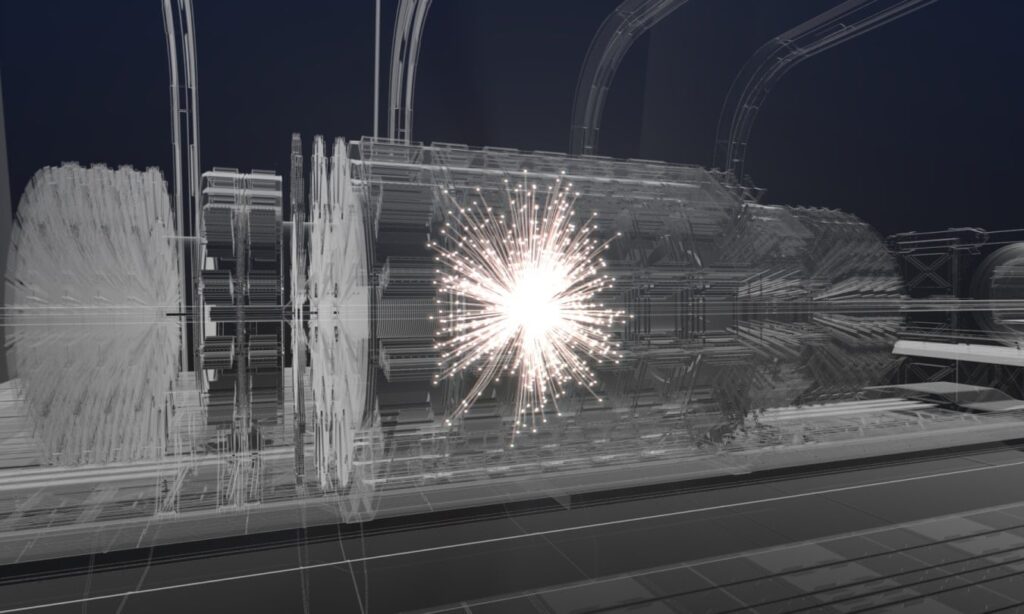
When proposing the new FCC, Prof Jon Butterworth of University College London said that a scaled-up collider would allow researchers to make unprecedented measurements of nature at the subatomic scale. He said:
It’s probing nature at the shortest distances and looking for the smallest things we can see … it’s a real exploratory mission. Everyone agrees that’s what we need to do. The question has been: what’s the best machine to do it?
One thing that may hold them back from getting their gigantic machine is the €20 billion price tag for construction. If approved, CERN will assess the technical and financial feasibility, first by conducting a geological survey to make sure there aren’t any features (like an underground lake, for example) that would require the plan to be reconsidered. When that matter is settled, and financial backing is secured, then the construction would begin within a decade. It would take another ten years to build, meaning the FCC wouldn’t be operational until the 2040s.
The LHC is expected to begin its final run at the end of 2027.
Deciding to build the FCC is more of a risk than the LHC because scientists don’t know what it will help them uncover. Butterworth explained:
With the LHC, we knew we’d either find the Higgs or break the Standard Model, and that’s a very luxurious position to be in. There is no equivalent scenario now, it’s much more exploratory. It’s definitely a higher risk.
Nevertheless, it makes sense that the only way to attain more knowledge would be to take the experiments to the next level in a more powerful machine.


