
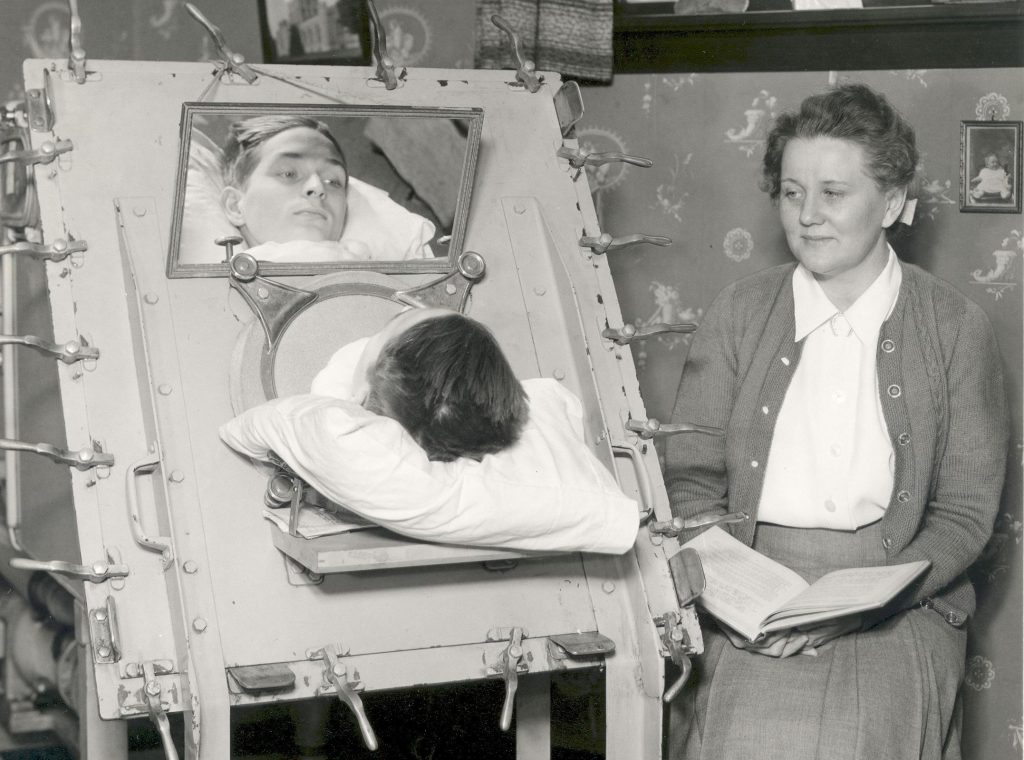
In the early 1900s, Polio was introduced to the world. Polio is a contagious virus that causes difficulty breathing and can affect the spinal cord, causing paralysis and sometimes death. In 1927, Harvard medical researchers invented the “Iron Lung,” a cylindrical chamber that encases a person’s entire body, except for the head, and uses controlled air pressure to help a patient breathe when they can’t breathe on their own. Thankfully the poliovirus vaccine came out in the 1950s, and since then, Polio has been eliminated in almost all countries worldwide.

Now, British engineers are developing a modern version of the Iron Lung to provide NHS’s coronavirus patients with a simple, inexpensive alternative to ventilators. As the pandemic spreads, ventilators across the world are in critically short supply for treating COVID-19 patients in need of respiratory support. Ventilators help patients who can’t breathe on their own because their lungs are profoundly affected by the virus. However, these machines are complex, expensive, require monitoring by trained personnel, and can be dangerous to use on a healthy person because they need the patient to be sedated.
The ventilators we use today, formally known as Intermittent Positive Pressure Ventilators, work through positive pressure. They pump oxygen or air directly into the lungs to help a patient breathe, whereas the iron lung is the opposite.
Within the iron lung’s cylinder chamber is a diaphragm connected to an electric motor. As the motor runs, it operates a crank that causes the diaphragm to expand and contract, which causes the air pressure to rise and fall due to the volume becoming smaller and larger. As the air pressure changes, the patient’s chest expands and contracts, allowing them to breathe.
During the polio era, such iron lungs were common to see in hospitals or private homes. However, throughout the years, sophisticated new machines have out-dated them. Now, the novel COVID-19 might be bringing them back.
This modern version of the Iron lung device is called “exovent.” It already reached the prototype stage and will be tested in the UK at two intensive care clinics. The exovent was developed by the University of Warwick, the Imperial NHS Trust, the Royal National Throat Nose, and Ear hospital, Marshall Aerospace & Defence Group, and teams of citizen scientists, academics, medical clinicians, manufacturers, and engineers.
The exovent doesn’t require intubation like the ventilators, and it’s a much simpler design. The team who designed the device said that patients could remain awake, drink, eat, take medications, and even talk on the phone. As a bonus, the machine improves heart efficiency by 25% over conventional ventilators, which can sometimes have harmful effects on cardiac functions.
Margot James, from the University of Warwick, said:
We are delighted to be working with exovent to help scale up their non-invasive ventilator from prototype to volume manufacturing. Our engineers and researchers are collaborating with the exovent team on the design, engineering, component sourcing, and assembly of the ventilator. I am extremely proud of the unstinting and dedicated efforts of our research team, led by Archie MacPherson at WMG, and glad that we are able to apply our expertise to this important project.
The team pointed out that the exovent has many benefits, including that regular wards can use it to free up ICU beds for more critical cases, and it’s also adaptable for individual patients. The machine doesn’t use compressed oxygen or air, it contains only a few moving parts, and the components are readily available.
Once approved, the team estimate they could have 5,000 exovents manufactured within a week in the UK.


