
The Rivian Adventure Network has quietly become one of the largest proprietary fast-charging networks in the United States. What started in 2022 with five sites and a handful of chargers has grown into a public 157-site, 1,000-plus-stall system that is now open to nearly every electric vehicle on the road. Yet most guides still treat it as a niche amenity for Rivian owners. This guide explains what the network is, where it has gone, who can use it, how much it costs, and what makes its site strategy different from Tesla’s, Electrify America’s, and the rest of the public charging landscape.
What Is the Rivian Adventure Network?
The Rivian Adventure Network, abbreviated RAN, is a network of DC fast-charging stations owned and operated by Rivian, the American electric vehicle maker behind the R1T pickup truck and the R1S SUV. Each site typically hosts between three and sixteen stalls, and each stall can deliver up to 300 kilowatts of power. At that rate, a Rivian R1T or R1S can add roughly 150 miles of range in 20 minutes, according to Rivian’s own documentation.
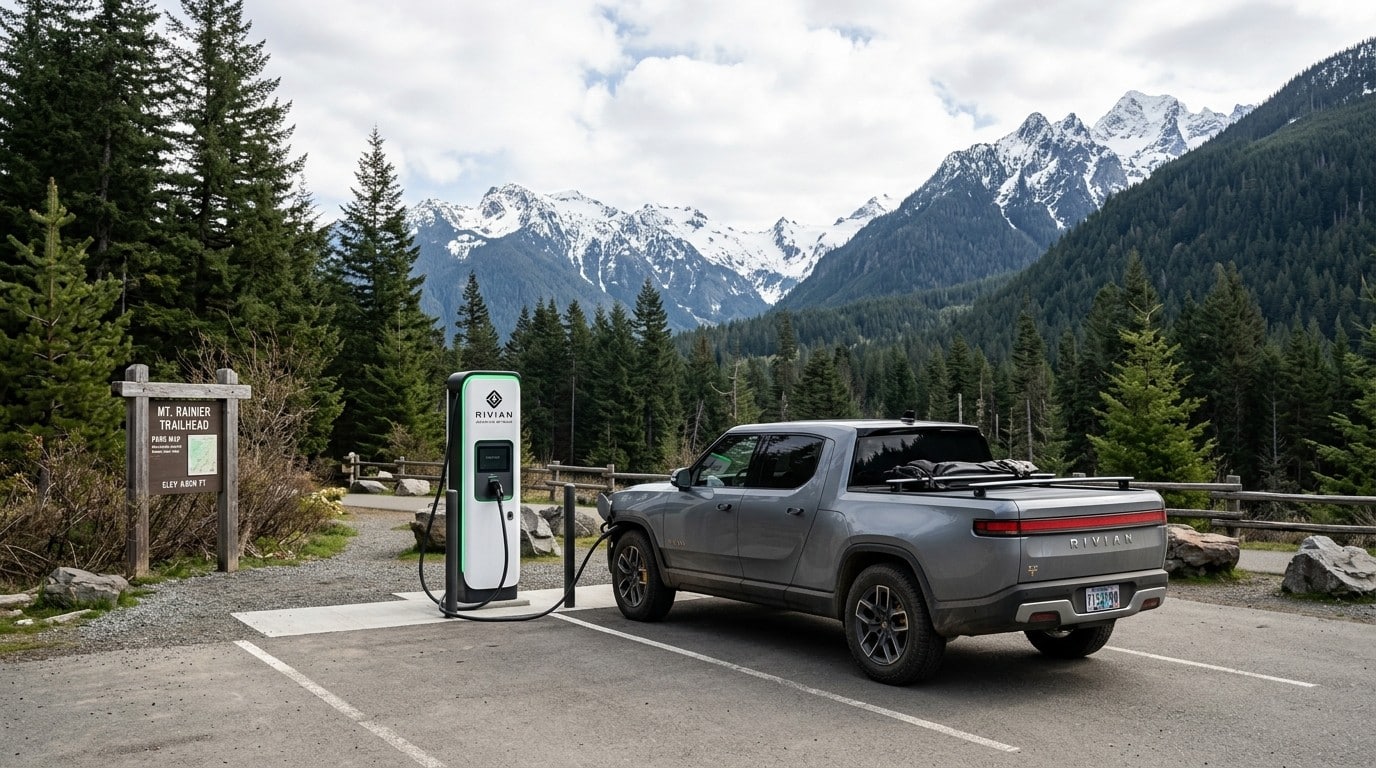
Rivian has framed the network from the start as more than a utility. The company pitches it as an enabling layer for outdoor adventure, a way to take an electric truck to trailheads, river crossings, ski towns, and national parks that conventional highway fast-charging networks tend to ignore. The branding is the giveaway: every site is named for its surrounding landscape, such as Joshua Tree, Mammoth Lakes, and Barstow, and the chargers themselves are designed to operate in remote areas with limited grid infrastructure.
The network is also matched, on an annual basis, with 100 percent renewable energy, meaning the electricity flowing through every Rivian-branded stall is offset by solar, wind, or other renewable generation purchased or developed by Rivian. That commitment is unusual among automakers and is one of the few that is verified and published rather than simply claimed in marketing.
Network Growth: From 5 Sites to 150+ in Four Years
The Rivian Adventure Network was first announced in March 2021, alongside Rivian’s partnership with Colorado Parks and Wildlife. The original 2020 announcement described a network that was still in planning stages and would not see its first operational sites for another two years. The first stations opened in 2022, originally reserved exclusively for Rivian owners and offering free charging as a launch perk. The early rollout was deliberately slow: by the end of 2022, the network consisted of just five active sites.
Deployment accelerated sharply in 2023 and 2024 as Rivian prioritized highway corridors and began building larger stations with more stalls per site. By early 2025, the network had passed 100 sites and 700 individual DC fast stalls. By Q2 2026, according to quarterly data tracked by Rivian Roamer and EV Charging Stations, the network had grown to 155 sites and 1,073 stalls. As of late August 2026, the directory counts 157 active sites and 1,087 individual chargers across 46 states.
The growth is even more striking when compared with the network Rivian set out to build. The company originally targeted more than 3,500 fast chargers at approximately 600 sites across the United States and Canada. At the current pace of roughly 8 to 10 new sites per quarter, the network will reach that target within a few years, though Rivian has not publicly committed to a specific end date.

The single largest site is Green River, Utah, with 16 stalls. Several other western and midwestern hubs, including Joshua Tree, California; Maple Grove, Minnesota; Lakewood, Colorado; and Park City, Utah, host 12 stalls each, making them feel more like miniature fuel plazas than typical highway pull-offs.
Where the Chargers Are Located
Geography is where the Rivian Adventure Network diverges most from the public fast-charging mainstream. California hosts the largest share of sites, with 30 stations, followed by Oregon (12), Colorado (10), Michigan (9), Arizona (8), Virginia (7), North Carolina (6), and Texas (6). Most other states have between one and four sites each.
The placement logic, however, is more revealing than the state counts. Search the RAN directory for any major national park gateway, and you will usually find a Rivian site within a short drive. Joshua Tree, Yosemite, Mammoth Lakes, Glacier, Yellowstone, Olympic, the Outer Banks, the Adirondacks, Acadia, and Big Bend are all within range of an Adventure Network site. So are lesser-known recreation destinations: Sedona, Arizona; St. Regis, Montana; Bishop, California; Salida, Colorado; and Forks, Washington, the wettest town in the contiguous United States. A short list of the most popular Adventure Network destinations includes:
- Joshua Tree, California (gateway to Joshua Tree National Park)
- Mammoth Lakes, California (Sierra Nevada ski and hiking hub)
- Bishop, California (climbing and Eastern Sierra trailheads)
- Sedona, Arizona (red rock trail system)
- Park City, Utah (ski resorts and Wasatch trails)
- Estes Park area sites, Colorado (Rocky Mountain National Park)
- St. Regis and Bozeman, Montana (Yellowstone and Big Sky access)
- Olympic Peninsula, Washington (Forks and Port Angeles)
- Barstow, California (Mojave National Preserve)
- Brewer and Kittery, Maine (Acadia and coastal New England)
The network is not, however, restricted to the West. Recent expansion has placed chargers in central New York (Queensbury, Latham), coastal Maine (Kittery, Freeport, Brewer), the Florida panhandle (Chipley, Tallahassee), and the Texas Hill Country (Waco, Columbus, Centerville). A smattering of sites in Georgia, the Carolinas, Virginia, and Tennessee now connect the Southeast to the broader network.
State coverage map sources like the U.S. Department of Energy’s Alternative Fuels Data Center, available at afdc.energy.gov/stations, confirm that 46 U.S. states now have at least one operational RAN site, and the network reports active stations in most Canadian provinces through partner programs.
Can Non-Rivian EVs Use the Network?
Yes, in most cases. From December 2024 onward, Rivian has been progressively opening every Adventure Network site to other electric vehicles equipped with a CCS1 (Combined Charging System) connector, which is the standard used by most non-Tesla EVs sold in North America before 2025. As of late July 2026, 151 of 156 sites, or 97 percent, are open to all EVs, according to the Q2 2026 report tracked by EV Charging Stations. The remaining handful of sites are expected to be converted before the end of 2026.
Non-Rivian drivers can locate compatible stations through the Rivian mobile app, which now lists every site regardless of vehicle brand. Charging sessions are billed by the kilowatt-hour through the app, typically at $0.43 to $0.51 per kWh for Rivian owners and a small premium for non-Rivian users, with site-specific rates shown in the app before a session begins. To use the network for the first time, drivers of any EV should:
- Download the Rivian app from the iOS App Store or Google Play.
- Create an account, add a payment method, and select the vehicle make and model.
- Tap the Map tab and filter by Rivian Adventure Network.
- Choose a site, confirm connector type, and tap Start to begin a session.
- Plug in, monitor real-time charging speed, and unplug when the session is complete.
The transition to NACS is the second half of the open-access story. In July 2025, Rivian began installing the North American Charging Standard, the Tesla-style connector, alongside CCS1 at new and existing sites.
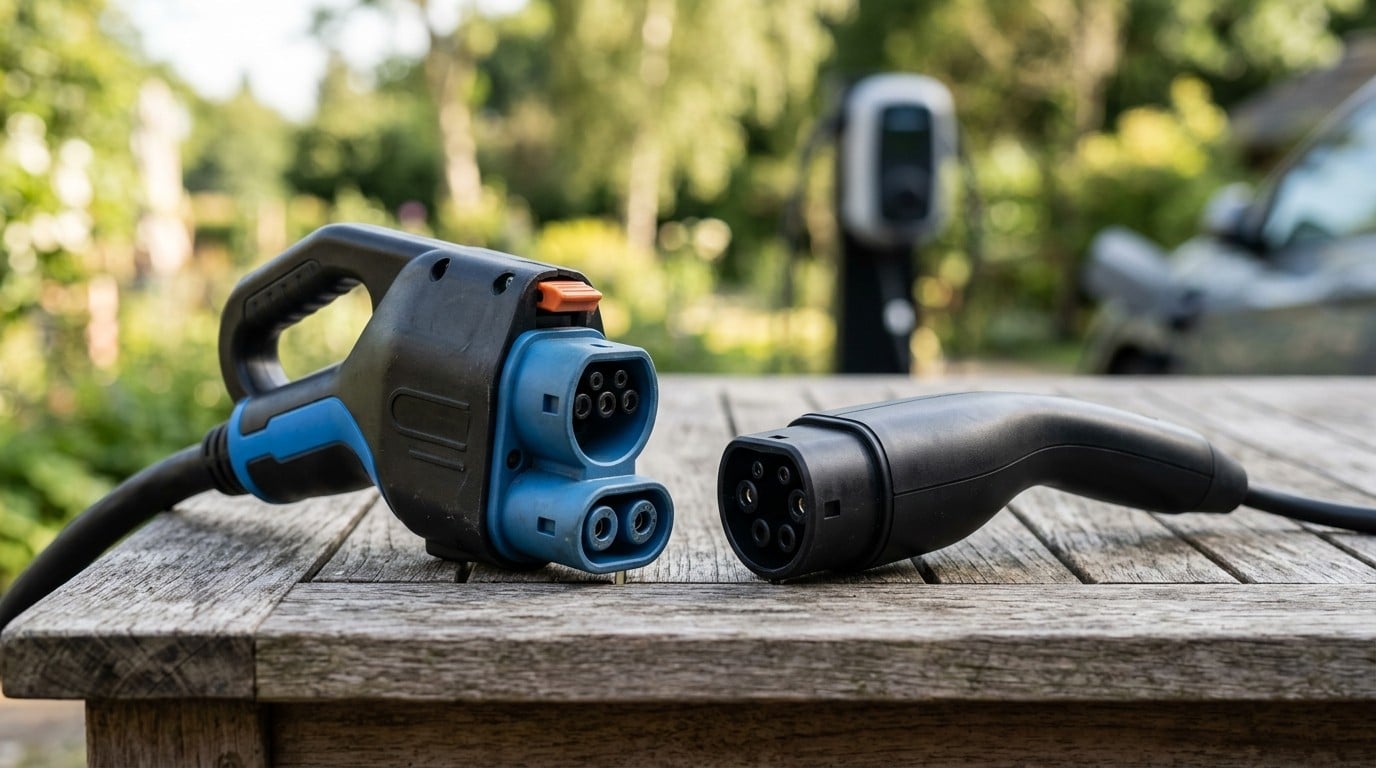
As of July 2026, 267 of the network’s 1,073 stalls, or roughly 25 percent, offer a NACS connector, with 15 sites now operating as NACS-only. This shift aligns Rivian’s network with the broader industry move toward NACS, which became the de facto standard for new EVs sold in the United States from 2025 onward.
Tesla owners can also benefit. While Teslas still need a NACS-to-CCS1 adapter to charge at most Rivian sites (a small number of NACS-equipped Teslas can use the network natively), Rivian drivers now have the reverse arrangement: they can use the Tesla Supercharger network with a Rivian-approved NACS DC adapter. That agreement, announced in 2023 and rolled out in 2024, gives Rivian owners access to more than 17,800 Tesla Supercharger stalls in addition to the Adventure Network.
Charging Speed and Pricing: What to Expect at a RAN Station
Speed is where the Rivian Adventure Network is most competitive. Each stall is rated for up to 300 kilowatts, and the average measured delivery at open-access sites now sits at roughly 200 kilowatts, according to the Rivian Roamer directory. That is comfortably above the 150-kW ceiling of most Electrify America stations and matches the peak output of Tesla’s V3 Superchargers.
Real-world charging curves vary by vehicle. A 2026 Rivian R1S with the Large Pack battery can charge from 10 to 80 percent in roughly 40 minutes, with the fastest part of the curve, between 10 and 50 percent, happening in about 20 minutes. Non-Rivian EVs typically see slightly slower peak speeds because of how their battery management systems negotiate with the charger, but most modern CCS1 vehicles will still pull between 150 and 250 kilowatts at a Rivian stall.
Pricing varies by site and is set to reflect local electricity costs. As of August 2026, the average rate across the network is approximately $0.43 to $0.55 per kWh for Rivian owners, with non-Rivian users paying a small premium. The most expensive sites, in remote recreation destinations like Bishop, California; Salida, Colorado; and the backcountry stations in Death Valley, can charge up to $0.67 per kWh. The cheapest sites, clustered around urban-adjacent Texas locations such as Waco and Centerville, charge as little as $0.26 to $0.37 per kWh. Idle fees apply if a vehicle remains parked at a finished stall for more than a few minutes, similar to Tesla’s policy. Compared with the cost of running a comparable gasoline truck on a long-distance trip, the energy cost per mile at a Rivian Adventure Network site typically lands between 12 and 18 cents, depending on the truck, payload, and route. That places the network in roughly the same operating-cost range as the rest of the U.S. fast-charging landscape.
Reliability has emerged as one of the network’s quiet strengths. Rivian owns the hardware, software, and maintenance contracts for every site, which the company says allowed it to maintain 98 percent uptime across the network in 2025. The independent Rivian Roamer directory, which grades stations on real session data, gives 91 percent of sites an A reliability grade and 2 percent a B grade.
The Site Selection Strategy: Why National Parks, Not Just Highways
The Rivian Adventure Network is the only major U.S. fast-charging network whose site selection logic explicitly prioritizes outdoor recreation gateways over highway traffic counts. Tesla, Electrify America, EVgo, and ChargePoint all locate chargers primarily along interstates and at suburban big-box retailers, where land is cheap and traffic is predictable. Rivian has, from the start, picked sites that other operators have passed over.
The strategic logic is straightforward. Rivian’s vehicles, the R1T pickup and R1S SUV, are designed for backcountry use. Their customers expect to drive to places like Moab, the Sierra Nevada, the North Carolina mountains, and the Olympic Peninsula. A charging network optimized only for highway long-distance travel would leave those customers stranded. By placing chargers at recreation gateways, often in small towns and at the edge of federal or state lands, Rivian makes its vehicles more useful in exactly the use cases they were designed for.
The approach also solves the classic chicken-and-egg problem of rural EV charging, and it feeds a wider debate over charging equity: which communities get served first, and why. As Green Car Reports noted in 2021, “backwoods charging stations, away from major highways, are hardly priorities for the big charging networks seeking to achieve profitability.” Rivian has accepted slower unit economics in exchange for a more defensible long-term moat: when the next electric pickup buyer is choosing between an R1T and a Cybertruck, the Rivian wins if the trailhead has a charger and the truck does not.
The strategy is now being validated by usage data. The fastest-growing destinations in the network, Joshua Tree, Yosemite, the Oregon Coast, and the Colorado Rockies, are all recreation-led sites. Rivian does not publish utilization figures, but the consistent appearance of recreation sites in trip-planning apps suggests these are where the network is most heavily used per stall.
100% Renewable Energy: How Rivian Matches Every Kilowatt-Hour
Every kilowatt-hour delivered through a Rivian Adventure Network charger is matched, on an annual basis, with renewable energy. That commitment is not a vague marketing claim: it is the third footnote in Rivian’s charging page, and it links to a detailed explanation of how the matching works.
The program operates in two parts. First, Rivian purchases renewable energy certificates, or RECs, from solar and wind projects in the same regional grids where its chargers operate. Second, where on-site generation is feasible, Rivian installs solar canopies or partners with local developers to add capacity directly to the grid serving the site. The result, Rivian says, is that the actual electrons flowing into a customer’s vehicle are not necessarily renewable, but the megawatt-hours consumed are matched by an equal amount of renewable generation added to the grid.
The matching is verified annually through third-party auditing, a step that goes beyond what most charging networks do. Tesla, for example, has claimed renewable matching for its Supercharger network in some markets but does not publish a verification methodology. Electrify America’s carbon-neutrality claims rest on offsets rather than direct renewable purchases. Rivian’s approach is closer in spirit to what Google and Microsoft do for their data centers: buy real renewable energy, retire the certificates, and disclose the methodology.
For drivers, the practical effect is that a session at a Rivian Adventure Network charger has a smaller carbon footprint than a session at a charger running on the local grid mix. For a state-park or national-park-adjacent site, where the surrounding landscape is often protected for ecological reasons, that carbon profile matters more than it does at an urban fast-charging plaza.
How the Network Stacks Up: Rivian vs Tesla vs Electrify America
The Rivian Adventure Network is now meaningfully competitive with the public networks, not just a Rivian-only amenity. The table below compares the network against its two main U.S. counterparts as of August 2026.
| Network | Sites | DC fast stalls | Peak power | Open to all EVs | Avg price per kWh |
|---|---|---|---|---|---|
| Rivian Adventure Network | 157 | 1,087 | 300 kW | 97% of sites | $0.43–$0.55 |
| Tesla Supercharger | ~2,400 (U.S.) | ~36,000 (global) | 250 kW (V3) / 500 kW (V4) | Native NACS; some CCS via adapter | $0.32–$0.49 |
| Electrify America | ~950 | ~4,800 | 150–350 kW | Yes (CCS1 + NACS) | $0.43–$0.69 |
What the table does not show is the qualitative difference. Tesla’s network has the deepest reach but is also the most crowded, especially around urban and suburban Supercharger sites. Electrify America’s network has the most stalls per site and the highest peak power, but it has historically suffered from reliability issues, with independent trackers reporting uptime below 85 percent for some stations. The Rivian Adventure Network sits in the middle on price and power but leads on site selection philosophy and claimed uptime.
For non-Rivian EV owners, the practical choice depends on route. For long interstate trips, Tesla’s Supercharger network remains the largest and most reliable. For trips that touch national parks, mountain corridors, or backcountry destinations, the Rivian Adventure Network is often the only fast-charging option that has been deliberately built for those routes.
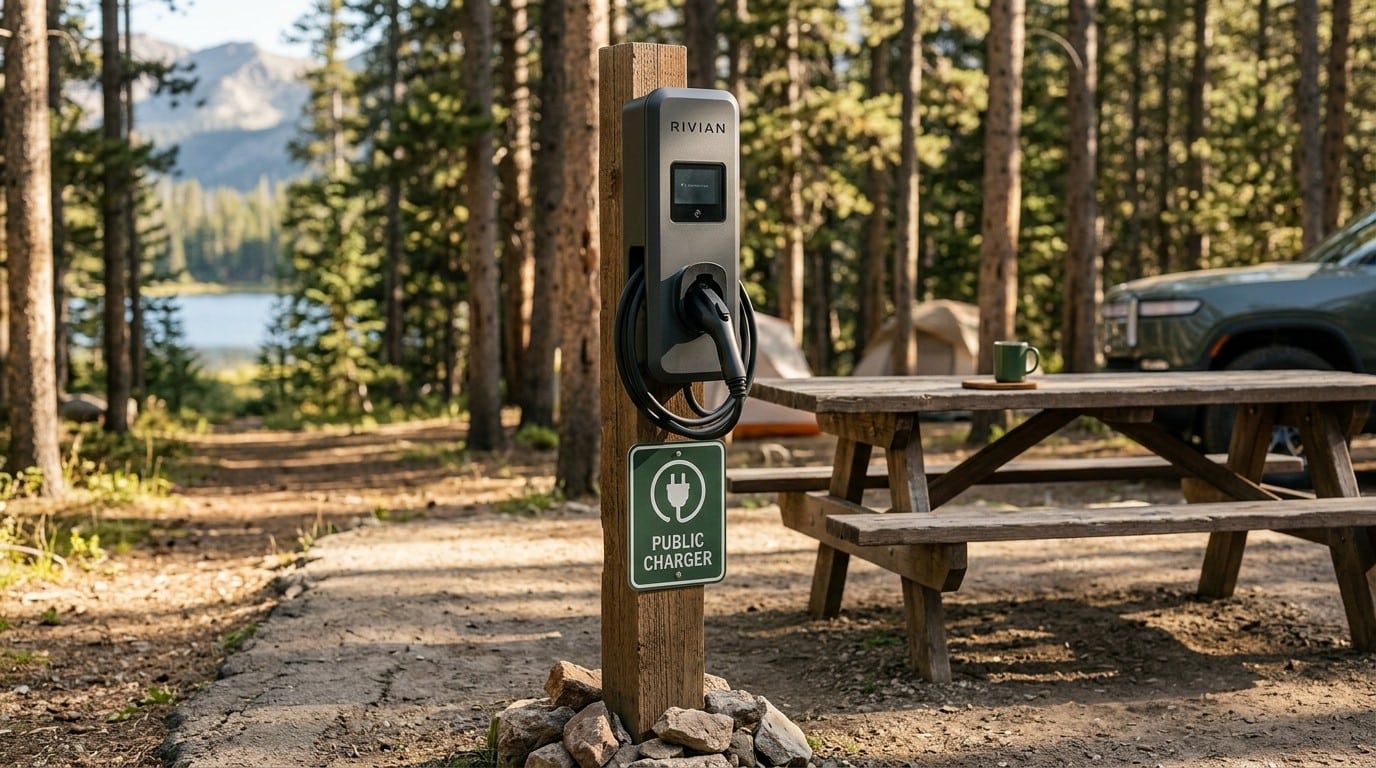
It is worth noting that the Adventure Network is only one part of Rivian’s broader charging footprint. The company also operates a parallel Level 2 network called Rivian Waypoints, with more than 540 ports at 208 locations across the United States. Waypoints add about 25 miles of range per hour and are open to all EVs, often placed in spots the DC fast network does not cover: state parks, hotels, restaurants, and small-town main streets. Together, the two networks form one of the most complete charging footprints of any single automaker in North America.
Frequently Asked Questions
Can anyone use the Rivian Adventure Network?
Yes, with a few caveats. As of late July 2026, 97 percent of Rivian Adventure Network sites are open to all EVs, including non-Rivian vehicles. You will need a CCS1-compatible EV or a NACS-equipped EV with the appropriate adapter, and you will need the Rivian mobile app to start a session. Pricing for non-Rivian users is slightly higher than for Rivian owners, but the network is no longer gated by vehicle brand.
How much does it cost to charge at the Rivian Adventure Network?
Rates vary by site, but the network-wide average is $0.43 to $0.55 per kilowatt-hour for Rivian owners and a small premium for non-Rivian users. The most expensive sites charge up to $0.67 per kWh. Idle fees apply if you leave your vehicle parked at a finished stall. Pricing is always shown in the Rivian app before you start a session.
What is the Rivian Adventure Network’s maximum charging speed?
Each Rivian Adventure Network stall is rated for up to 300 kilowatts of DC fast charging. Real-world delivery averages around 200 kilowatts across the network, depending on the vehicle, the state of charge, and ambient temperature. A Rivian R1T or R1S can add roughly 150 miles of range in 20 minutes at a healthy charge level.
Can Tesla use the Rivian Adventure Network?
Yes, in most cases. Tesla vehicles with the older CCS-compatibility retrofit can use Rivian’s CCS1-equipped stalls with an adapter. Newer Teslas with native NACS connectors can use the 25 percent of Rivian sites that now offer NACS. Tesla drivers can find compatible sites through the Rivian app, which shows connector types for every station.
How many Rivian Adventure Network sites are there?
As of late August 2026, the Rivian Adventure Network has 157 active sites and 1,087 individual DC fast-charging stalls across 46 U.S. states. The company’s long-term target is more than 3,500 chargers at approximately 600 sites across the United States and Canada.
Is the Rivian Adventure Network really powered by 100 percent renewable energy?
Rivian matches 100 percent of the electricity delivered through its Adventure Network chargers with renewable energy on an annual basis, verified through third-party audits. The matching uses a combination of renewable energy certificates and direct renewable energy purchases in the same regional grids as each site. This is a stronger commitment than most charging networks have made.
Conclusion
The Rivian Adventure Network has matured from a slow, exclusive launch into one of the most strategically interesting fast-charging networks in North America. Its growth from 5 sites in 2022 to 157 sites in 2026 is impressive on its own, but the real story is the site selection philosophy. By placing chargers at outdoor recreation gateways rather than only at highway exits, Rivian has built infrastructure that supports the specific use cases its vehicles were designed for. The decision to open the network to non-Rivian EVs in 2024, followed by the transition to NACS connectors in 2025, has made the Adventure Network a public resource as well as a brand asset. For anyone planning a road trip that touches a national park, a mountain pass, or a remote stretch of coastline, the Rivian Adventure Network is now one of the most useful charging options on the map. That same focus on purpose-built electric infrastructure is what made the company’s partnership with Amazon on electric delivery vans a similar case study in vertical integration.
The R1T pickup, the vehicle the network was first designed around, can be used to power a campsite or a worksite when stationary, and that same off-grid capability is what the Adventure Network supports in reverse. It is worth noting that the Adventure Network is only one part of Rivian’s broader charging strategy. The company also operates a parallel Level 2 network called Rivian Waypoints, with more than 540 ports at 208 locations across the United States. Waypoints are slower than Adventure Network stalls (typically 11.5 kW, adding about 25 miles of range per hour) but are open to all EVs and are often placed in spots the DC fast network does not cover: state parks, hotels, restaurants, and small-town main streets. Together, the two networks form one of the most complete charging footprints of any single automaker in North America.


