
Sodium nitrite is frequently added to cured meats, jerky, or bacon to prevent spoilage while giving the meats their distinctive color and salty, tangy flavor. However, it can also cause health complications in large amounts. It has been linked to heart disease, diabetes, and even bowel cancer. This additive has been removed from some foods due to these concerns.
With this in mind, a team at the University of Burgos in Spain developed a color-changing film that displays nitrite levels. The new material is called Polysen, which means “polymeric sensor.” It comprises hydrochloric acid and four monomers, individual molecules that interact with one another to form a longer polymer chain.
The monomers and acid react with any nitrites present in the meat when a slice of the film is placed on a sample of meat, in a process known as a four-step azo coupling reaction. The film is removed once that reaction has ended (in about 15 minutes) and then submerged at room temperature for one minute in a sodium hydroxide solution. This gives it a yellow hue; the more nitrite there is in the meat, the more intense the yellow.
The researchers put Polysen discs on 26 pieces of pork to test the technology. Eighteen were purchased at the supermarket, while the researchers purposefully added sodium nitrite to the remaining eight.
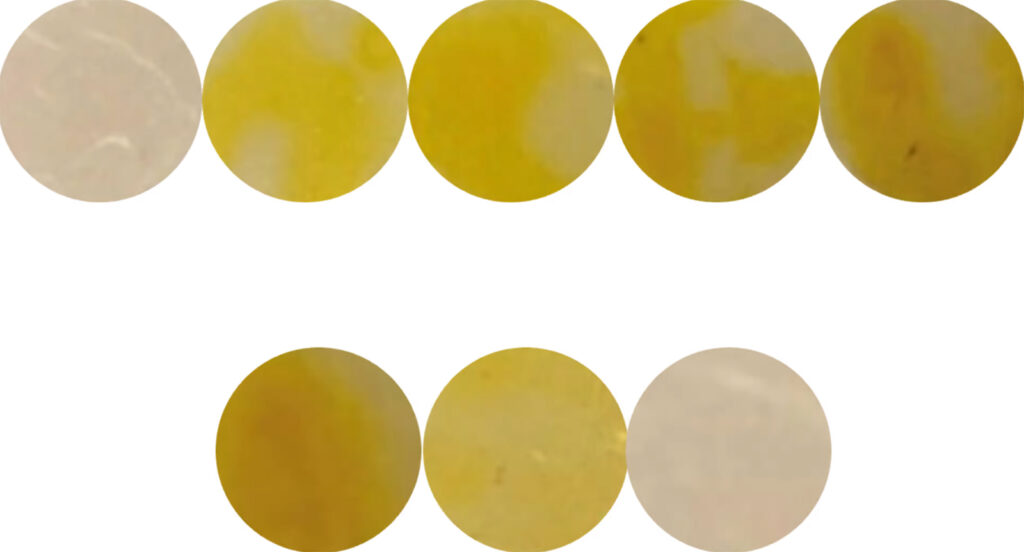
A customized smartphone app was used to match each disc’s shade of yellow to its known corresponding nitrite level after those discs had undergone the reaction and changed color. As a result, the film produced outcomes resembling those attained by a more conventional, intricate nitrite detection procedure.
The Polysen technology may eventually be evolved into a simple, low-cost kit that individuals could use to test meats at home. Finally, the film complies with European safety regulations regarding transferring chemicals from the material into the meat.
A paper detailing the research, led by José M. García and Saúl Vallejos, was published on August 3, 2022, in the journal ACS Applied Materials & Interfaces.


