
China has plans to produce 40 percent of their energy solely through renewable sources by 2030. Researchers from the Harvard John A. Paulson School of Engineering and Applied Sciences (SEAS) and Huazhong University of Science and Technology in China, said this is possible through increasing their offshore wind power to reach that goal.
The majority of the country’s wind energy comes from onshore wind farms, of which most are located nearly 1000 miles away from the nearest coastal city, in Inner Mongolia. The problem with that is, most of the people live in heavily populated coastal cities. The research showed that around 16 percent of the energy was wasted between 2010 and 2016, which costs more than $1.2 billion.

Nearly 80 percent of China’s total energy consumption comes from coastal provinces, such as Jiangsu and Guangdong. In order for it to make environmental and economic sense, researchers say it’s time for China to build offshore wind farms, which will be much closer to these regions.
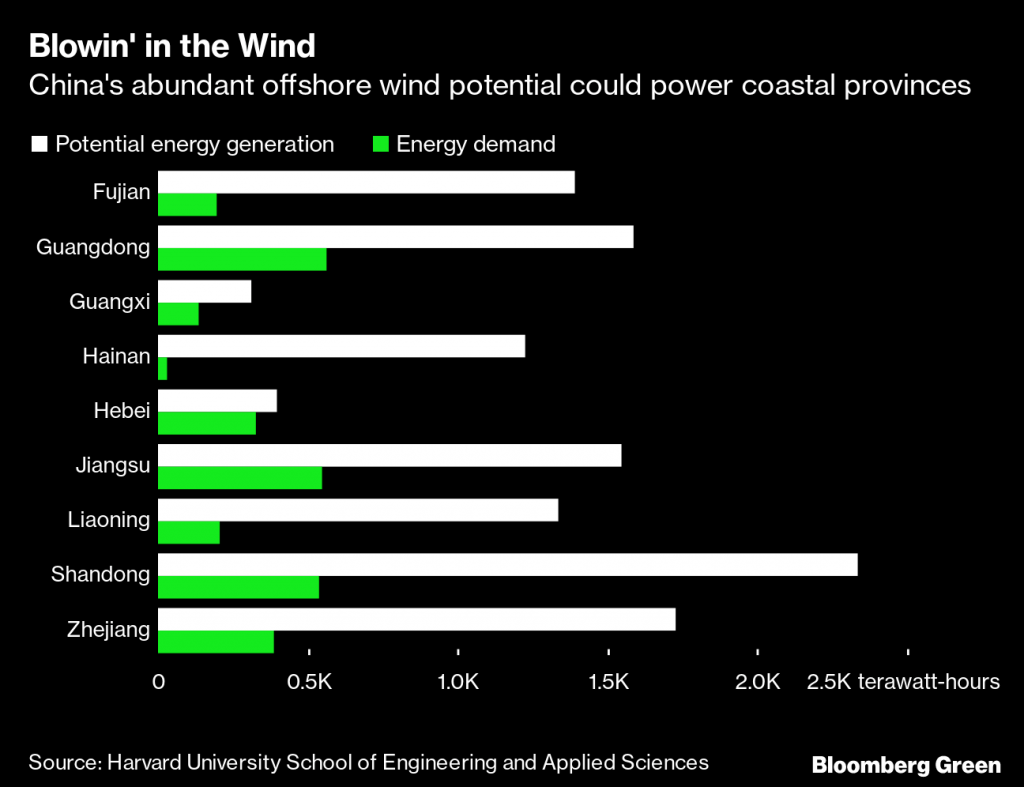
The study shows offshore wind off the coast of China has the capacity to produce 5.4 times more power than the current demand. The Gilbert Butler Professor of Environmental Studies at SEAS, and senior author of the study, Michael McElroy, comments:
This is an important new contribution, recognition that China has abundant off-shore wind potential that can be developed and brought onshore to the power-hungry coastal provinces at costs competitive with existing coal-fired polluting power plants.
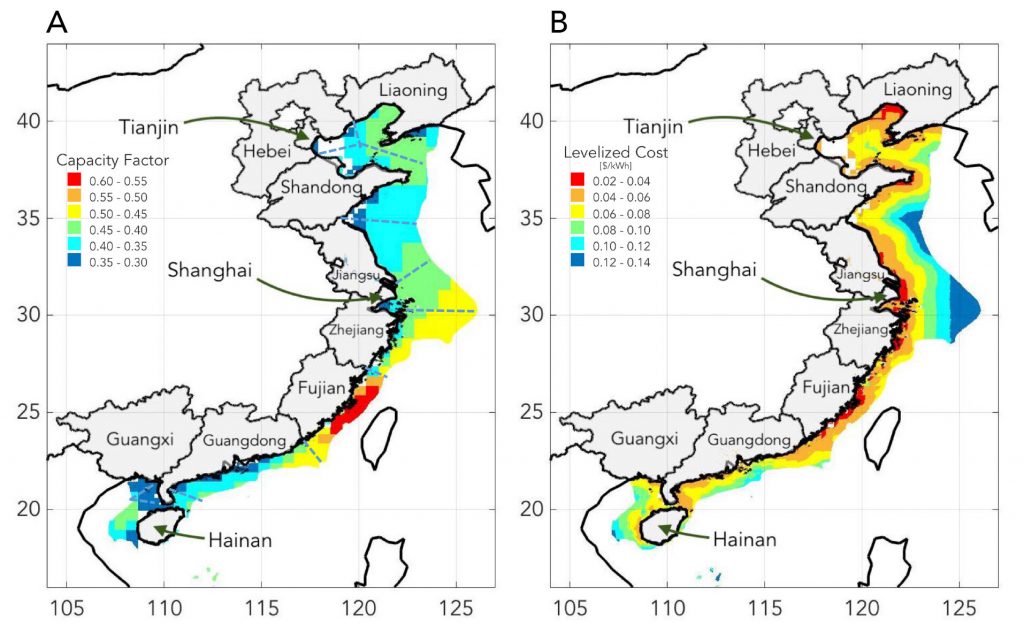
To determine the costs and output potential, the team looked at which areas the offshore wind farms could be built. They excluded environmentally protected areas, shipping zones, and areas where the water levels exceed 60 meters. They then calculated hourly capacity for each turbine and the average wind speeds for each area.
The papers first author, a graduate student in Earth and Planetary Science, Peter Sherman explains:
We estimate offshore wind costs according to a range of values derived from recent offshore wind farm developments. Offshore wind turbines have historically been prohibitively expensive, but it is clear now that, because of significant technological advances, the economics have changed such that offshore wind could be cost-competitive now with coal and nuclear power in China.
They determined the area that offers greatest return and highest wind capacity is Fujian, followed by Zhejiang, Guangdong, Shanghai, and Hainan.
The researchers also estimate that if electricity prices are low, the offshore wind has the potential to provide more than 6,000 terawatt-hours, or 200 percent, of the total energy demand. Of course, this also depends on construction costs, but even if the wind farms are built at a cost of $3,500 per kilowatt, they would still provide 36 percent of their energy needs.
McElroy concluded the study by stating:
Our research demonstrates the potential for cost-effective, offshore wind to power coastal regions, reduce greenhouse gas emissions and improve air quality in China.
After looking at the results of this study, it only makes sense for China to implement offshore wind farms if they are serious about reaching their goals, and becoming 40 percent renewable by 2030.


