
The conversation around next-gen batteries often focuses on the promise of longer range and faster charging, yet nearly every innovation remains within the traditional lithium-ion family. While solid-state designs currently lead the near-term race—backed by compelling prototypes like Samsung’s 600-mile model—a far bolder concept is now taking shape. The concept is lithium-air, a battery that ‘breathes’ external oxygen, targeting an energy density that aligns more closely with liquid fuels than with contemporary battery packs.
For many years, lithium-air existed largely as a set of tantalizing, yet frustrating, laboratory results. Although these cells could store extraordinary energy by weight, they struggled significantly to deliver adequate power or survive repeated charging cycles. That trajectory shifts dramatically with two linked advances originating from Japan’s National Institute for Materials Science (NIMS) and its collaborators.
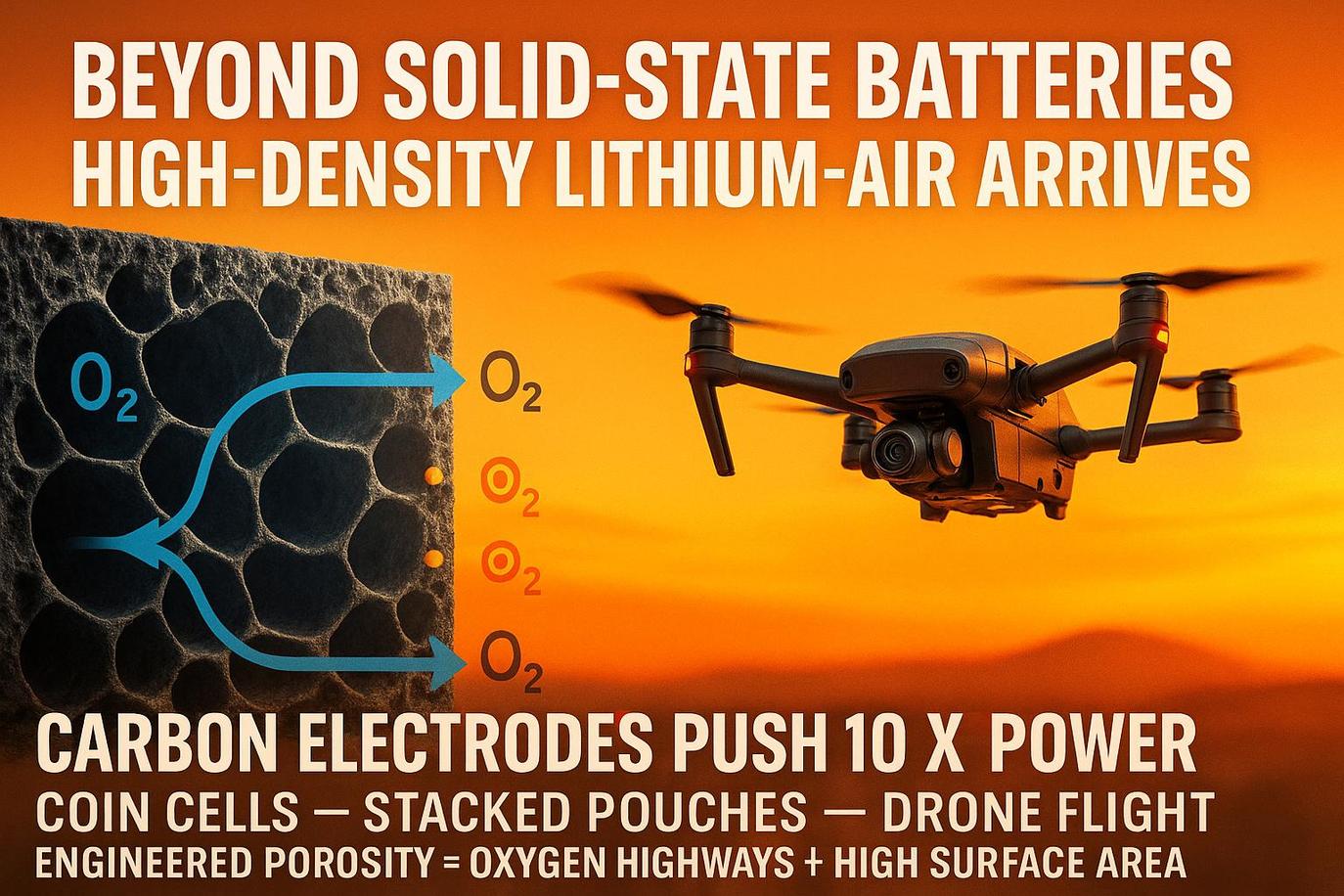
One research team successfully engineered a tenfold increase in output by meticulously tuning the microscopic pores within a carbon nanotube air electrode, while another team constructed 1 Wh-class stacked pouch cells utilizing a robust, hierarchically porous carbon membrane. These breakthroughs collectively transition lithium-air from being purely a theoretical curiosity toward functional hardware that engineers can stack, seal, and precisely measure in watt-hours.
Key Advances and Quick Facts on Lithium-Air Battery Progress
Lithium-air batteries will partner with the carbon innovation, demonstrating that the importance of scale in battery development is just as crucial as power. The companion breakthrough uses a graphitized carbon membrane with interconnected pores that guide oxygen and make room for the discharge products that used to clog earlier cathodes. That architecture enabled a 1-Wh multi-stack that cycled stably in pouch-cell format, as explained in Cell Reports Physical Science, which describes the method.
To form a mental picture, imagine a lightweight drone that simply refuses to sag the moment you ask it to lift heavy equipment. In NIMS’ experiments, a porous carbon electrode paired with a low-viscosity amide electrolyte delivered enough power to keep a small airframe hovering, as detailed in the Journal of Power Sources. While not a commercial aircraft, the result represents real mechanical work from a chemistry previously known more for high energy storage than for usable power output.
- What’s new: A tenfold power increase from a carbon nanotube air electrode with a low-viscosity amide electrolyte.
- Why it matters: A 1-Wh-class stacked pouch cell using a hierarchically porous, graphitized carbon membrane showed stable cycling.
- Where it fits: Solid-state remains the near-term upgrade for EVs, with major programs like Toyota’s planned solid-state rollout setting expectations.
- What it could enable: Lightweight systems such as high-endurance drones and, eventually, electric aircraft that need far higher energy per kilogram than today’s packs.
- What still blocks progress: Sensitivity to ambient air components, limits on cycle life, and lithium-metal safety challenges that must be engineered around.
While lithium-air won’t replace today’s EV packs next year, solid-state remains the practical milestone on the road map, with players like Toyota’s planned solid-state rollout and China’s solid-state battery program shaping near-term products.
The value of lithium-air is different. It points to a far end of the spectrum where energy density might unlock electric aviation, high-endurance drones, and other weight-sensitive machines that are difficult to decarbonize with conventional cells.
To place these technologies in the broader energy ecosystem, keep in mind that ‘air-breathing’ batteries already play a pivotal role on the electrical grid. Iron-air technology is being built for multi-day storage using abundant materials, as seen in Form Energy’s iron-air battery project in Maine.
Lithium-air batteries are a lighter, riskier cousin aimed at machines that must fly, climb, or stretch for extreme range. The science is advancing, the engineering questions are finally concrete, and the next sections unpack what changed and why it matters.

The Battery Evolution: From Lithium-Ion to Solid-State to the Lithium-Air Frontier
Many engineers understand the lithium-ion story: steady improvements in cathode chemistry, silicon blended into anodes, and continuously better management electronics.
The next large step, solid-state, replaces the flammable liquid electrolyte with a solid medium that promises higher energy density and improved safety. This inherent advantage explains why prototypes like a 600-mile solid-state EV prototype and Toyota’s planned solid-state rollout attract significant interest from automakers and investors.
Lithium-air sits further out on the horizon. Instead of carrying oxygen inside the battery, the cell draws it from outside and forms discharge products directly in the porous cathode. In theory, removing the mass of an oxygen-bearing cathode material allows much higher specific energy.
In practice, engineers had to solve two stubborn problems: delivering enough power to do real work and keeping the cathode breathing for many cycles without clogging.
What Makes Lithium-Air So Wildly Different?
Lithium-air changes the job of the positive electrode. Rather than storing oxygen inside a metal oxide crystal, a porous carbon network hosts reactions that use oxygen from the environment. That design can free up weight, which is why the theoretical specific energy is so attractive. This design can free up weight, making the theoretical specific energy exceptionally attractive. The catch is that the cathode must manage several simultaneous requirements. It must:
- Administer oxygen.
- Transport ions.
- Conduct electrons.
- Accommodate the solid products that form during discharge.
When those products choke the pores, the battery’s voltage sags and the cycle ends early. The breakthroughs covered here attack that critical bottleneck using microstructure that guides gas and ions through a well-engineered maze.

Achieving a Tenfold Power Jump: Tuning Porous Carbon Electrodes for Lightweight Applications
The initial advance specifically focuses on optimizing power delivery. NIMS and Seikei University built a highly porous carbon nanotube air electrode and paired it with a low-viscosity amide-based electrolyte that moves ions with less drag. The result was a tenfold increase in output current compared with their earlier lithium-air cells, as detailed in the Journal of Power Sources.
Practically speaking, the improvement means a small lithium-air pack can now drive a lightweight rotor system rather than simply lighting an LED. Crucially, the electrode’s pores are not random holes; they are tuned so oxygen pathways are open, surface area is high, and the carbon network can carry electrons where they are needed. The electrolyte’s low viscosity reduces resistance to ion motion, which helps maintain voltage under load. Together, those changes turn high energy on paper into higher power in practice.
How Engineers Model “Just-Right” Porosity
Porosity design integrates principles established in fuel cells and other porous electrodes. Engineers think in terms of pore size distributions, connectivity, and tortuosity, a measure of how winding the pathways are. If pores are too small, discharge products quickly block them. If pores are too large, surface area falls and reaction rates suffer. The sweet spot balances gas access, ion transport, and electronic conduction. That is why the NIMS study emphasized both the carbon architecture and the electrolyte’s flow properties, a combination that raised current without trading away the cell’s energy potential.
From Coin-Cell Curiosities to 1-Wh Stacked Lithium-Air Pouch Cells
Power alone is insufficient for a practical battery; devices fundamentally need stable watt-hours, not just bursts of watts. The second advance tackles scale using a hierarchically porous, graphitized carbon membrane that is sturdy enough to stand on its own. The membrane combines mesopores that provide abundant reaction surface with macropores that act like highways for oxygen and a reservoir for discharge products. That design enabled a multi-stack pouch cell with 1-Wh-class energy and stable cycling.
The electrodes were fabricated in sizes relevant to real hardware and then successfully stacked into a functional package. That is a quiet but crucial shift. Researchers can now explore sealing strategies, oxygen management, and lean-electrolyte operation in a form factor that laboratories worldwide can reproduce. It also sets up fair comparisons with other technologies, from iron-air battery projects for grid-scale energy storage to the solid-state cells racing toward passenger cars.
Why 1 Wh Matters for Drones and Future Electric Aircraft
While one watt-hour sounds small in absolute terms, its significance in battery development is immense. In battery development, however, crossing the one-watt-hour threshold in a stacked pouch cell is the moment the conversation turns from chemistry alone to systems engineering. Stacks can be scaled, packaging can be tested, and power electronics can be tuned around real impedance and heat.
For drones, it means experimenting with endurance and payload in the same lab that built the cell. For future electric aircraft, it means researchers can finally map the demanding tradeoffs among cycle life, safety, and oxygen handling using parts that look and behave like miniature versions of what a flight-ready pack might one day require.

Porous Carbon’s Role in Clean Mobility: Structure Over Scarce Material Mining
Lithium-air’s recent progress is a story not just of chemistry, but fundamentally of structure. Both Japanese teams focused on carefully arranged carbon: they used carbon nanotube networks for quick movement and self-supporting membranes with pores that allow oxygen in and space for waste products to escape. By extracting more performance from the same atoms, pore engineering shifts attention from scarce metals toward abundant carbon.
This approach aligns with a broader sustainability logic. Maximizing energy and power per gram reduces the material burden of the pack, supporting the core sustainability arguments regarding the environmental advantages of modern lithium batteries. Carbon electrodes can be tailored so mesopores host the electrochemical reactions while macropores serve as highways for gas flow and storage for reaction products. When that hierarchy is tuned well, the cell breathes more freely and wastes less electrolyte. The result is practical efficiency rather than speculative marketing.
Comparing Lithium-Air to Grid-Scale Air-Breathing Systems
The role of carbon actively complements other air-breathing systems that prize abundant materials. Grid-scale designs do not chase weight, so they often choose iron or zinc instead of lithium. The zinc-air batteries designed for lower-cost long-duration storage target multi-hour to multi-day use cases where cost dominates. Lithium-air lives at the other end of the spectrum, where grams matter and structural design is the lever that can turn laboratory promise into flight-worthy power.
Where Lithium-Air Fits Among Metal-Air and Next-Gen Batteries
Battery families succeed in different arenas because each chemistry trades among energy density, power delivery, durability, safety, and cost. Placing lithium-air on that map clarifies why it attracts aerospace attention while iron-air and zinc-air win on the grid:
- Iron-air uses an abundant active material and tolerates heavy systems, leading utilities to pilot projects such as an iron-air deployment in Minnesota to buffer wind and solar during long weather swings.
- Zinc-air targets similar multi-day niches with low material cost, prioritizing storage duration over weight.
- Lithium-air aims for the opposite problem: packing the most energy into the least mass so machines can hover, climb, or cross long distances without refueling.
Against today’s vehicles, solid-state remains the near-term favorite. It improves safety and promises higher energy density without changing how batteries are packaged or managed. Engineers already know how to integrate solid-state modules into cars.
Lithium-air sits further out, but its recent gains in power and scale mean researchers can finally test modules rather than only coins. To provide the broader engineering context, resources on renewable energy storage solutions for electrical engineers help anchor how different technologies serve distinct jobs.
Looking even further, research into quantum batteries reminds us that energy storage is a portfolio. Some bets deliver this decade; others build the knowledge that enables the next.

Engineering Challenges: Addressing Oxygen Sensitivity, Cycle Life, and Lithium Safety
Progress does not erase physics. Lithium-air reacts with oxygen, and real air contains carbon dioxide and water. Those contaminants trigger side reactions that form unwanted compounds and clog pores. Many experiments therefore use controlled oxygen rather than open air. Even in clean conditions, the cathode gradually accumulates discharge products that are hard to remove completely. The best recent cells demonstrated stable operation for more than a hundred cycles, which is impressive for this chemistry but still short of what cars or aircraft would require.
Another hard problem is the anode. Lithium-air typically uses lithium metal, which can form needle-like structures during charging that risk short circuits. Researchers counter this with electrolyte choices, protective layers, and current controls. However, the engineering must also include reliable packaging, fault detection, and conservative operating windows.
Finally, pack-level questions remain: how to deliver oxygen cleanly, how to capture or neutralize byproducts, and how to maintain performance when scaled from a few centimeters to modules measured in tens of centimeters.
Decarbonization Imperative: Lithium-Air’s Role in the Long-Term Climate Story
Aviation and certain freight categories are stubborn emissions sources because energy per kilogram is the binding constraint. If batteries ever hope to displace kerosene in short flights or unlock practical eVTOL routes, a critical need exists. Energy density must climb while power and durability hold. Lithium-air is one of the few chemistries that directly addresses the necessary direction for extreme energy density. The recent tenfold power gain and a working one-watt-hour stack move the discussion from “if” to “how.”
That bigger picture reveals a toolkit where each chemistry excels at a specific task, and lithium-air is positioned to test the limits of lightweight energy storage.
There is also spillover value. Techniques that sculpt carbon microstructure migrate into adjacent fields, including solid-state designs that need fast ion pathways and lithium-sulfur systems that wrestle with diffusion limits. On the grid side, heavier chemistries continue to evolve for cost and resilience, as explained in widely used engineering references.

Final Assessment of Lithium-Air: The Long-Term Energy Density Frontier
Clearly, lithium-air is not intended as a direct, drop-in replacement for current electric vehicle batteries; rather, it represents a bold new frontier in energy storage. The significant shift in recent years is how scientists have successfully translated a general, ambitious concept into viable engineered hardware.
Specifically, porous carbon electrodes have demonstrated real power output, and hierarchically structured membranes have delivered stable watt-hour performance in stackable pouch cells that can be replicated globally. Although the essential journey toward commercial electric aircraft or ultralong-range vehicles still requires breakthroughs in oxygen management, cycle life, and inherent safety, the fundamental direction for this chemistry is now firmly established.
The inherent promise of lithium-air rests on its theoretical specific energy, which vastly exceeds that of lithium-ion because the cell utilizes oxygen drawn from the ambient air, eliminating the need for a heavy, integrated cathode material. While real-world commercial packs will inevitably fall short of theoretical maximums, even achieving a fraction of this potential translates into partial gains critical enough to enable machines and applications currently impossible with existing battery technology. For this reason alone, lithium-air’s continued progress warrants close attention from those tracking the global energy transition.
Expert Answers: Key Facts on Lithium-Air Power, Safety, and Scale
How Much More Energy-Dense Could Lithium-Air Be Than Today’s EV Batteries?
Theoretical values reach far beyond lithium-ion because the cell draws oxygen from outside rather than carrying it in a heavy cathode. Practical packs will be lower than theory, but even partial gains could enable machines that are impossible with current cells.
Can Lithium-Air Batteries Really Power Electric Aircraft?
Not today, but the path is clearer. A tenfold power increase and a one-watt-hour stacked pouch cell indicate that designers can begin testing modules for weight-sensitive platforms like drones while charting what aircraft would demand.
What Does “1-Wh-Class” Actually Mean in Real Terms?
It means the cell stack stores roughly one watt-hour of energy, enough to run a one-watt device for about an hour. Crossing this threshold in a pouch format allows engineers to test packaging, stacking, thermal behavior, and controls in a realistic form factor.
How Soon Could Lithium-Air Reach Products I Can Buy?
There is no firm timeline. Cycle life, oxygen management, and safety must improve substantially first. Expect years of materials and systems work before any commercial claims.
What Are the Biggest Technical Problems Still Unsolved?
Keeping pores clear in real air, extending cycle life by multiples, and managing lithium metal safely. Each problem has candidate solutions, but all require rigorous validation outside of controlled laboratory setups.
How Is Lithium-Air Different from Iron-Air and Zinc-Air Batteries Used for the Grid?
Iron-air and zinc-air aim for low-cost, long-duration storage where weight is not a constraint. Lithium-air targets the opposite extreme, where grams matter and high specific energy determines what is possible.


