
Football season in America is a cultural staple that nearly everyone partakes in religiously. Every weekend, groups of friends get together for tailgating parties and to enjoy the games. But when game-goers tailgate, they use portable gas generators. Since there are so many, which goes across the whole country, it’s a significant source of emissions.
A group of Ohio State University students noticed this problem and created a solution. They teamed up and founded a startup to develop a sustainable alternative – a portable rechargeable battery pack available through a delivery system linked to a phone app.
The app is a smart mobility and logistics platform to coordinate battery distribution and track status. Getting a battery-pack is as easy as downloading the app and requesting a delivery. Someone from the company will come riding an electric cargo bike to deliver the emissions-free power source. When ready to go, you can order a pick up through the app.
The team – consisting of a doctoral student, Danny Freudiger, and engineering undergraduates, Caleb Buaful, Jacob Buaful, Jr., and Anita Nti – first got motivated after asking Buckeye fans about how much energy their generators use to power the slow cookers, mini-fridges, TVs, and satellite dishes before, during, and after the games.
They compiled the observations with scientific research and campus data to find out the carbon footprint. They found that the tailgate parties for one day just at their campus emit over 120,000 pounds of carbon dioxide! That’s the same as running 3,200 sedans over the same period.
Nti said:
This project definitely sparked my interest in sustainability. People automatically think of sustainability on such a large scale and totally negate the fact that there’s so much we can be doing on a smaller scale that can come together to actually make a large impact.
We came back and started talking and thinking: If that’s just from one day, that’s thousands of pounds of CO2 being emitted at one game and just at Ohio State, how much more would be over a season and then at other schools across the nation as well? We saw that as a very significant impact. So, we thought about how we could possibly be a solution.
That’s the moment Electrion was born – their “Energy Storage as a Service” (ESaaS) project.
Caleb Buaful said:
From there, we really thought about the user experience. Because you are providing this as an alternative, you want that transition to be smooth. If it’s too hard, they’ll just keep using the generator because it’s easy to use.
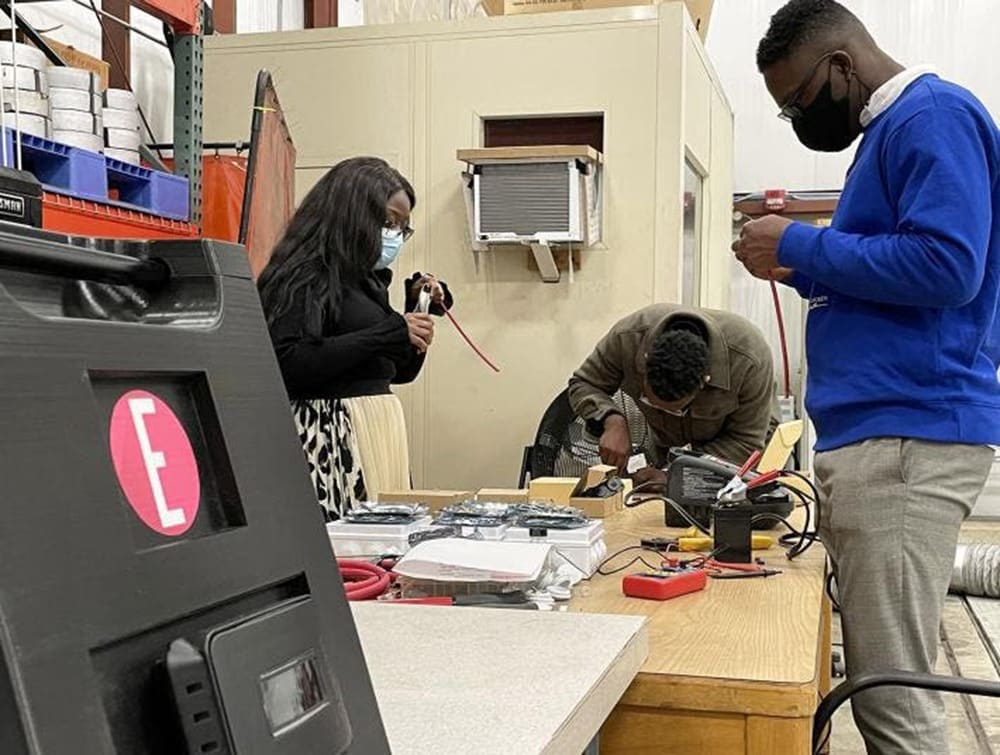
Straight away, Electrician attracted investors who joined the team to commercialize their ESaaS system. First, they received an $89,000 Ohio State Sustainability Fund grant to launch the pilot program.
Jacob Buaful said:
I would say the first push was the Ohio State Sustainability Fund grant that we won. That was an eye-opener: We won something; this could mean something.
The team then connected with an investment firm called MegaJoule Ventures – a company that aligns with groups focused on developing, validating, and launching environmentally sustainable energy solutions. The firm invested $250,000 to help build batteries and the acceleration of Electrion products market introduction.
MegaJoule Ventures’ CTO, Michael Gurin, said:
MegaJoule Ventures is excited about the Electrion opportunity because of the great team in place both in terms of vision but also the depth of knowledge rapidly they gained and the accelerated deployment schedule they maintained in releasing an advanced prototype. Their fundamental understanding of the electrical energy storage market is also strategically aligned with our investment strategy.
All the team members are also members of the Ohio State multidisciplinary student organization Smart Campus, founded by Freudiger. Smart Campus’s mission is to develop innovative solutions through collaboration and project-based teams to improve the university’s community. Freudiger is dedicated to the idea that everything should have a focus on sustainability.
He said:
I think everything we do should be about sustainability. One of the bigger reasons why we’re here is to leave the world a better place than we found it so future generations can enjoy it and have it better off than we did, hopefully, if we do things the right way. I think all of that is centered around sustainability. It’s sustainability for energy. It’s sustainable communities. There are so many different components to sustainability, and that’s why I think it’s so important that we keep it at the front of our minds all the time.
The team realized that Electrion aligned perfectly with the university’s efforts to become carbon neutral by 2050, which helped them secure the support they needed.


