
A team at Carnegie Mellon University has developed a new self-healing material that has several impressive applications. Some of which include, automatically sealing itself around a broken arm as a smart polymer cast, a membrane that can detect where it has been cut, and pneumatic actuators that can be dismembered and reconfigured into different shapes.
The unique characteristics of the composite material allow it to self-heal and enable devices made from it to regain their functionality or gain new functionality after being cut or punctured. Impressively, when the cut ends of the material are positioned together, the pieces reconnect, and the seam between them slowly disappears.


Mohammad Islam, a professor in the Department of Materials Science & Engineering (MSE), and Lining Yao, assistant professor in the Human-Computer Interaction Institute (HCII), led the research team. In the study, they demonstrate the material’s self-healing properties by building an assortment of sensors and actuators.
Yao said:
We’re definitely trying to push the bounds of people’s imaginations.
Islam notes that other researchers have invented self-healing materials, but most of them depend on the flow of reagents for healing. For example, reagents encapsulated within the material release after the material is cut, and then it repairs the damaged areas.
However, this new material is more effective. It’s made from a combination of two elements – a self-healing polymer called polyborosiloxane (PBS) and multiwalled carbon nanotubes (MWCNTs), which creates conductivity. When the material is cut, it doesn’t flow. Instead, it retains its shape while self-healing.
Since the smart material still functions when it heals, it’s possible to create sensors or other electronic devices as modules that can be assembled or rearranged as desired. “You can build things sort of like LEGO pieces,” Yao added. Another possibility is to design devices that can be made as standard sheets or other forms and then cut into any needed shape for use.
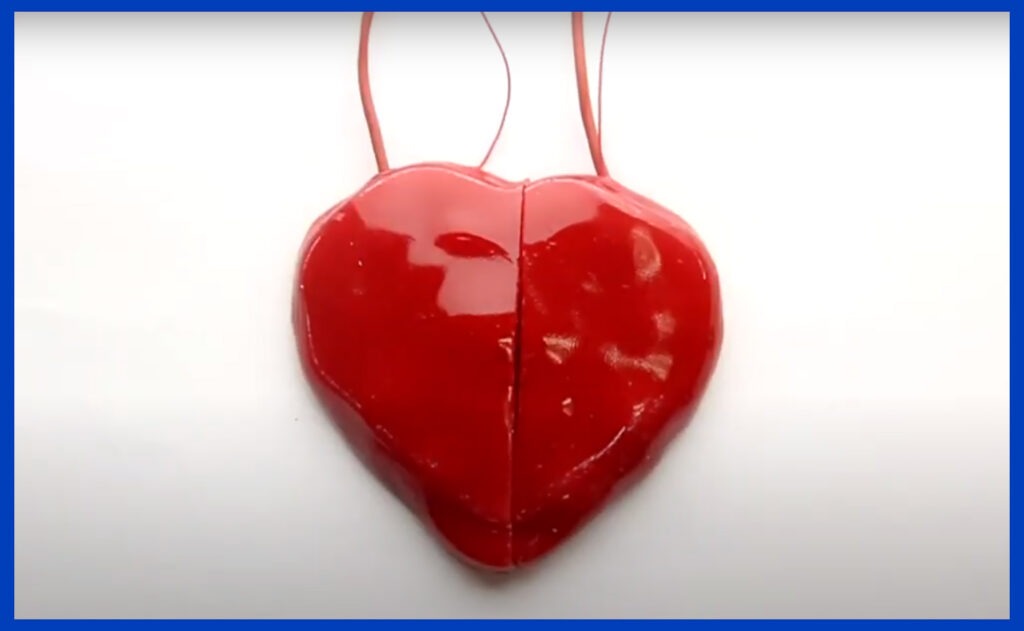
Koya Narumi, a lead author of the study, said:
I foresee a possibility that the interfaces we encounter in our daily lives will become more and more autonomous, more like a ‘life-form’ that helps us rather than something that is used by us.
One example of how the material could be used like this is to build a reusable arm cast that molds itself around a broken arm and heals its seam. Such a cast could potentially adjust itself over time to speed up the healing process.
Narumi is a Ph.D. student at the University of Tokyo who was a visiting student in Yao’s Morphing Matter Lab at CMU. “Self-healing is an interesting concept that opens the team’s imagination to explore more intelligent interfaces,” said Fang Qin, who is also a lead author of the study and a master’s student in the Electrical & Computer Engineering Department.

Islam highlights that the research involved experts across disciplines:
We (in materials science and engineering) could make the material in a simple sense, but Lining has huge expertise in designing systems. By having this collaboration, we can do things we couldn’t do by ourselves.
Last fall at the Association for Computing Machinery’s Symposium on User Interface Software & Technology (UIST) in New Orleans, the team reported on the material and their prototypes. Now, they’re working on new applications that involve self-assembly and self-actuation.


