
In 2019, engineers from the Georgia Institute of Technology developed a two-millimeter-long robot, dubbed “micro-bristle-bot,” that weighs less than a teaspoon of salt. The robot was designed to potentially save human’s lives by entering the body to repair tissues.
Most robots run on electricity, but vibrations power micro-bristle-bot. It’s 3D-printed with a super tiny actuator, in a four- or six-legged configuration. To power the actuator, specific frequencies are blasted out of a vibrating table; however, an ordinary speaker can power it the same way. Only when the frequency is ideally in tune with the robot’s onboard components will the device come to life, as its external vibrations reverberate inside the robot to move its legs up and down.
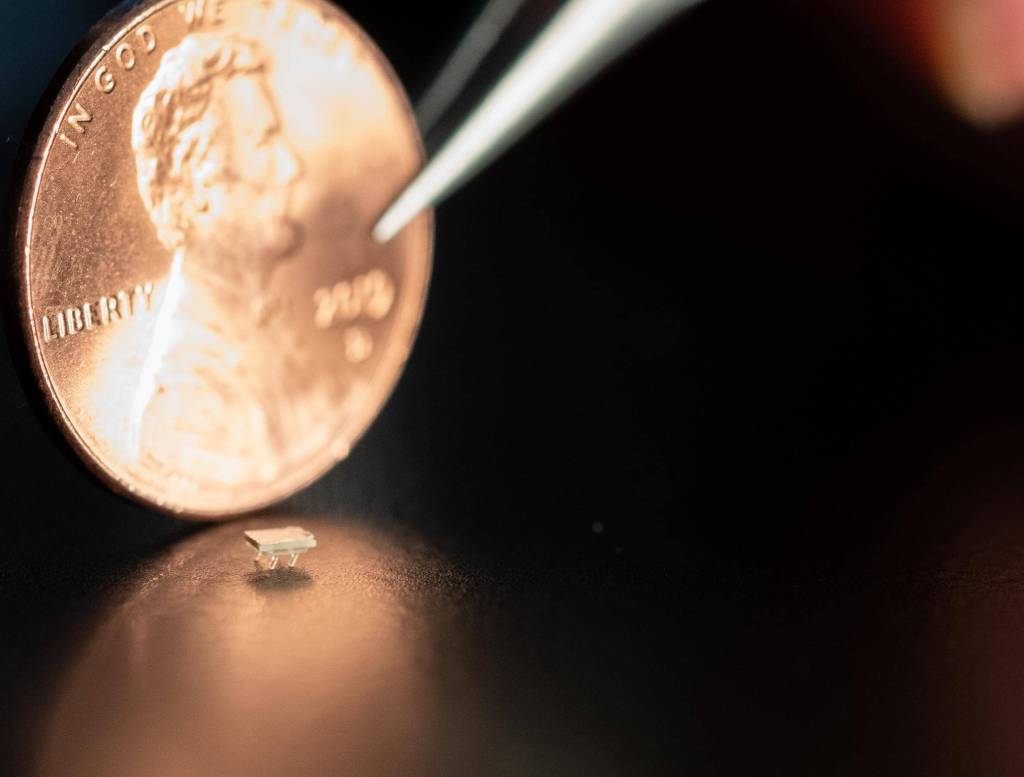
Now, scientists led by Prof. Oliver G. Schmid of Germany’s Chemnitz University of Technology, have developed what is known to be the smallest microelectronic robot in the world. However, unlike the micro-bristle-bot, this flat-bodied microbot moves by shooting out dual jets of bubbles. The study, which also involved researchers from the Chinese Academy of Sciences Changchun and the Technical University of Dresden, was published in Nature Electronics.
The new microbot measures as little as 0.8 mm wide, by 0.8 mm long, by 0.14 mm tall, and is controlled wirelessly by an external transmitter. When the bot receives an electrical signal from the transmitter, an induction coil in the middle of the device heats one of two rolled-polymer tubes.
Both tubes run along either side of the robot and continuously suck in a hydrogen peroxide/water solution, in which the bot is immersed. Each tube contains a bit of platinum, which causes a catalytic reaction, creating oxygen bubbles that shoot out of the rear ends of the tubes, causing the bot to thrust forward.

Schmidt explained:
We construct the microbot initially in such a way that it swims in circles if no heat is applied at all. If some heat is applied, the turning is compensated, and the microbot swims in a straight line. If more heat is applied, the microrobot turns in the other direction.
The team also built the device a manipulator arm, in the form of an actuator made of a thermoresponsive polymer. The arm opens or closes depending on how much heat is applied, allowing it to grasp tiny objects. In addition, the little bot can be equipped with a miniature LED light.
Watch the microbot in action, with bubbles shooting out in steams behind it as it moves, in the video below.


