
In a remarkable breakthrough, scientists have for the first time encountered the faint cosmic symphony of gravitational waves originating from the movements of massive black holes in the universe. This groundbreaking discovery reveals the whispered echoes of supermassive black hole binaries subtly stretching and squeezing the very fabric of space-time, akin to an astronomically scaled cosmic orchestra.
Cosmic Gravitational Waves Detection
The detection of these cosmic low-frequency gravitational waves is considered a monumental step forward in the field of astrophysics. This historic moment reveals a new dimension of the universe, akin to a grand-scale symphony. “It’s really the first time that we have evidence of just this large-scale motion of everything in the universe,” stated Maura McLaughlin, Co-director of NANOGrav, the research collaboration that published these astounding results in The Astrophysical Journal Letters.
Einstein had anticipated this cosmic symphony. His theory of general relativity foresaw that colossal objects like black holes moving in the space-time continuum would create echoing ripples, much like footprints left behind in the sand. Scientists have often referred to these ripples in the fabric of reality as the harmonious background music of the universe.
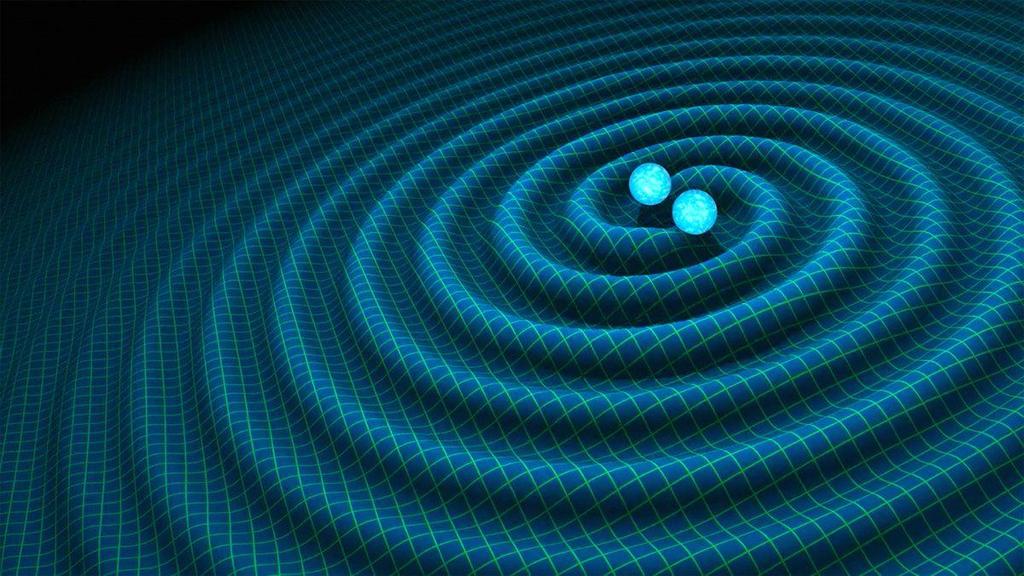
Breaking Gravitational Waves’ Secrets
In 2015, using the tool known as the Laser Interferometer Gravitational-Wave Observatory (LIGO), researchers were able to detect high-frequency gravitational waves for the first time, thereby confirming Einstein’s theory. However, these high-frequency waves represented only the percussions and accelerations of black hole collisions. What scientists have now detected are the deeper, slow undulations of lower-frequency waves, symbolizing the somber harmonies of these celestial bodies performing the cosmic opera.
Chiara Mingarelli, an astrophysicist at Yale University and an active member of the NANOGrav team, enlightened us about the marvel of these cadences, explaining that these slow waves take years – even decades – to complete their cycle. The primary composers of these ethereal rhythms are supermassive black holes, billions of times more massive than our Sun, scattered across the cosmic winds.
These black holes continually generate gravitational waves as they partake in an intricate dance with each other in binary systems. “Supermassive black hole binaries, slowly and calmly orbiting each other, are the tenors and bass of the cosmic opera,” said Szabolcs Marka, an astrophysicist at Columbia University who was not associated with the research.

NANOGrav Collaboration
For such a grand symphony, a divine theater was necessary. The NANOGrav collaboration has turned our galaxy into a gravitational wave detector, using multiple telescopes across North America, including the Green Bank Telescope in West Virginia, the Arecibo Telescope in Puerto Rico, and the Very Large Array in New Mexico. To decode these faint waves, the researchers focused on pulsars, the remnants of massive stars following supernova explosions that emit flashes of radio waves, akin to cosmic lighthouses.
As the gravitational waves traverse across the universe, they subtly modify the fabric of space-time, causing minute shifts in the pulsar’s rhythm. The NANOGrav team meticulously monitored 68 pulsars across the sky, paving the way for multi-messenger astronomy.
However, decoding the origin of these waves remains a challenge. Marc Kamionkowski, an astrophysicist at Johns Hopkins University, offered a tantalizing insight: these waves are like the constant hum at a crowded party- omnipresent, yet difficult to trace back to a single conversation.
This discovery has created ripples of excitement among the scientific community, promising a new realm of “cosmic archaeology” that can help us trace the history of black holes and galaxies across the cosmos. As Sarah Vigeland from NANOGrav suggested, “We’re starting to open up this new window on the universe,” initiating a revolutionary chapter in the realm of astrophysical exploration.


