
For most of computing’s history, the substrate has been a choice between silicon and, more recently, exotic materials like superconducting qubits. In August 2026, a quieter third option started producing real engineering results: wetware computing, the practice of using living biological material such as bacteria, neurons, and fungal threads as functional hardware. Within the span of two weeks, MIT researchers unveiled living bacterial transistors that perform arithmetic on an agar plate, Singapore switched on the world’s first commercial biological data center powered by human neurons, and the fungal memristor field crossed a memory-speed threshold that puts mycelium-based memory inside the same conversation as conventional chips.
None of these efforts are trying to replace your laptop. What they are doing is opening a new design space, where the circuit is alive, self-assembles, and runs on chemistry rather than electricity. Below is what wetware actually means, how the three 2026 milestones fit together, and what each approach can (and cannot) do today.
What Is Wetware Computing?
Wetware is shorthand for biological matter, primarily neurons, brain cells, engineered microbes, and similar living systems, treated as computational hardware. The term borrows from “hardware” and “software” to describe a third layer: organic, self-organizing circuitry that processes information through chemistry or electrical signaling rather than transistor switching.
The label has floated around biology labs for decades, but in 2026 it has acquired a sharper meaning. It joins a longer lineage of biological substrates being explored for data storage and processing, from DNA-based archival storage to engineered microbes harnessed for energy and materials. Researchers now distinguish three families of wetware, each using a different biological substrate and each suited to a different job:
- Engineered microbial logic. Bacteria or yeast are reprogrammed so that colonies act like logic gates, performing Boolean operations and arithmetic through molecular signalling.
- Neural processors. Lab-grown neurons are interfaced with silicon electrodes so their natural spiking activity can be read as computation, used today for low-power AI inference.
- Fungal and slime mold memory. Mycelium networks are wired up as memristors (resistors with memory), storing state in their electrical response to prior stimuli.
These are not competing approaches. They are converging on the same conclusion: a wetware layer can complement silicon where biology has a structural advantage, such as ultra-low power consumption, self-repair, growth, and chemical sensing, rather than competing on raw clock speed.
MIT’s Living Bacterial Transistors: Logic From Engineered Cells
The clearest 2026 milestone in microbial logic came on 17 August, when a team at MIT led by Christopher Voigt, head of the university’s Department of Biological Engineering, published the description of a “living circuit board” built by printing bacterial transistors. The paper appeared in Nature Chemical Biology, with postdoctoral researcher Hamid Doosthosseini as lead author and former MIT postdoc Haorong Chen as co-author.
Rather than engineer an entire circuit into one cell (the standard approach in synthetic biology), the MIT group designed five strains of Pantoea agglomerans, a bacterium that commonly lives on plant surfaces, that could be combined in different physical layouts to build any desired circuit:
- Two transistor strains, switched on or off by a small molecule called OC-6, and able to detect a second molecule called OC-12 as their information input. Their output is a third molecule, OHC-14.
- Three relay strains, which translate the OHC-14 signal from one colony into a signal the next colony can read, so information flows in one direction across the agar plate.
Each colony was printed about five millimeters from its neighbor onto agar, a gel-based growth medium, using a liquid-handling robot, then left to grow for seven days. The MIT team demonstrated multi-input logic gates, OR gates, “imply” gates, a demultiplexer that routes one signal to several destinations, and a two-bit adder built from 24 wired colonies, the largest circuit reported in the work.
“We’ve built some initial computer architecture components that are commonly used, but any operation can be built with these five strains,” Doosthosseini said in the MIT News release. Voigt added that “computationally, there’s nothing that your iPhone can do that these circuits couldn’t do,” though he was clear about the trade-off: each calculation takes roughly eight hours, slow by electronic standards but fast on the timescale of plant biology.
The intended near-term application is agricultural. Circuits could coat the roots or leaves of crops, sensing drought or pest attack and triggering an in situ response such as the production of a fungicide. The research was funded in part by the U.S. Defense Advanced Research Projects Agency (DARPA) and the U.S. Intelligence Advanced Research Projects Activity (IARPA).

Singapore’s Neuron-Powered Data Center
Two weeks before the MIT paper, on 6 August 2026, a very different wetware milestone went live. The Yong Loo Lin School of Medicine at the National University of Singapore (NUS Medicine), the Singapore-based data center operator DayOne, and the Melbourne biotech firm Cortical Labs jointly unveiled what they call the world’s first independently operated biological data center, housed inside NUS’s Life Sciences Institute.
The system consists of 20 CL1 biological computing units stacked in a single server rack. Each CL1 carries at least 200,000 lab-grown human neurons, derived from blood cells that were first reprogrammed into stem cells and then guided to become cortical neurons, sitting on a silicon chip fitted with microelectrodes. Across the rack, the facility holds roughly at least 4 million living neurons that exchange electrical signals with conventional hardware, and their activity is interpreted as computing power.
The pitch from Cortical Labs founder and CEO Hon Weng Chong is that biological data centers are well suited to applications where training data is scarce and conditions change quickly: drug discovery, anomaly detection in cybersecurity, and robotics control. Each CL1 draws about 30 watts, compared with roughly 700 watts for a high-end Nvidia H100 GPU under full load, though the comparison is not direct since the architectures solve different problems. Neurons must be fed every three days with a cocktail of sugar, micronutrients, and pH buffers, with carbon dioxide, oxygen, and nitrogen pumped in by a dedicated life-support system, and the cultures typically last about six months before replacement.
DayOne, which closed a $4.5 billion funding round in June 2026 at a reported $20 billion valuation, has signalled it could scale the Singapore facility from 20 units to as many as 1,000. The company frames the prototype as a step that “shifts the conversation from research to commercial application” for biological computing.
The parallel timing is not a coincidence. The MIT paper and the Singapore prototype both reached formal unveilings in mid-August, and both speak to the same underlying bet: that living cells can do useful work that silicon cannot easily do alone, at a power budget silicon cannot match.

Fungal Memristors: Memory From Mycelium
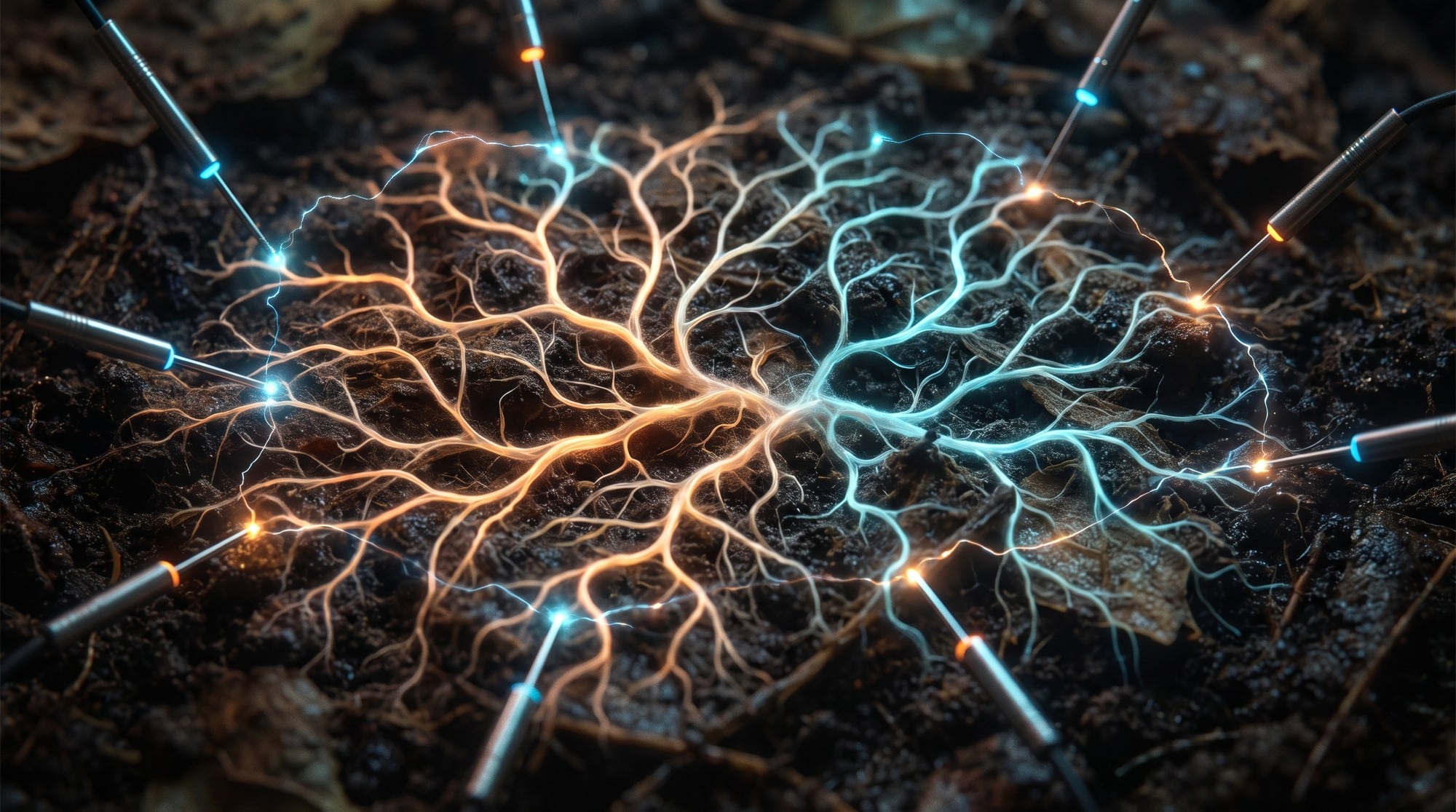
While bacteria-as-logic and neurons-as-processors are grabbing headlines, a third wetware thread has been quietly maturing in the background: fungal memristors, memory devices built from the thread-like networks, or mycelium, that fungi grow underground.
A 2025 study from The Ohio State University, published in PLoS One, trained shiitake (Lentinula edodes) mycelium to function as organic memristors. Memristors are passive circuit elements whose resistance depends on their history of applied voltage, which makes them useful as memory cells and as building blocks for brain-inspired “neuromorphic” computing. The Ohio State team showed that fungal memristors can be grown, trained, and preserved through dehydration and can switch between electrical states at frequencies up to 5.85 kHz with about 90% accuracy. Notably, shiitake mycelium has demonstrated radiation resistance, suggesting potential aerospace applications where conventional electronics would fail.
This is a different point on the wetware spectrum. Bacterial transistors are slow but composable; neurons are fast but fragile; mycelium sits in between, capable of analogue memory behaviour at speeds that start to overlap with low-end silicon memristors. The work builds on a longer arc of fungal-electronics research that has produced biodegradable circuit substrates, self-healing thermal sensors, and reservoir-computing chips from mushroom-derived material.
What makes mycelium attractive as a substrate is not just its electrical behavior but also its life cycle. Mycelium can be grown at room temperature, shaped into arbitrary forms, and composted at end-of-life, sidestepping much of the energy and waste associated with chip fabrication. The trade-off is reproducibility: biological variation between samples must be calibrated out before mycelium-based devices can scale.
How Wetware Stacks Up Against Silicon and AI
The honest answer to “How does WETWARE compare?” is that it is not competing with the H100 in your data center. It is competing with silicon in specific niches where silicon is structurally disadvantaged.
| Property | Silicon | Engineered Bacteria | Human Neurons | Fungal Mycelium |
|---|---|---|---|---|
| Clock speed | ~GHz | ~hours per operation | ~milliseconds per spike | Up to ~kHz switching |
| Power per useful operation | High | Very low (metabolic) | ~30 W per CL1 unit (200K neurons) | Low |
| Self-repair | No | Yes (cell division) | Limited (cultures need replacement) | Yes (growth) |
| Sensing | Requires external sensors | Native chemical sensing | Electrical only | Native chemical/thermal |
| End-of-life | E-waste | Compostable | Biological waste | Compostable |
| Best fit today | General compute | In-plant decision logic | Low-power AI inference, sparse-data tasks | Analog memory, neuromorphic research |
The “wetware AI” framing that has emerged in 2026 is specifically about AI workloads that traditional GPUs handle poorly: tasks with little training data, conditions that change in real time, and decisions that benefit from analogue rather than digital precision. Cortical Labs has been explicit that its biological data center is positioned to complement AI where data is sparse, not replace GPU clusters.
The other structural advantage is chemical integration. A bacterial transistor does not need a separate sensor to detect a pesticide in soil; its molecular logic already speaks the language of the environment. That is the bet MIT is making for agricultural deployment, and it is a category of capability silicon has no equivalent for.

Real-World Applications and Hard Limits
For all the momentum, every wetware effort in 2026 shares a short list of hard constraints.
Speed. The MIT bacterial circuits take about eight hours per calculation. The Singapore CL1s operate at neural timescales (milliseconds per spike) but require substantial silicon hardware to read out and interpret activity. Fungal memristors switch at kilohertz rates, far below silicon. None of this matters for the intended use cases, but it forecloses any direct competition with general-purpose CPUs.
Reproducibility. Living systems drift. Cultures must be fed, refreshed, and calibrated. Cortical Labs replaces its neurons roughly every six months. Bacterial colonies must be grown fresh. Mycelium devices vary from sample to sample. Engineering around this is the active research problem, not a solved background.
Scale and supply chain. Scaling biological computing requires biology supply chains: cell-culture facilities, sterile growth media, gas mixtures, and trained technicians. That is part of why the Cortical Labs/Day One partnership in Singapore matters: it is the first attempt to integrate wetware into conventional data center operations.
Ethics and regulation. Bacterial circuits raise fewer concerns than human-neuron systems, but the use of human-derived cells at scale is already drawing regulatory attention, particularly around consent, biosafety, and what counts as a “device” versus an “organism.”
Where the technology is closest to deployment is also where it is least controversial: agricultural sensing, environmental monitoring, and low-power edge inference. These are the targets the MIT team, Cortical Labs, and the Ohio State group all name in their public statements.
The Road Ahead for Biological Computing
The 2026 milestones are best read as a synchronisation event rather than a coincidence. Three independent labs on three continents, working on three different biological substrates, all produced headline results within the same summer. That synchronization suggests a field approaching an inflection point where the questions shift from can biology compute?” to “What should biology compute?”
Three near-term developments are worth watching:
- Hybrid wetware-silicon stacks. Expect more architectures like Cortical Labs’ CL1, where a biological component handles a specific class of decision (low-data inference, chemical sensing, or analogue memory) while silicon handles everything else. The biological data center in Singapore is the template.
- Field-deployed microbial circuits. The MIT team’s agricultural pitch (root-coating bacteria that detect drought or pests and respond with a fungicide) is the first credible mass-deployment scenario for engineered living logic. Greenhouse pilots are plausible within two to three years.
- Mycelium-based memory devices. Fungal memristors are the closest wetware substrate to a commercial non-volatile memory product, but reproducibility and packaging are unsolved. If a fabrication method emerges that grows and encapsulates mycelium memory at scale, it would unlock biodegradable, low-power neuromorphic chips.
None of this means your next computer will run on bacteria. What it does mean is that the architecture of computing now has a third branch on the tree, alongside silicon and quantum, that is finally producing results you can point to and measure. Wetware is no longer a thought experiment. It is an emerging engineering discipline, and 2026 is the year it started behaving like one.
For broader context on how digital simulation is starting to mirror biological systems at scale, see the recent work on digital cells that simulate the whole cell cycle in four dimensions.
Frequently Asked Questions
What Is Wetware in Computing?
Wetware refers to biological material, primarily neurons, brain cells, engineered microbes, and similar living systems, used as computational hardware. Unlike silicon chips or quantum processors, wetware processes information through chemistry, electrical signaling, or both, using the same biological machinery that living cells use to communicate and respond to their environment. The term is borrowed from “hardware” and “software” and refers to the organic, self-organizing layer that sits beneath both.
Is There a Computer Built Using Brain Cells?
Yes. Cortical Labs, an Australian biotech firm, sells the CL1, a biological computing unit containing roughly 200,000 lab-grown human neurons on a silicon chip fitted with micro-electrodes. In August 2026, the first independently operated biological data center, using 20 CL1 units and at least 4 million neurons, went live at the National University of Singapore in partnership with data center operator DayOne.
How Much Does a Human Brain Computer Cost?
Pricing for commercial biological computing hardware is not yet widely published, since the technology is in early commercialization. Cortical Labs has sold CL1 units to research institutions and is now supplying DayOne’s Singapore facility at scale. Analysts expect wetware compute pricing to fall between conventional GPU cloud-rental rates and the cost of running a small cell-culture lab, which is non-trivial. The economic case rests on power efficiency: a CL1 draws roughly 30 watts, compared with around 700 watts for a high-end Nvidia H100 GPU under full load.
How Close Are We to Uploading Our Minds?
Mind uploading remains speculative. Current wetware systems interface with small populations of neurons (hundreds of thousands per CL1 unit) to perform specific computational tasks; they do not replicate the 86 billion-neuron connectivity of a human brain. Researchers in biological computing treat the technology as a way to build new kinds of processors, not as a path to whole-brain emulation.
What Are Examples of Wetware Computing?
Three examples illustrate the field in 2026: MIT’s living bacterial transistors, which perform Boolean logic and two-bit addition on agar plates using engineered Pantoea agglomerans; Cortical Labs’ CL1, which uses human neurons on silicon electrodes to do low-power AI inference; and Ohio State University’s fungal memristors, which use shiitake mycelium as analogue memory devices that switch at kilohertz speeds.
What Companies Are Working on Wetware Computing?
The most prominent commercial players in 2026 are Cortical Labs (Australia), which builds neuron-based processors and partners with Singapore’s DayOne for data center deployment; Pivot Bio, which applies engineered microbes to sustainable agriculture; and several academic groups commercializing their work through startups, including the Ohio State team developing fungal memristors. Larger semiconductor and biotech firms are watching the space closely but have not yet announced commercial wetware products.
Is Wetware Computing Related to Organoid Intelligence?
Yes. Organoid intelligence is the broader research umbrella for any system that uses brain-cell cultures or brain-like biological structures as computational substrates. Wetware computing is the engineering discipline that takes organoid-intelligence research and turns it into deployable hardware. Cortical Labs, for example, describes its work as bridging organoid intelligence and commercial computing.


