
CSIRO-affiliated company Future Feed won a $1 million international prize for its development of a seaweed feed product that reduces the methane cattle burp and fart into the atmosphere. The company worked for a decade to find and refine the emission-busting seaweed. It plans to use the Food Planet Prize winnings to help First Nations communities in Australia generate income by cultivating and selling the product.
Cattle are cows raised as livestock for meat, dairy, and hides (for leather). There’s a lot of them globally, so the quantity of emissions they generate is significant. One cow alone produces as much as one car. About 15% of global greenhouse gas emissions are methane from livestock.
Methane remains in the atmosphere for a far shorter period than carbon dioxide (about nine years), but it’s several times more potent. Its global warming capability is 86 times higher than CO2 when averaged over two decades and 28 times higher over a century.

While research reveals we have to eat less meat to reduce our emissions footprint, for most, it’s easier said than done. That’s why researchers worldwide are working to find alternative solutions. A Pennsylvania State University team also developed a dietary supplement for cows, but it only cuts their methane emissions by a quarter. Meanwhile, another group of scientists came up with a method to gene-edit cows to reduce their methane burps and farts. They even won the Nobel Prize for it, but gene-editing is controversial.
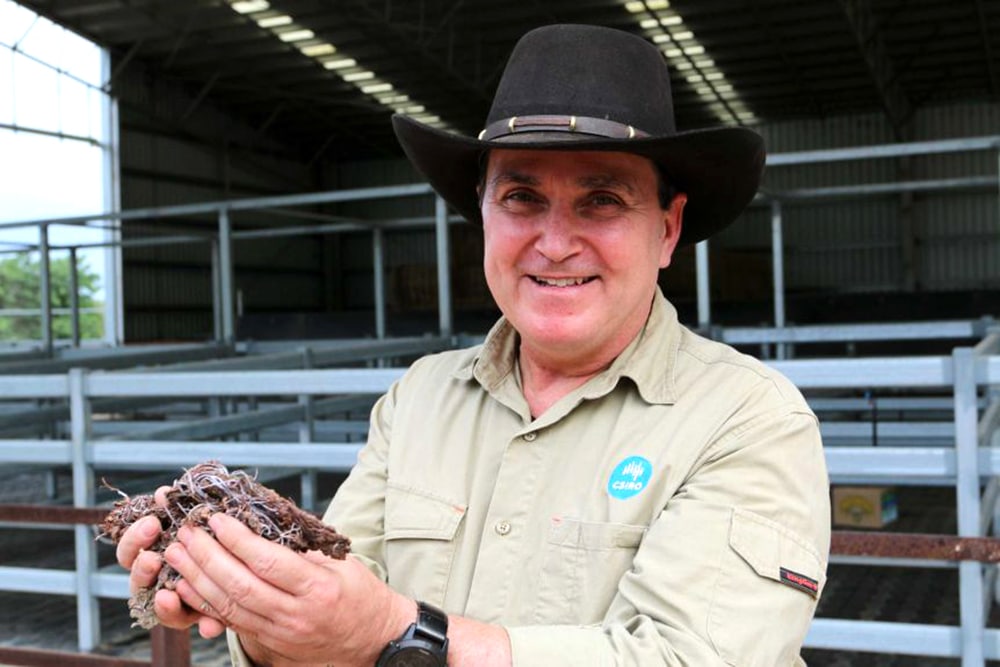
Michael Battaglia, CSIRO scientist and Future Feed director, said that their product – which contains Australian ‘super seaweed’ Asparagopsis – virtually eliminated methane from the animals’ bodily emissions when added to cattle feed. Meaning, if commercialized, its potential to reduce the global greenhouse gas footprint is massive.
Dr. Battaglia said:
We know that just a handful [of the product] per animal per day, or 0.2% of their diet, can virtually eliminate 99.9% of methane.
There’s an ingredient in the seaweed that stops the last little process on the way of producing methane from the little microbes that produce it. Instead of going into producing methane, other microbes come along and then produce the good things, the fatty acids and things, that the animal goes on to produce milk or meat with.
We think we can tackle the dairy and the feedlot part of that pretty simply; which may be five megatons in Australia and globally 500 megatons of emissions. That’s equivalent to taking 100 million cars off the road. But in the long run, if we can start to think about ways to deliver this into grass-fed sectors, the impact is 10 to 100 times more than that.
Fortunately, the product is set to be sold on the Australian market, and the company is working with several industry growers to grow the seaweed at scale.
Dr. Battaglia said:
We’re doing the tests, figuring out the quality assurance processes. We’re hoping to start to see the first low-carbon products in the market by the end of this year, or early next year, and really start to give consumers that option for the milk and the meat that they like that has a reduced environmental footprint.
We have agreements between the Indigenous Land and Sea Corporation involving the Narungga Nation Aboriginal peoples, and a seaweed-growing company CH4. The intent [is] to develop commercial-scale Asparagopsis cultivation and processing to generate maximum benefit for the Narungga people.
Future Feed also plans to expand the initiative globally with the prize’s extra funding.
Dr. Battaglia said:
We plan to set up a commercialization fund for First Nations peoples around the world to be engaged in the production of the seaweed so they can get livelihoods as well as provide the ongoing seaweed supplies.
The Food Planet Prize judges acknowledged the product’s positive social impacts when selecting it as the winner. They chose Future Feed’s creation from a pool of over 600 entries.
And the product’s benefits stretch beyond methane emission and job opportunities for natives.
Dr. Battaglia said:
The technology could also have indirect benefits, including filtering detrimental nutrients in ocean water and creating alternative incomes in developing countries where fisheries are in decline.
This great idea comes as nations worldwide are under mounting pressure to lower agricultural emissions and prepare for the COP 26 Glasgow Climate Change Conference.


