
Eye-tracking technology monitors where you’re looking and how your pupils and irises are reacting. An HD video camera is enough to collect the data. The information can be used for various purposes, so eye tracking is starting to pop up all over the place. According to a research review from last year, when the information is crunched through advanced data analysis systems, it can divulge an extraordinary amount of information about you.
The paper’s abstract says:
Our analysis of the literature shows that eye-tracking data may implicitly contain information about a user’s biometric identity, gender, age, ethnicity, body weight, personality traits, drug consumption habits, emotional state, skills and abilities, fears, interests, and sexual preferences.
Certain eye-tracking measures may even reveal specific cognitive processes and can be used to diagnose various physical and mental health conditions.
The analyzed data is used to study a myriad of psychiatric and neurological conditions, such as autism spectrum disorder (ASD), attention deficit hyperactivity disorder (ADHD), obsessive-compulsive disorder (OCD), Parkinson’s, Alzheimer’s, and Schizophrenia, among others.
Through pattern recognition, researchers have learned how to glean a tremendous amount of information about someone through their eyes. Today, the saying that the eyes are “the windows of the soul” is more accurate than ever before.
What eye-tracking technology measures can do:
- Look to see which way your eyes are pointing to infer what you’re looking at.
- Track the length of fixations and the rapid eye motions between them – things like smooth pursuit movements and the acceleration speed and maximum speed of your eye movements.
- Analyze your eyelids, focusing on how far open your eyes are, how long your eyes stay shut when you blink and how often you’re blinking.
- Look to see how dry or watery your eyes are through reflections and if there’s any redness.
- Measure the dilation of your pupils – an indication of drug use, fear, sexual interest or arousal, and certain types of brain damage.
- Note iris texture, eye color, eye shape, skin color, eyebrow movements, facial expressions, and the depth of the wrinkles surrounding your eyes.
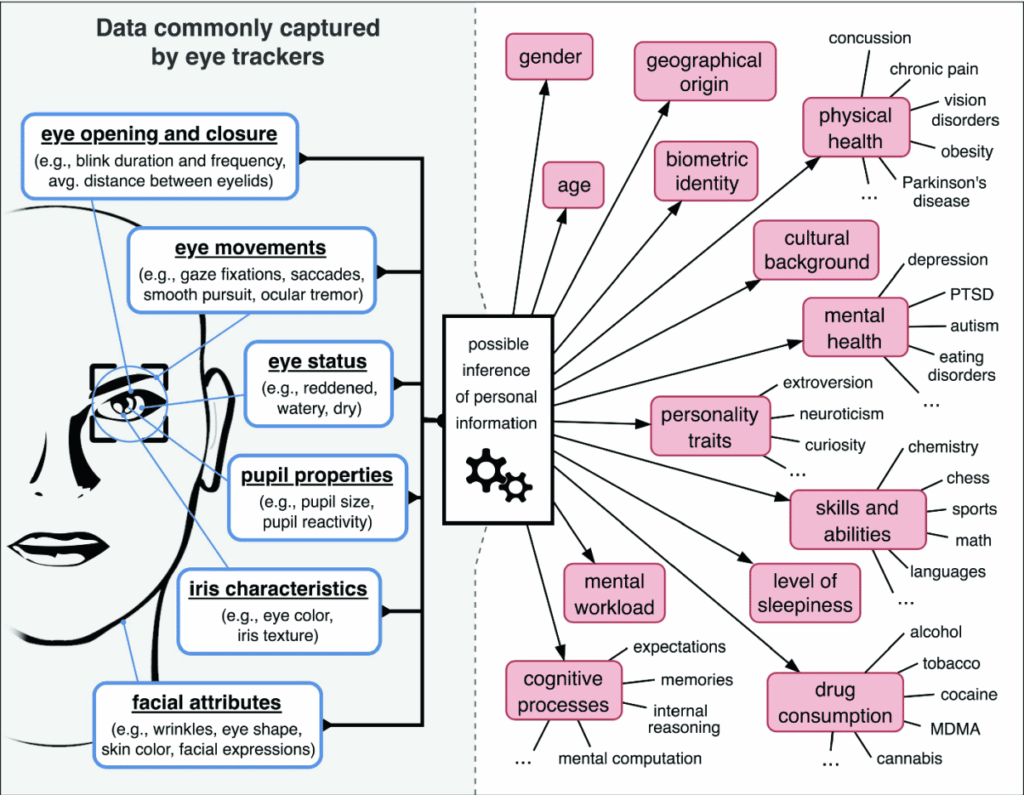
Using these findings, biometric identity can be established. For example, the patterns and colors of your irises can be used almost like a fingerprint. And so can your pupil reactivity, the trajectories your eyes take when following a moving object, and your gaze velocity – mechanical and brain function differences make these things unique to you.
Your level of thinking activity can be gauged too. For example, pupil dilation can be used to measure mental effort and degree of task difficulty. And blink rate is linked to dopamine level, signifying goal-directed behavior and learning.
These sorts of things can be seen with the naked eye (by a human viewer), which is why you can tell when someone’s thinking (like accessing memories or getting imaginative) by analyzing their eye movements.
However, harnessing more detailed information involve the world of deep learning and AI. Pattern-finding machine learning algorithms can even predict our personalities, specific emotions and intensity, specific mating preferences, phobias, and interests or areas of expertise just by analyzing how our eyes move in everyday life. Researchers have even demonstrated that they can distinguish between rational, emotional reactions and instinctive ones.
The list goes on.
Naturally, since any device that can watch your eyes can learn a disturbing amount about you, many are concerned about the practice’s privacy issues. But many companies have access to such technology and are already using it to gather information, mainly for marketing or matters of security.
The study’s authors write:
It may reasonably be assumed that some of the companies with access to eye-tracking data from consumer devices (e.g., device manufacturers, ecosystem providers) possess larger sets of training data, more technical expertise, and more financial resources than the researchers cited in this paper. Facebook, for example, a pioneer in virtual reality and eye-tracking technology, is also one of the wealthiest and most profitable companies in the world with a multi-billion-dollar budget for research and development and a user base of over 2.3 billion people.
Since it is unlikely that companies will voluntarily refrain from using or selling personal information that can be extracted from already collected data, there should be strong regulatory incentives and controls.
Governments should consider strong regulatory incentives and controls moving forward since it’s unlikely that companies will voluntarily refrain from selling or using personal information extractable from already collected data.


