
The local AI mini PC market has split into two clear tiers in 2026. At the top, the NVIDIA DGX Spark ($4,699) and AMD Strix Halo systems (roughly $2,000 and up) put 128GB of unified memory on your desk and run models up to 200 billion parameters. Below them sits a quieter, cheaper tier that gets far less attention: Intel’s Core Ultra mini PCs, which sell for roughly $350 to $1,500 and pair a modest neural processing unit (NPU) with integrated Arc graphics.
This guide explains what Intel is actually offering in the AI mini PC space, what the hardware costs, and how it stacks up against the DGX Spark and Strix Halo. The short version: Intel does not compete in the 128GB unified-memory range at all. It competes as the budget introduction to local AI, topping out around 64GB of usable RAM, and that is precisely where it makes sense.
What Is an Intel AI Mini PC?
An AI mini PC is a small-form-factor desktop built around a processor that has a dedicated NPU for on-device AI work. Intel’s version of this is the Core Ultra family, the brand it uses for chips that combine a CPU, an integrated Arc GPU, and an NPU on a single package.
So can a mini PC run AI? Yes, but with a firm caveat that separates this class from a DGX Spark. A mini PC’s AI capability is set by two things that matter more than the NPU’s TOPS rating: how much system memory it has, and how fast that memory feeds the processor. An Intel mini PC can comfortably run small to mid-size models, roughly 7B to 32B parameters when quantized, plus the everyday Copilot+ features like background blur, live captions, and transcription. It cannot hold a 70B or 120B model the way a 128GB unified-memory machine can.
Intel frames these machines as the everyday AI PC rather than a developer workstation. HP is moving in the opposite direction, pre-installing an offline AI model for scientific research on its Z-series workstations. The official Intel AI PC overview positions them for productivity, creativity, and privacy-first local inference, not for fine-tuning frontier models. That positioning is the key to understanding everything that follows.
Intel’s NPU Generations Explained: The TOPS Numbers That Confuse Buyers
Before comparing anything, you have to untangle the single most misleading number on an Intel AI mini PC box. There are two different TOPS figures, and vendors often quote the larger one without saying so. If you want the full terminology primer, see our TOPS and NPU explainer.
The first is NPU TOPS, which measures only the dedicated neural engine. The second is platform TOPS, a combined figure that adds the CPU and GPU to the NPU. A “99 TOPS” sticker does not mean a 99 TOPS NPU. It usually means a roughly 13 TOPS NPU plus the integrated GPU and CPU. This distinction is why two otherwise similar Intel boxes can advertise wildly different numbers.
Intel has shipped four NPU generations so far, and they do not progress in a straight line:
| Generation | Codename (Series) | NPU TOPS | Combined Platform TOPS | Memory | Copilot+ PC? |
|---|---|---|---|---|---|
| 2023 | Meteor Lake (Core Ultra 100) | 11 TOPS | ~34 TOPS | DDR5 / LPDDR5X, up to 96GB | No |
| 2024 | Lunar Lake (Core Ultra 200V) | 48 TOPS | 120 TOPS | LPDDR5X on-package, 16 or 32GB | Yes |
| 2025 | Arrow Lake-H (Core Ultra 200H) | 13 TOPS | 99 TOPS | DDR5 up to 96GB, LPDDR5X up to 64GB | No |
| 2026 | Panther Lake (Core Ultra 300) | 50 TOPS | ~180 TOPS (vendor claim) | DDR5 / LPDDR5X | Yes |
The counterintuitive detail most roundups miss: Arrow Lake-H’s NPU is weaker than Lunar Lake’s. The newer Core Ultra 9 285H advertises 99 TOPS, but only 13 of those come from the NPU, while the older Core Ultra 200V line delivers 48 NPU TOPS. Intel’s own Lunar Lake documentation lists the 48 TOPS figure explicitly. The 99 TOPS figure is real, but it is a whole-platform number that leans on the Arc 140T GPU, not the NPU.
Why does this matter? Because Microsoft requires a minimum of 40 NPU TOPS for the Copilot+ PC label. Lunar Lake qualifies; Arrow Lake-H does not. If you specifically want the NPU-driven Windows AI features, a 48 TOPS Lunar Lake box is the better pick, even though an Arrow Lake-H box markets a higher combined number.

Intel AI Mini PC Hardware and Pricing in 2026
Intel does not sell a first-party consumer mini PC anymore; it sold the NUC business to ASUS in 2023. The market is now filled by third-party vendors building around Core Ultra silicon, and prices track the generation you buy.
| Model | Processor (NPU TOPS) | RAM | Typical Price | Notes |
|---|---|---|---|---|
| GMKtec K15 | Core Ultra 5 125H (11 TOPS) | 16GB DDR5 | $350 to $450 | Budget NPU entry, OCuLink for eGPU |
| ASUS NUC 14 Pro | Core Ultra 5/7 Meteor Lake (11 TOPS) | Up to 96GB DDR5 | $400 to $600 | The RAM headroom pick |
| Ninkear L20 | Core Ultra 5 226V (48 TOPS) | 16GB LPDDR5X | $500 to $700 | Lunar Lake, 97 TOPS platform |
| Chuwi AuBox X | Core Ultra 5 226V (48 TOPS) | 16GB LPDDR5X | ~750 (699 EUR) | Lunar Lake, 40 NPU TOPS |
| ASUS NUC 14 Pro AI | Core Ultra 200V Lunar Lake (48 TOPS) | 16 or 32GB | $1,000 to $1,900 | 120 TOPS system, sub-0.6L, Copilot+ |
| GEEKOM IT15 | Core Ultra 9 285H (13 TOPS NPU) | 32GB DDR5, upgradable | $1,199 to $1,399 | 99 TOPS platform, Arc 140T |
| Minisforum M2 Pro | Panther Lake (50 TOPS) | DDR5, configurable | Announced June 2026 | ~180 TOPS platform, 10GbE + 2.5GbE |
The pattern is consistent: spend under $600 and you get a Meteor Lake or Lunar Lake box with 11 to 48 NPU TOPS and 16GB to 32GB of memory. Spend $1,000 to $1,500 and you move into Arrow Lake-H territory with more RAM headroom but a weaker NPU. The ASUS NUC 14 Pro AI is the standout middle option, the first device marketed as an AI mini PC, detailed on the official ASUS NUC 14 Pro AI page.
Note what is absent from every row: 128GB of unified memory. The highest RAM figure here is 96GB of ordinary DDR5 on the NUC 14 Pro, and that is standard dual-channel system memory with far less bandwidth than a 256-bit unified pool. Intel simply does not sell the configuration that defines the DGX Spark and Strix Halo class.

Intel vs DGX Spark vs Strix Halo: Where the RAM Ceiling Sets the Limit
All three companies sell a “mini PC that does AI,” but they are solving different problems. The DGX Spark is an AI appliance with 128GB of coherent unified memory and a 200 Gbps interconnect for clustering. Strix Halo is an x86 workstation that happens to put 128GB on one chip. Intel’s Core Ultra mini PCs are conventional small desktops with an NPU added on.
| System | Memory for Models | Memory Bandwidth | Typical Price | Realistic Model Fit |
|---|---|---|---|---|
| NVIDIA DGX Spark | 128GB unified | 273 GB/s | $4,699 | Up to 200B params (FP4) |
| AMD Strix Halo (128GB) | 128GB unified | ~215 to 256 GB/s | $2,000 to $4,300 | 70B models comfortably |
| Intel Core Ultra mini PC | 16 to 96GB shared (not unified) | ~90 to 136 GB/s | $350 to $1,900 | 7B to 32B models |
The gap is not about compute; it is about memory. A 128GB unified pool can hold a 70B model at 4-bit quantization with room to spare. Intel’s dual-channel DDR5 or LPDDR5X tops out at roughly 90 to 136 GB/s of bandwidth, which is fine for small models but becomes a bottleneck the moment you try to feed a large one.
Quantization changes the math slightly in Intel’s favor. The rough rule of thumb is about 0.5GB per billion parameters at 4-bit:
- 16GB: a 7B to 8B model fits, with room for context.
- 32GB: a 14B to 20B model is comfortable.
- 64GB: a 32B model runs well, and a 70B model fits in principle but generates tokens slowly because of the bandwidth ceiling.
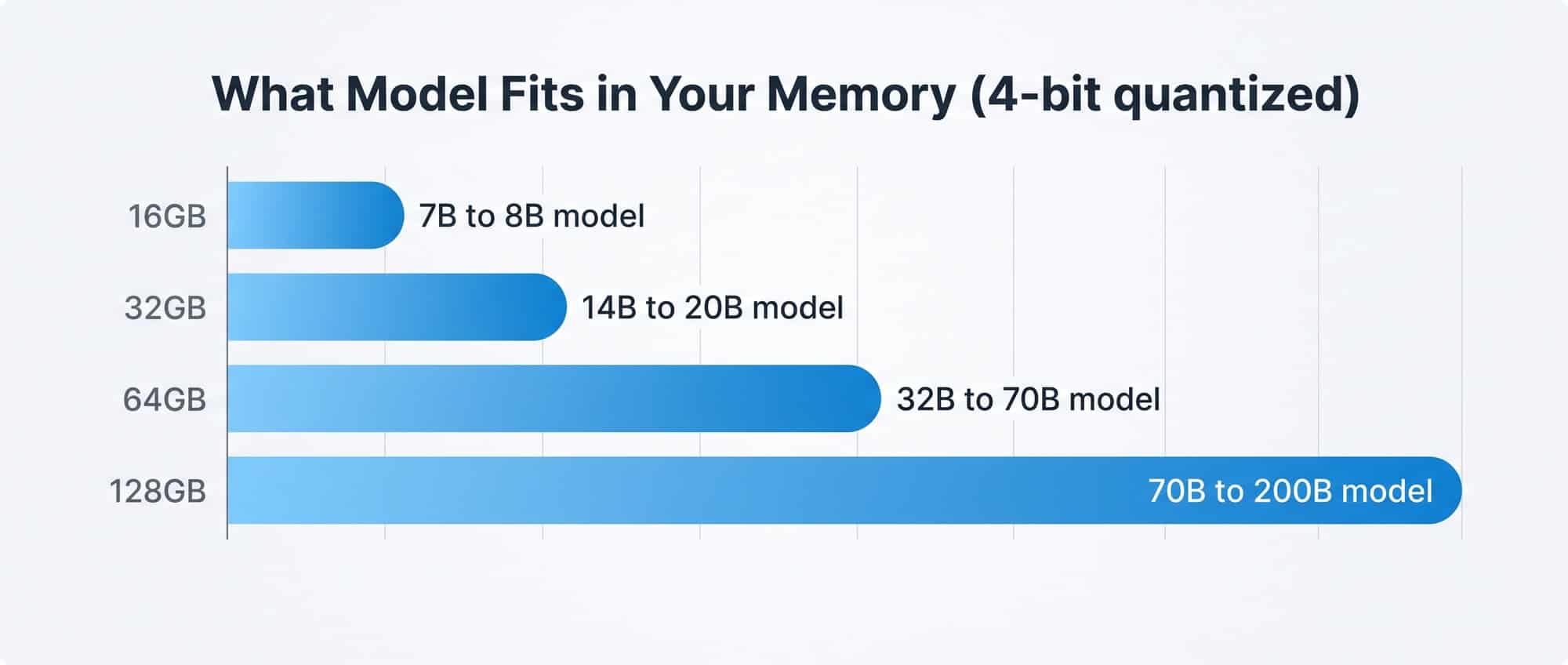
So a 64GB Intel box can, in theory, load a quantized 70B model that would not fit on a 32GB RTX 5090. But it will generate tokens far slower than the DGX Spark or Strix Halo, let alone a discrete GPU. Capacity does not equal speed, and this is where Intel’s budget pitch meets its physical limit.
The Budget Angle: Why Intel Owns the Entry Tier, and How It Compares to a GPU
Intel’s real argument in 2026 is price per usable system, especially during a GDDR7 shortage that pushed a single RTX 5090 to roughly $4,300 to $5,000 on the street. For less than a third of that, an Intel Core Ultra mini PC gives you a complete, low-power machine that handles light local AI, Copilot+ features, and small quantized models out of the box.
This is the angle that the DGX Spark and Strix Halo comparisons tend to skip: for a beginner who wants to try local inference without spending workstation money, an Intel mini PC is often the cheapest complete starting point. It draws around 7 to 12 watts at idle, runs near-silently, and costs less than the graphics card alone in a serious AI rig.
If you need more GPU muscle later, most of these boxes leave a door open. Several models ship with OCuLink or USB4, which lets you attach an external GPU. Intel’s own Arc B580, at $249 to $300 with 12GB of GDDR6 and 456 GB/s of bandwidth, is the cheapest discrete card that runs a 7B model at usable speeds, and it pairs naturally with these mini PCs as an upgrade path.
The honest trade-off, again, is bandwidth. A discrete GPU has hundreds of gigabytes per second of memory bandwidth, while an Intel mini PC’s shared memory runs at a fraction of that. For interactive small-model use, the difference is tolerable. For large models or batch inference, it is not.

Intel’s Software Stack: Catching Up, but Not CUDA
NVIDIA’s edge in local AI has never been just hardware; it is CUDA, the decade-old software ecosystem that most ML frameworks target first. AMD has been closing that gap with ROCm. Intel sits in third place, but it is moving.
Intel’s answer is a three-part stack. OpenVINO handles inference across CPU, iGPU, NPU, and Arc GPUs. IPEX-LLM, an open-source extension for PyTorch, accelerates local LLMs and integrates with the tools people already use: llama.cpp, Ollama, vLLM, HuggingFace Transformers, and LangChain, with 70-plus models optimized. Underneath both sits oneAPI, Intel’s SYCL-based compute platform with its Level Zero GPU runtime.
The IPEX-LLM GitHub repository is the best evidence that Intel is serious: it is actively maintained, supports low-bit formats like FP8, FP6, and INT4, and runs the same model through a single interface whether the backend is an iGPU, an NPU, or an Arc card.
But the gap remains real. CUDA is an “install the driver, install PyTorch, done” experience. Intel’s GPU compute path is more fragmented: the llama.cpp SYCL backend effectively requires Intel’s proprietary MKL library from the oneAPI toolkit, while the more portable Vulkan backend is easier to set up but less optimized. The NPU software ecosystem is only a few years old versus CUDA’s decade-plus, and NPU support for general LLM work trails both CUDA and ROCm. The honest summary: Intel’s software is catching up and is genuinely usable today, but it is not as well supported as NVIDIA’s CUDA or AMD’s ROCm for serious local model work.
Can You Link Intel Mini PCs Together?
The DGX Spark has a trick its rivals cannot match: a ConnectX-7 Smart NIC with up to 200 Gbps of bandwidth, which lets you link two units into a single 256GB pool for models up to 405 billion parameters.
Intel mini PCs have no equivalent. They ship with standard Ethernet: 2.5GbE is typical, a few premium boxes add 10GbE, and all of them include Wi-Fi 7 or Wi-Fi 6E. There is no high-speed interconnect for joining two machines into one coherent memory pool, so you cannot shard a single huge model across a pair of Intel boxes the way you can with a Spark.
What you can do is cluster several of them over commodity networking. That works for multi-agent setups, distributed inference where each node runs its own smaller model, or a homelab that needs many cheap nodes rather than one fast fabric. It is a different use case than the Spark’s two-node 405B trick, but it is a legitimate one for the right workload.

Intel Mini PCs for Gaming: A Brief Note
Intel’s integrated Arc graphics make these boxes competent light gaming machines, though this is not their purpose. The Arc 140T in the Core Ultra 9 285H delivers roughly 4.8 teraFLOPS and lands around a GTX 1650 class card: about 45 frames per second at 1080p high settings, dropping to the high 20s at 1080p ultra. The Lunar Lake Arc 130V is a step below that.
That is enough for esports titles, older AAA games at medium settings, and everyday media. It is not a serious gaming rig, and it trails the Radeon 8060S in Strix Halo by roughly half. Treat gaming as a bonus, not a reason to buy.
Best Intel Mini PC for Local AI in 2026
For local AI specifically, prioritize memory and bandwidth over the TOPS sticker. Here is a sensible decision path:
- Best budget entry: a Lunar Lake box like the Ninkear L20 or Chuwi AuBox X, which gets you 48 NPU TOPS and Copilot+ features for $500 to $750.
- Best overall Intel AI mini PC: the ASUS NUC 14 Pro AI, the first true AI mini PC, with a 120 TOPS system and a sub-0.6-liter chassis at $1,000 to $1,900.
- Best for RAM headroom: the ASUS NUC 14 Pro, which accepts up to 96GB of DDR5 if you want to stretch toward larger quantized models.
- Best performance under $1,500: the GEEKOM IT15 with the Core Ultra 9 285H, the fastest Arrow Lake-H option, though its NPU is only 13 TOPS.
- Worth watching: Panther Lake mini PCs like the Minisforum M2 Pro, which bring a 50 TOPS NPU and roughly 180 combined TOPS as the next generation.
Are Intel AI PCs Worth It? Pros, Cons, and Downsides
The verdict depends entirely on what you are trying to run. As an entry point to local AI, an Intel mini PC is often worth it. As a DGX Spark or Strix Halo replacement, it is not.
Pros
- Low cost: complete systems start around $350, less than a mid-range graphics card alone.
- Small and quiet: a sub-1-liter chassis that runs near-silently and draws only 7 to 12 watts at idle.
- Platform flexibility: full Windows and Linux support, with upgradeable DDR5 slots on some models.
- Copilot+ on Lunar Lake: the 48 TOPS NPU unlocks Windows Studio Effects, live captions, and on-device transcription.
- Enough for small models: a 14B to 20B quantized model runs comfortably on 32GB to 64GB.
Cons
- No 128GB unified memory: Intel does not offer the configuration that defines the DGX Spark and Strix Halo class.
- Low memory bandwidth: roughly 90 to 136 GB/s caps large-model speed well below discrete GPUs.
- Immature NPU software: the NPU ecosystem is only a few years old and trails CUDA and ROCm.
- Soldered RAM on Lunar Lake: 16GB or 32GB fixed at purchase, with no upgrade path.
- No high-speed clustering: standard Ethernet only, with no ConnectX-7-class interconnect.
The most common complaint from buyers is the memory ceiling. A mini PC that cannot be upgraded past 32GB of soldered RAM ages poorly for AI, which is why the DDR5 models with upgradeable slots, like the NUC 14 Pro and GEEKOM IT15, tend to hold value better for this use case.
One cross-shop worth noting: at the same $500 to $1,000 price point, Apple’s Mac Mini M4 offers 16GB to 32GB of unified memory and a 38 TOPS Neural Engine. The Mac has the unified-memory advantage, while Intel counters with x86 flexibility, upgradeable RAM on some models, and broader compatibility with the Windows and Linux AI tooling most local-LLM users already run.
Frequently Asked Questions
Can a mini PC run AI?
Yes. A mini PC with an NPU can run small to mid-size models (roughly 7B to 32B parameters when quantized) and everyday Copilot+ features locally. It cannot run the 70B-plus models that 128GB unified-memory machines handle.
What is the best mini PC for AI training?
For serious training and fine-tuning, none of the Intel mini PCs are ideal; a DGX Spark or a discrete NVIDIA GPU is the stronger tool. For light inference and experimentation, the ASUS NUC 14 Pro AI and GEEKOM IT15 are the best Intel options.
Are AI PCs worth it?
They are worth it if you value privacy, low latency, or zero per-token cloud cost, and if your workloads fit within 16GB to 64GB of memory. If you need frontier-model performance, a cloud API or a larger unified-memory system is the better investment.
What are the downsides of a mini PC?
The main downsides for AI are limited memory, low memory bandwidth, no high-speed multi-node clustering, and soldered RAM on some models. For general desktop use, the trade-offs are fewer upgrade options and constrained graphics.
Conclusion
Intel has found a clear niche in the local AI mini PC market, and it is not the one the headlines cover. While the DGX Spark owns raw capacity and Strix Halo owns value at 128GB, Intel owns the entry tier: complete, low-power systems for $350 to $1,500 that handle small quantized models, Copilot+ features, and first experiments with local inference. Above all of these now sits a 192GB tier led by AMD’s Ryzen AI Max+ PRO 495, covered in our guide to the 192GB AI mini PCs.
The limitation is honest and structural. No Intel mini PC offers the 128GB of unified memory that defines the class above it, and its software, while improving quickly, still trails CUDA and ROCm. The enterprise ceiling above this tier is now NVIDIA’s DGX Station, a 748GB GB300 system aimed at trillion-parameter local models. For the right buyer, that does not matter. A cheap, quiet box that runs a 14B model locally and costs less than a mid-range graphics card is a genuinely useful thing, and it is the role Intel is built to fill. For the complete picture across GPUs, Macs, and unified-memory desktops, see our local AI hardware ladder.


