
The new flagship of the category is about the size of a thick hardback book lying flat, roughly 22 by 21 centimeters and three inches tall, yet it holds more memory than most full-size gaming desktops. At IFA 2026 in Berlin, Minisforum unveiled a compact workstation with 192GB of unified memory built around AMD’s new Ryzen AI Max+ PRO 495 chip, and it can reportedly run a 284-billion-parameter language model on a desk without touching the cloud.
It is not alone. Acemagic, CHUWI, GMKTec and Framework all have 192GB machines announced or previewed, though firm prices and dates are scarce and some of what circulates comes from trade-show booth quotes rather than official listings.
Quoted prices cluster somewhere between $7,000 and $8,000 for a fully loaded unit, though none of these are final list prices yet, and that is a remarkable number for a computer you could still carry in a backpack.
Here is what these AI mini PCs actually contain, who is selling them, whether you can genuinely buy one today, which large language models fit inside them, and how fast those models will run once they do.
What Actually Changed With Gorgon Halo
The chip at the center of all of this is the Ryzen AI Max+ PRO 495, which AMD released in May 2026 under the codename Gorgon Halo. It replaces the Ryzen AI Max+ 395, the Strix Halo processor that powered the first wave of 128GB mini AI supercomputers.
The honest summary is that AMD changed two things and left the rest alone.
| Specification | Ryzen AI Max+ 395 | Ryzen AI Max+ PRO 495 |
|---|---|---|
| CPU cores | 16 Zen 5 / 32 threads | 16 Zen 5 / 32 threads |
| Boost clock | 5.1 GHz | 5.2 GHz |
| Integrated graphics | Radeon 8060S, 40 RDNA 3.5 CUs | Radeon 8065S, 40 RDNA 3.5 CUs at 3.0 GHz |
| NPU | Up to 50 TOPS | Up to 55 TOPS |
| Total platform AI | Up to 126 TOPS | Up to 131 TOPS |
| Maximum memory | 128GB LPDDR5X-8000 | 192GB LPDDR5X-8533 |
| Memory interface | 256-bit | 256-bit |
| Graphics memory carveout | Up to 96GB | Up to 160GB |
The CPU is effectively unchanged, with leaked benchmark results suggesting a gain of around 5%. The GPU is the same 40-compute-unit RDNA 3.5 design with a slightly faster clock. The real story is memory: 50% more capacity, on the same 256-bit bus, at a faster speed.
Because the memory is unified, AMD lets firmware hand up to 160GB of it to the graphics side. That leaves roughly 32GB for the operating system, model loaders and everything else running in the background. In practice the useful ceiling for a single model is around 160GB, not 192GB, which matters when you read the marketing claims later in this article.
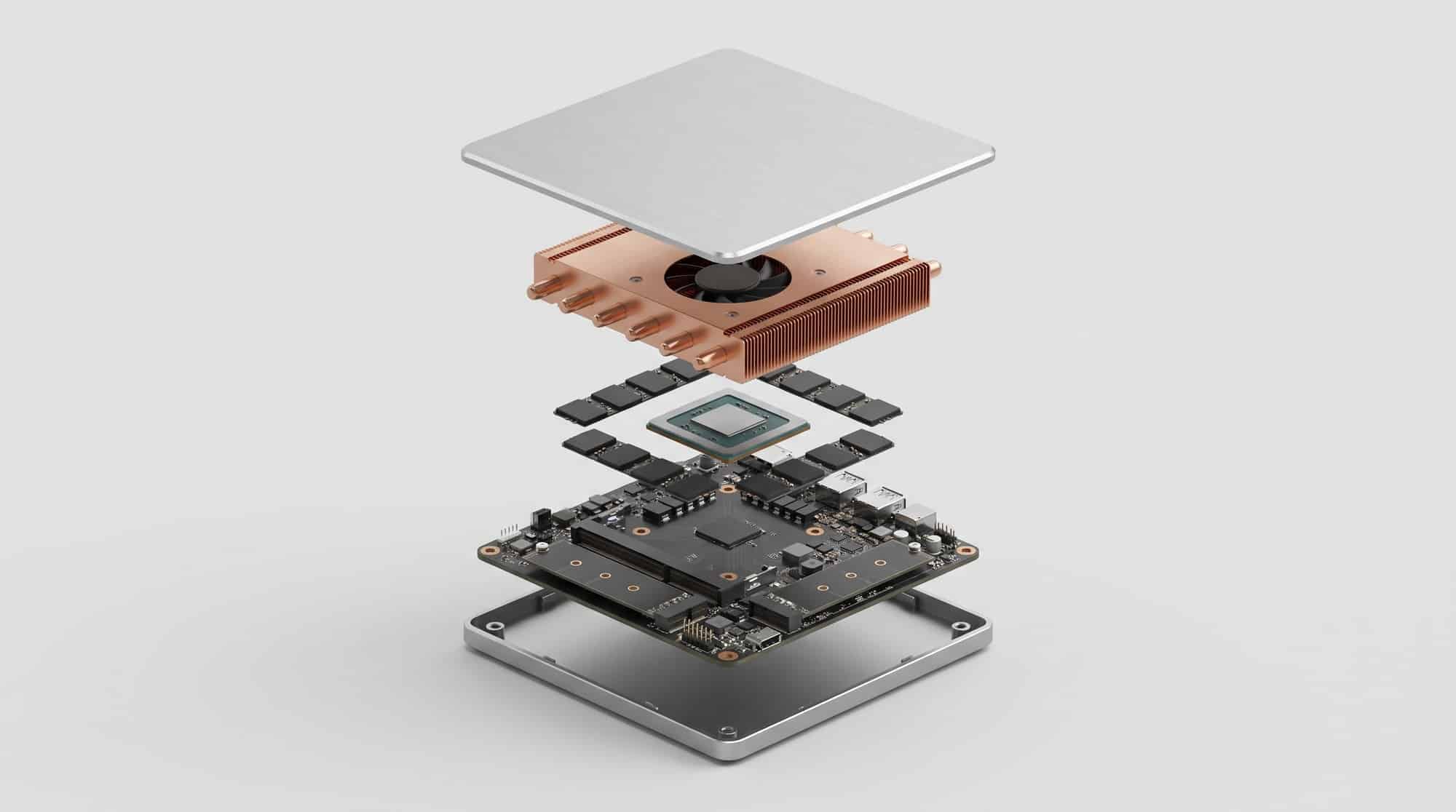
One consequence worth flagging early: this is LPDDR5X, which is soldered to the board. You cannot start with 64GB and upgrade next year. The capacity you pay for on the day you order is the capacity the machine will have forever.
The 192GB Mini PCs You Can (Almost) Buy
Six distinct products are now in the world, and they are not all at the same stage of existence. The table below separates the ones you can order from the ones you can only read about.
| Machine | Memory | Price | Status |
|---|---|---|---|
| Minisforum MS-S1 Max-P495 | 192GB | Not final, about €7,000 (roughly $8100) | Store listing live, sales expected this month |
| Acemagic F9A Pro495 | 192GB | No official price; around €8,000 quoted at IFA booth | Teaser pages live, email notify only; September 10 pre-sales cover the 128GB 395 version |
| GMKTec 192GB model | 192GB | Not announced | Shown at IFA |
| CHUWI UniBox AI495 Pro | 192GB | Not announced | Announced |
| Framework Desktop 192GB | 192GB | Not announced | Previewed at AMD Advancing AI |
| AMD Ryzen AI Halo 192GB | 192GB | Not announced | Listed as coming soon |
The Minisforum MS-S1 Max-P495 is the best documented machine of the group, so it is the easiest to describe in detail. At 222.1 × 206.3 × 77.1mm and 2.8kg, its 3.5-liter chassis is closer to a small form-factor desktop than a bare mini PC, and it houses a 320W power supply rather than an external brick. That space buys connectivity: dual 10GbE ports, two USB4 v2 ports running at 80Gbps, two standard USB4 ports, two M.2 slots supporting up to 16TB of storage in RAID, and a full-length PCIe 4.0 slot for an expansion card. Cooling uses six heatpipes with phase-change material and twin fans spinning up to 3,600 RPM, with selectable power modes of 60W, 95W and 120W sustained.
Here is the important caveat: there is one chip in every one of these boxes. The same Ryzen AI Max+ PRO 495, the same 40-compute-unit graphics, the same soldered 192GB of LPDDR5X. Testing of the previous 128GB generation found only around a 5% speed difference between vendors on identical models, attributable to cooling and firmware rather than hardware. Expect the same here. What varies between brands is ports, networking, chassis size and power arrangement, not AI performance, so buy on price, availability and connectivity. Treat any vendor’s speed figures as marketing until independent reviewers confirm them, since no third-party benchmarks exist yet for any of these machines.
On those secondary criteria the field is closer than it looks. Acemagic’s F9A Pro495 is the smallest of the set at 158.5 × 158.5 × 81.5mm, roughly two liters, trading the Minisforum’s pair of 10GbE ports for dual 2.5GbE and swapping the internal PCIe slot for an OCuLink connector. CHUWI’s UniBox AI495 Pro sits in the middle at 2.9 liters on a 240W external adapter, matching the Minisforum with dual 10GbE and an OCuLink port while offering three M.2 slots and a full-size SD card reader, though its listed configurations top out at 2TB. Framework’s version is the largest at 4.5 liters, with repairability and mainboard upgrades as its selling point rather than port count.
For scale, all of them are bigger than NVIDIA’s DGX Spark, which manages 128GB in 1.1 liters. The new machines run two to four times that volume because they carry a 192GB soldered memory array and a cooling solution rated for 120W of sustained load.
Are They Actually In Stock?
This is the question most coverage skips, so it deserves a direct answer: almost none of them are.
Here is where each machine stands as of publication:
- Minisforum MS-S1 Max-P495: closest to a real purchase, with the official store listing live behind a masked four-digit price, a limited-stock notice, UK product pages already published, and sales expected to begin this month.
- Acemagic F9A Pro495: the 192GB version exists only as teaser product pages with an email notification signup. Acemagic staff at IFA reportedly quoted around €8,000, but that is a booth statement, not a list price. The September 10 pre-sale date circulating in coverage applies to the weaker 128GB 395 version, listed at $4,999 with ordering not yet active.
- Framework Desktop: previewed publicly at AMD’s Advancing AI event with no price and no date, and the current 128GB Framework Desktop illustrates how far pricing has already moved before the new model even ships.
- CHUWI UniBox AI495 Pro: full specifications published, with pricing and release date both deferred to a later announcement.
- GMKTec: hardware shown on the IFA floor with nothing available to order.
- AMD Ryzen AI Halo 192GB: still listed as coming soon despite an announced third-quarter target that expires at the end of this month, leaving it the least certain of the group.
There is also no independent benchmark data on any of these machines. Every performance figure quoted so far comes from the vendor that sold you the concept.
What Size LLMs Fit in 192GB
Capacity is the reason this hardware exists, so it is worth doing the arithmetic rather than repeating marketing claims.
A model’s weights occupy memory proportional to parameter count and precision. At 4-bit quantization, the format most local users run, weights consume roughly 0.55 to 0.6 bytes per parameter once you include the overhead of a GGUF file.
| Model size | Memory at Q4 | Fits in 160GB? | Memory at Q8 |
|---|---|---|---|
| 8B | About 5GB | Yes, easily | About 9GB |
| 32B | About 19GB | Yes, easily | About 35GB |
| 70B | About 40GB | Yes, easily | About 75GB |
| 120B | About 70GB | Yes, easily | About 125GB |
| 235B | About 132GB | Yes | No |
| 284B | About 160GB | Only just | No |
| 405B | About 230GB | No, needs two nodes | No |
Notice what that last column reveals. A 128GB machine already handled 70B models comfortably at 4-bit, and could hold a 120B model as well. The genuine new territory begins around 200 billion parameters, and only at aggressive quantization. Not every capable model needs that much room, though, since Bonsai 2 27B packs a 27-billion-parameter ternary model into just 5.9 GB.
Context length eats the remaining headroom. Key-value cache for a long conversation can add tens of gigabytes on top of weights, which is why AMD’s headline claim of “300 billion plus parameters at 4-bit quantization” describes a full model with minimal room to think rather than a 300B model running a useful conversation. Minisforum’s own published figure of a 131,000-token context at 122B parameters and Q8 is the more informative number, because it accounts for the cache.
How Fast Will Those Models Run?
Minisforum’s demonstrated figures for the MS-S1 Max-P495, provided by the company and not yet independently verified, are roughly 15 tokens per second on a 284-billion-parameter model at Q4, and around 27 tokens per second on a 122-billion-parameter model at Q8.
Fifteen tokens per second is readable but sluggish, sitting below the 20 to 30 tokens per second that most people consider conversational. Twenty-seven is genuinely usable. For comparison, a small 8B model on the same class of hardware produces output faster than most people can read.
The company also demoed a cluster of four units running an open model in the 671-billion-parameter class, which is frontier-scale territory and far beyond what one machine can hold. That demonstration points at rack deployment for small businesses rather than anything a hobbyist will reproduce.
The Bandwidth Problem Nobody Mentions
This is the part that determines whether these machines are worth $7,000, and it is missing from nearly every announcement.
Language model token generation is memory-bound. Each token requires the processor to read through the entire set of weights, so speed scales with memory bandwidth far more than with compute performance. TOPS figures, which dominate the marketing, mostly describe prompt processing and quantized math throughput, not how fast words appear.
Because Gorgon Halo keeps the same 256-bit interface, its theoretical bandwidth is about 273GB per second. That is a 7% increase over the 128GB Strix Halo systems it replaces.
The practical upshot is easy to state. These machines let you run dramatically bigger models at roughly the same speed as last year’s 128GB boxes. They do not let you run the same models faster.
The same arithmetic governs machines far smaller than these. Lenovo’s AI Host P7 squeezes 80 gigabytes into a 300-gram chassis drawing 30 watts, but that memory is split across two pools joined by a PCIe link, and a 122-billion-parameter model has to span both just to load.
That distinction carries an implication the marketing does not: upgrading from a Strix Halo system to a Gorgon Halo system is a capacity decision, not a performance one. If a 120-billion-parameter model already fits comfortably in 128GB, moving to 192GB will make it load identically and generate tokens at an indistinguishable rate, because the constraining factor, the width of the memory bus, is the same in both machines. The purchase only makes economic sense for workloads that previously could not fit, or that need so much accumulated context that the operating system was being crowded out of the allocation.
The 160GB graphics carveout is what changes. On a 128GB machine, allocating enough memory to the GPU left too little for the operating system, so big models spilled into system RAM or failed to load. Here the arithmetic works: 160GB for weights, 32GB for everything else. That is why 235B and 284B class models become viable at all, not because the silicon got quicker.
Apple’s Mac Studio M3 Ultra remains the speed champion among single-box units with comparable capacity, at 819GB per second, roughly three times the throughput. The base 96GB configuration starts at $3,999, so a 192GB build costs more than the base figure often quoted.
How They Compare to the DGX Spark and Strix Halo
Two machines already occupy this shelf. NVIDIA’s DGX Spark is a 128GB Grace Blackwell mini workstation, and the Strix Halo 128GB boxes proved the concept of a desktop language model.
| System | Memory | Bandwidth | Largest practical model | Approximate price |
|---|---|---|---|---|
| Gorgon Halo mini PC | 192GB | 273 GB/s | 235B to 284B at Q4 | Reported booth quotes around $7,600 to €8,000; no final MSRPs |
| NVIDIA DGX Spark | 128GB | 273 GB/s | 120B class | $3,999 to $4,699 |
| Strix Halo mini PC | 128GB | 256 GB/s | 120B class | $2,000 to $3,500 |
| Mac Studio M3 Ultra | 192GB | 819 GB/s | 120B to 235B at Q4 | From $3,999 (96GB base; 192GB costs more) |
NVIDIA’s official DGX Spark specifications and Gorgon Halo share identical theoretical bandwidth, and published benchmarks show what that means. On a 120-billion-parameter model in 4-bit format, the DGX Spark generated 38.55 tokens per second against Strix Halo’s 34.13, while a rig of three older RTX 3090 cards managed 124.03.
Where the DGX Spark wins decisively is prompt processing, at roughly 1,723 tokens per second against Strix Halo’s 339.9. NVIDIA’s TensorRT software stack and FP4 tensor cores do the work there; memory bandwidth does not. Expect Gorgon Halo to sit closer to the Strix Halo line than the NVIDIA one on that metric, since it is the same fundamental architecture with more memory.
AMD’s official Ryzen AI Halo platform page frames the 192GB tier directly against the DGX Spark, which tells you who AMD considers the actual competitor.
Two Boxes Are Better Than One
Most of these machines can be linked together, but the quality of the connection varies widely, and none of them match NVIDIA’s purpose-built clustering path. The DGX Spark ships with an onboard ConnectX-7 SmartNIC offering 200GbE over QSFP ports, and NVIDIA publishes an official clustering guide with a setup tool supporting two to four units over a single direct cable using RoCE, a low-latency protocol designed for distributed AI work.
By contrast, every AMD-based option relies on standard networking and community software, mainly the RPC backend in llama.cpp, with no RDMA and no vendor clustering tool. Within that constraint the pipes differ. Minisforum’s MS-S1 offers dual 10GbE plus USB4 v2 at 80Gbps, the fastest wired combination in this group, and CHUWI’s UniBox matches it with dual 10GbE. Acemagic’s F9A, however, carries only dual 2.5GbE, the narrowest pipe in the category. Framework’s much-discussed 50GbE demonstration used add-in network cards fitted in the PCIe slot, so that speed does not come in the box; it shows what the slot makes possible rather than what ships by default.
Clustering solves the capacity ceiling but not the bandwidth ceiling, and it adds real complexity. Community testing on the previous 128GB generation found that linking two machines roughly tripled time to first token compared with a single box, and established a blunt rule: if the model fits in one machine, adding a second makes it slower, not faster. Linked machines pool memory capacity, never memory bandwidth. Framework demonstrated two 192GB units pooling 384GB, AMD itself has shown a four-node cluster running a trillion-parameter model, and owners have run 405B and 671B class models across multi-node Strix Halo clusters at only a few tokens per second.
For a 405-billion-parameter model at Q4, two 192GB nodes are the minimum needed to hold the weights on this hardware. Minisforum’s four-unit demonstration of a 671-billion-parameter-class model sits at the far end of that approach, closer to a rack project for a small business than a weekend setup.
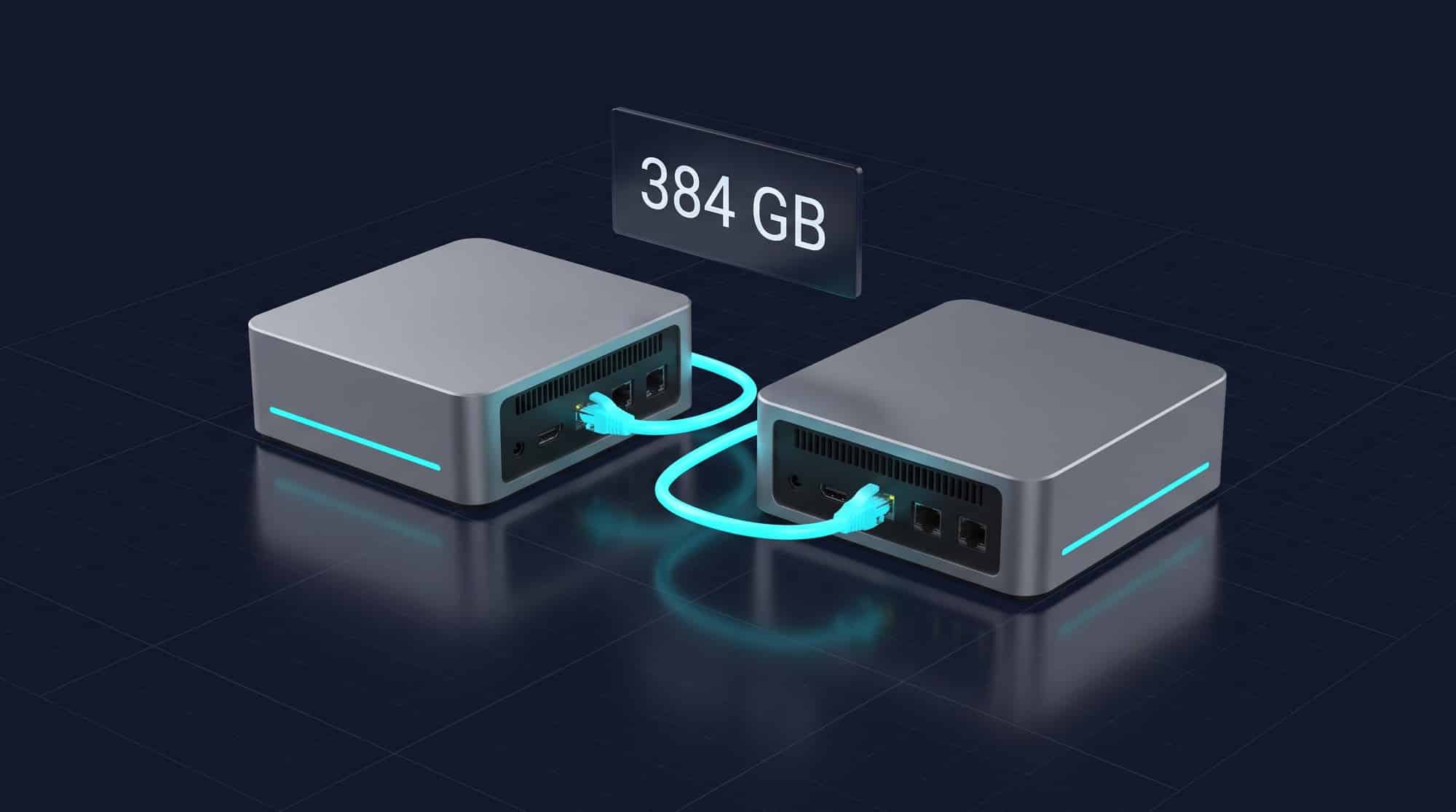
Clustering solves the capacity ceiling but not the bandwidth ceiling, and it adds real complexity. Software such as llama.cpp and vLLM supports tensor parallelism across machines, but getting a two-node inference pipeline running reliably on Linux is a weekend project, not a checkbox. Community measurements suggest latency over 10GbE hurts more than enthusiasts expect, which is presumably why Framework reached for 50GbE add-in cards for its demo.
For a 405-billion-parameter model at Q4, two nodes is the only way to fit the weights on this hardware. Minisforum’s four-unit 671B demonstration sits at the far end of that approach.
Why They Cost So Much
The price is mostly memory, and the memory is expensive because of a shortage nobody predicted cleanly.
Framework’s Desktop with the older 128GB Strix Halo chip launched in February 2025 at $1,999. The same base configuration now costs $3,449, before storage upgrades, which pushes a complete system closer to $4,000. That is roughly a 73% increase on the base unit, driven almost entirely by DRAM and SSD pricing, with no change to the silicon. AMD’s 128GB Halo reference platform sits at $3,999, and it is reasonable to expect the 192GB version to arrive well above that.
Reading that column left to right is the clearest way to understand what buyers are actually paying for. The silicon tier has barely moved in performance terms, yet the price of a given memory capacity has nearly doubled in eighteen months, and the new capacity ceiling multiplies it again. RAM, not compute, is the cost driver of the current generation of local AI hardware.
Data center demand for high-capacity memory is the cause, and AI infrastructure procurement has absorbed a large share of LPDDR and HBM supply. Mini PC makers are buying memory in a market where hyperscalers buy in far larger volumes at better prices.
That produces an uncomfortable value calculation. Entry-level 128GB Strix Halo machines that start around $2,000 to $2,600 run a 120B model at roughly the same speed as a $7,600 192GB machine runs a bigger one. You are paying several thousand dollars more for access to a weight class you otherwise cannot load on a single box.
Frequently Asked Questions
Are mini PCs good for AI?
For inference, yes, with an important caveat. Modern mini PCs using unified-memory chips can hold very large models that a consumer graphics card cannot fit at all. What they cannot do is train those models quickly, or generate tokens fast. A mini AI PC is well suited to running an existing model privately and cheaply over years; it is a poor substitute for a workstation with a high-bandwidth discrete GPU.
What is the best 192GB AI mini PC?
There is no meaningful performance winner, because every machine uses the same chip and the same memory. The previous generation showed around a 5% speed spread between brands. Choose on the criteria that actually differ: the Minisforum MS-S1 Max-P495 has the widest port selection with dual 10GbE, 80Gbps USB4 v2 and an internal PCIe slot; Framework’s version is the pick if repairability and Linux support matter; Acemagic and CHUWI compete on smaller chassis and, if their pricing holds, lower cost.
Is it worth buying an AI PC?
For most people, no. Efficient models change the arithmetic: Recursive’s Flint keeps only about 2.5 billion of its 40 billion parameters active per token, which is how an ordinary laptop reaches well over 100 tokens per second without any of this hardware. A 192GB machine makes sense when a specific model above roughly 200 billion parameters is required, when data cannot leave the building for privacy or compliance reasons, or when inference volume is high enough that API costs exceed the hardware price within a couple of years. If you want a capable local assistant, a 32GB machine running a 32B model delivers a snappier experience for a tenth of the cost, and there is a growing middle ground of cheaper AI mini PCs based on Intel silicon that reach 96GB without the five-figure price.
What is the downside of a mini PC?
Four limitations define the category here:
- Soldered memory: capacity is a permanent decision made at checkout, not an upgrade path.
- Heat and noise: a chassis this small pushing 120W sustained runs its fans hard, and there is nowhere for the sound to go.
- A restricted expansion slot: the full-length PCIe connector on most of these units is electrically x4, which caps what a connected GPU can achieve.
- Repair risk: a compact board holding an $8,000 component is expensive to fix and difficult to source parts for.
Can a 192GB mini PC run DeepSeek?
Yes, and this is the flagship use case. DeepSeek’s V4 Flash model at 284 billion parameters fits in the 160GB graphics carveout at Q4, with Minisforum quoting about 15 tokens per second. Be aware that this is Minisforum’s figure for Minisforum’s machine; it has not been independently verified, and speeds will vary by vendor, software stack and quantization format. Smaller distilled variants of open models run considerably faster on a single box.
The Bottom Line
The 192GB generation of AI mini PC is real, priced, and arriving within weeks, but it delivers capacity rather than speed. The 273GB per second memory bus is the same ceiling NVIDIA built the DGX Spark around, and no vendor is disputing that in its marketing.
What it genuinely changes is that a 200-billion-parameter model now fits on one desk, in one box, for less than the cost of a year of cloud GPU rental at serious volume. That is a meaningful threshold to cross. Whether it holds after independent reviewers get their hands on the hardware is the next question, and the first wave of real-world testing should land with the October shipments. It also feeds a wider home AI gold rush, in which enthusiasts are building their own local AI servers rather than renting cloud capacity.

