
Current VR (Virtual Reality) headsets are big and bulky because of optics. To get the light to focus from the display into your eyes, there needs to be a distance between the macro display and the lens. Some solutions have been proposed for shortening the distance to make smaller headsets, but none have gone through because they require new lenses and displays. Why spend more money just to make the headset a smaller box on your face? Companies would have to manufacture new pieces when the lenses and displays of today are cheap, simple to make, and work well, achieving a high resolution and wide field of view.
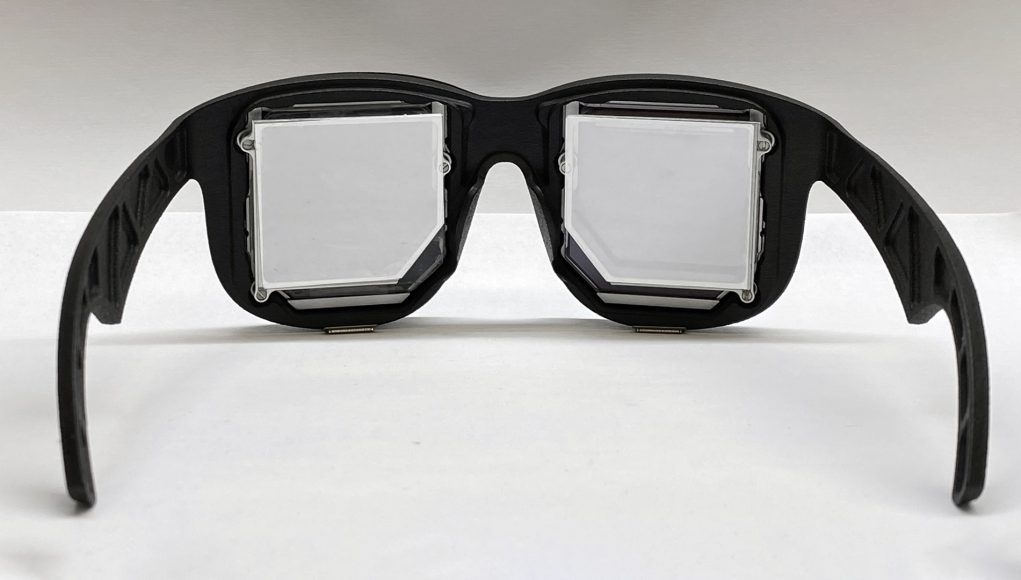
However, now Facebook’s AR/VR R&D division called Facebook Reality Labs has demonstrated an approach that not only achieves an incredibly compact device but can also support significantly wider color gamut than today’s VR displays and makes progress “toward scaling resolution to the limit of human vision.” Researchers Junren Wang and Andrew Maimone combined two features (holographic lenses and polarization-based optical ‘folding’) to create functional VR glasses 9mm thick. Their proof-of-concept headset based on folded holographic optics is the thinnest VR display demonstrated to date.
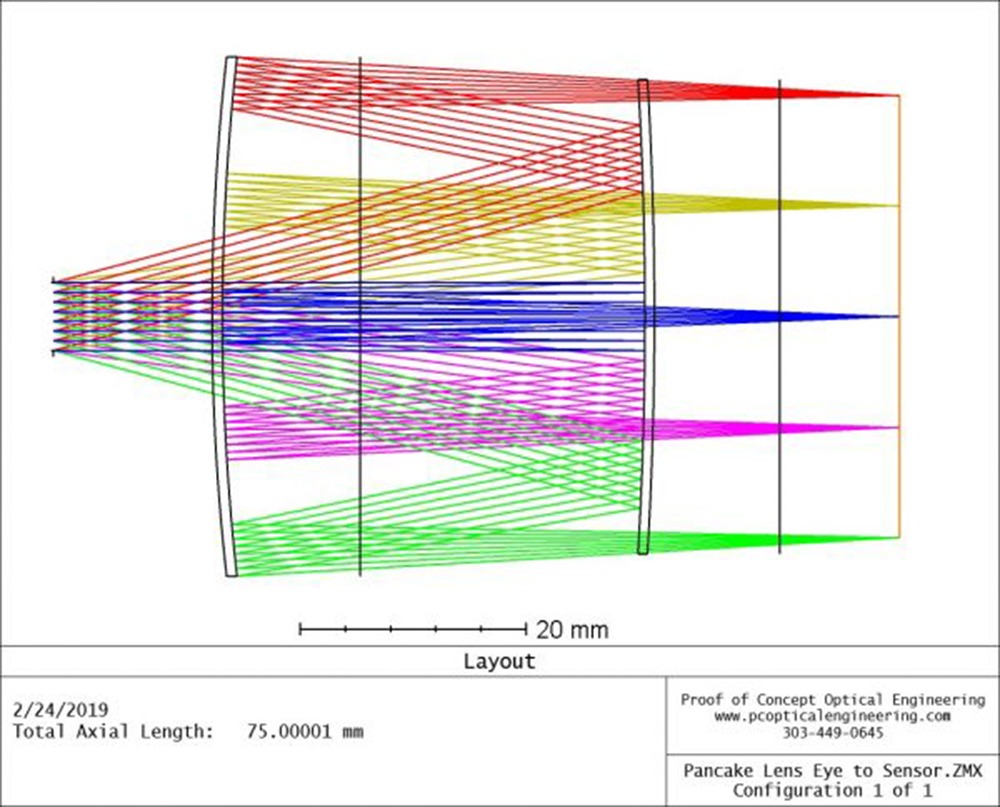
Folded optics are crucial to shortening the distance between the display and your eyes. What this means is that the path the light has to travel is folded. Meaning the light still travels the same distance, but the path has been condensed. It’s like when you fold a paper in half, and the width remains the same, but the paper is taking up less space since you folded it over on itself. Polarization is used to direct the light along the folded path.

Then, to shrink the distance even further so the display and the lenses are one, the researchers turned the lenses into holograms. They did this by capturing a hologram of a real lens. Meaning the design employs a hologram of a lens as the lenses.
The sleek headset worked, and with further development, the researchers say their folded holographic optics technique could make glasses-like VR headsets that offer huge color gamut, wide field of view, and even retinal resolution.

It may sound like they have it all figured out, but this is only the beginning. It’ll likely be another decade before this technology leaves the lab as there’s still a lot of work to be done. Among the many unresolved issues include: They haven’t demonstrated a full-color version for a head-worn device; it needs a bigger eye-box (their proof of concept was only 8mm, but it has to be at least 10-12mm); and the rest of the components (driving electronics, tracking cameras, light source, etc.) need to be built-in.
The researchers write:
Our prototypes were monoscopic and used external light sources and display drivers. A truly portable and practical display would integrate a pair of display modules, a computing platform, batteries, positional trackers, and all external components into a sunglasses-like frame.
The final product should be a standalone Quest-like VR headset equipped with everything necessary for the complete VR experience with no harness.


