
Across ports, warehouse districts, and municipal depots, a quiet shift is unfolding in commercial transportation. Hydrogen-powered fleet adoption is not rolling out across the entire country at once. Instead, commercial hydrogen fuel-cell trucks are appearing in specific places where routes repeat daily, vehicles return to base, and fuel demand can be predicted with surprising accuracy.
Ports sit at the center of this shift, serving as high-intensity nodes where zero-emission freight corridors finally make operational sense. When fueling and range are planned like clockwork, the transition becomes an upgrade in efficiency rather than a gamble.
Niche operational focus allows the market to anchor high-density demand while fuel supply chains scale to meet real-world fleet workflows. Logistics leaders are prioritizing maritime decarbonization, focusing on integrating hydrogen into shipping fuel supply chains as global logistics evolve.
In Southern California, Class 8 fuel-cell trucks are already moving freight between the Port of Los Angeles and inland warehouses under structured pilot programs designed to validate station throughput, operational reliability, and real-world fleet workflows. Real-world data is overturning the old assumption that a nationwide network must precede adoption. Instead, deployment thrives in tightly defined nodes where freight density is highest.
A dispatcher watching trucks cycle through the same gate appointments each morning does not need a futuristic story to understand the point. If fueling and range can be planned like clockwork, a new drivetrain becomes less like a gamble and more like an operational upgrade.

Strategic Signals for Hydrogen-Powered Fleet Adoption in Commercial Hubs
Quick Facts: Hydrogen Fleet Adoption in Ports, Depots, and Closed-Loop Routes
Evidence from recent deployments reveals several critical milestones in infrastructure and vehicle rollout. These signals demonstrate that ports and depots are not just testing the technology but are actively integrating it into daily work.
- The Port of Los Angeles publicly rolled out Shore-to-Store fuel-cell drayage trucks and hydrogen stations in 2021 as part of a heavy-duty port freight demonstration designed to validate operational reliability.
- HTWO Energy Savannah was announced as a port-adjacent logistics node with 1,200 kg/day initial hydrogen production designed to scale toward 4,200 kg/day.
- Refueling profiles dictate station economics, as specific equipment configurations and design choices significantly impact levelized refueling costs for heavy-duty fleets.
- Heavy-duty economics remain fuel-price sensitive, and policy research on hydrogen’s role in heavy-duty trucking highlights cost drivers that change by duty cycle.
- U.S. freight electrification and hydrogen planning is being sequenced around hubs and corridors, following a phased zero-emission corridor strategy to ensure infrastructure reliability.
These early data points clarify the operational path forward. By focusing on high-density freight nodes, the industry is creating a blueprint for national expansion that starts where the demand is most predictable.
The Hydrogen Trucking Market is Not Waiting for a National Network
Real-world data is overturning the old assumption that a nationwide network must precede adoption. Instead, deployment thrives in tightly defined nodes where freight density is highest.
Why Hubs Come Before Highways
The logic is embedded in a strategy for hub-centered freight infrastructure, which describes a phased approach that starts with high-density ports. Early planning skips the gamble of nationwide expansion. Instead, the focus rests on ports and distribution clusters to anchor high-density demand from the start.
That corridor-first pattern is already reshaping how regions think about clean freight, utilizing coordinated shipping corridors and rail hubs to concentrate investment where logistics density is highest.
Predictable Routes turn Infrastructure into a Schedule
Uptime and refueling speed remain the primary concerns for logistics leads. They need to know a vehicle can complete a full day of work without the need for improvisation. In environments where trucks run the same 100 to 200 mile loops, infrastructure can be engineered to meet known demand rather than speculative expansion.

Optimizing Zero-Emission Freight Corridors through Closed-Loop Logistics
The Closed-Loop Flywheel: Why Warehouse-to-Port Routes Come First
Notice how station utilization stabilizes when fleets move between ports and fixed rail yards. This predictability removes the guesswork for infrastructure investors.
Shore-to-Store Proves the Throughput Math
The Shore-to-Store model offers unusually specific details, where fueling throughput and fleet operations data describe a ten-truck Class 8 fuel cell demonstration.
California’s captive route for drayage trucks makes the business logic plain: steady demand allows operators to size equipment for repeatable cycles.
Commercialization signals are also starting to stack around the same platform. PACCAR describes how the Kenworth T680 and Peterbilt 579 are being advanced through new production plans for Class 8 hydrogen trucks, providing fleets with a clear product roadmap.
A related North American signal is how Toyota’s and Hino’s Class 8 fuel-cell electric truck concept is framed around a standardized chassis-and-fuel-cell pairing meant for predictable heavy-duty work.
Port-Adjacent Hydrogen Nodes in Savannah and Warehouse Logistics
A similar pattern shows up in Georgia. Hyundai positioned their HTWO Energy Savannah facility near the port to anchor infrastructure through concentrated freight demand. Distribution-focused pilots in other regions have tested onsite hydrogen production at warehouse logistics centers, reinforcing the message that controlled fueling unlocks deployment.
Why Ports Create First-Wave Hydrogen Truck Demand
When people ask through voice search, “Why are hydrogen trucks used at ports first,” the operational answer is straightforward. Ports concentrate freight movement, generate repeated short-haul trips, and create centralized refueling opportunities. Those conditions can keep a station busy enough to justify its build.

The Hidden Backbone Fleets: Buses, Refuse Trucks, and Yard Tractors
Hydrogen adoption is not limited to drayage corridors. Some of the most stable early demand is emerging from fleets that return to the same depot every night. Transit agencies, sanitation operations, and port terminals all share a critical trait: predictable duty cycles with centralized fueling.
Depot Fueling and Predictable Duty Cycles
Transit and sanitation fleets provide the ultimate stress test for depot-based fueling strategies. By observing how these vehicles perform under strict schedules, operators can gauge the long-term viability of the technology.
- Transit Bus Benchmarks: Performance tracking from AC Transit reveals how fuel-cell buses handle the rigors of revenue service while maintaining reliability.
- International Service Milestones: Transit fleets have also logged Aberdeen’s 100,000-kilometer hydrogen bus benchmark, grounding the discussion in day-to-day reliability.
- Waste-to-Fuel Projects: Municipal concepts also connect waste systems to supply, including projects that convert garbage-derived energy into hydrogen fuel for municipal transit.
These examples illustrate a growing trend toward circular energy systems in municipal infrastructure. Scaling these successes requires a continued focus on localized production and predictable duty cycles.
Imagine a sanitation supervisor evaluating a new drivetrain. The primary concern isn’t the chemistry; it’s whether the vehicle can finish a full route without missing a single pickup window. In that framing, the technology becomes an operations problem with known constraints.
Industrial Equipment as Anchor Demand
Ports and industrial yards add another layer because equipment can run long shifts in a small geographic footprint. That intensity can turn terminal tractors and yard trucks into anchor loads that justify early hydrogen supply.
Technical specifics of cargo-handling duty cycles are documented in a ZECAP final report on hydrogen fuel-cell yard tractors at the Port of Los Angeles. NREL’s recent analysis of port energy logistics and infrastructure costs models how fueling design shapes the feasibility of zero-emission operations.
Retail hydrogen adoption still hinges on infrastructure availability, which is why hydrogen cars in 2025 remain tied to limited retail networks even as commercial fleets move faster in controlled environments.

Heavy-Duty Hydrogen Station Economics and Strategic Offtakes
Why Utilization is the Whole Game for Hydrogen Stations
Utilization remains the defining metric for station profitability. High capital costs demand consistent throughput to drive down the cost per kilogram dispensed.
What Utilization Means for Cost Per Kilogram
NREL’s modeling for high-capacity hydrogen station costs shows the per-kilogram price is highly sensitive to station size, daily throughput, and delivery logistics. This is why early deployments cluster around places where demand is steady rather than episodic.
Turning Route Mileage into Station Sizing
Consumption rates translate this into practical sizing, with baseline scenarios for heavy-duty fuel consumption helping to define equipment requirements. Actual consumption varies with load, terrain, and drive cycle, but the underlying point is simple: predictable mileage becomes predictable fuel demand.
Supply Logistics Matter as Much as the Dispenser
Reliable supply matters as much as station design, especially as the infrastructure for renewable hydrogen production and distribution matures across major trade hubs. Port-adjacent supply is part of that story, including projects that Hyport Oostende’s surplus-wind green hydrogen plant is close to maritime and industrial demand. Planning also has to connect refueling, grid upgrades, and equipment transitions, which is why NREL lays out a sustainable port operations planning framework that ties equipment choice to energy logistics and emissions targets.
From Diesel Contracts to Hydrogen Offtakes
Contracts, not just technology, close these deals. Fleet leads require the same structured supply and predictable pricing they currently enjoy with diesel.
Volume-Backed Pricing that Looks like Fuel Contracting
A clear signal comes from Germany, where a planned €8/kg truck-hydrogen price at selected stations is explicitly tied to contractually secured purchase volumes and high-capacity infrastructure starting January 1, 2026.
Upstream Green Hydrogen Offtakes Feeding Retail Stations
Supply agreements upstream of the pump are also becoming more common. Lhyfe and H2 MOBILITY signed a multi-year renewable hydrogen supply commitment for deliveries to four fueling locations in Germany.
Fleet-Side Fuel Supply Agreements that Stabilize TCO
Fleet-side contracts are emerging as well. A long-term green hydrogen supply agreement between Norwegian Hydrogen and MaserFrakt shows how a transport operator can treat fuel as a negotiated input rather than a volatile variable.
Bundled Service Models That Package Trucks, Fuel, and Support
Hyroad outlines a bundled maintenance and fuel supply model built around integrated infrastructure access and operational coverage.
A fleet buyer might not say “offtake” in a meeting. They say something more practical: fixed inputs, guaranteed uptime support, and pricing that can be modeled before signing.

Commercial Fleet Real-World Performance: The Path to National Network Scale
Reality Check: Hydrogen vs. Battery-Electric in Commercial Fleets
Hydrogen fuel-cell vehicles do not automatically outperform battery-electric trucks. The economics vary by duty cycle, infrastructure access, electricity rates, and hydrogen fuel price.
Where Battery-Electric Often Wins on Cost
Selecting the right zero-emission drivetrain involves a rigorous comparison of energy logistics and operational costs. While the technology is maturing rapidly, the choice often comes down to the specific demands of the route.
- Battery-Electric Performance: This pathway typically wins on cost for short-haul routes where charging can be managed cheaply and downtime is available.
- Hydrogen Competitiveness: Fuel-cell options compete hardest in high-uptime environments requiring fast refueling and heavy payloads.
- Total Cost of Ownership: The economic modeling for long-haul truck operations shows how sensitive hydrogen viability is to fuel cost assumptions.
Understanding these trade-offs allows fleet owners to de-risk their transition to clean energy. As fuel benchmarks stabilize, the decision rule for specific duty cycles will become even more precise.
Where Hydrogen Still Competes in High-Uptime Duty Cycles
That does not make hydrogen irrelevant. It highlights segmentation. In tightly scheduled freight environments, refueling time, payload, and route certainty can matter enough to justify a different trade-off. A complementary modeling perspective appears in research for short-haul port drayage energy logistics, which focuses on duty cycles and infrastructure requirements.
Scaling Path: Hubs → Corridors → Network
Infrastructure development follows a pattern of anchoring supply and demand within high-utilization clusters before bridging these nodes into corridors.
Demand-Linked Hydrogen Hubs
In the U.S., the development of regional clean hydrogen hubs is designed to accelerate clustering by linking production and distribution. The practical importance is not the press headline. It is whether hubs can create reliable, contracted fuel demand that supports stations and fleet operations.
Corridor Sequencing From Freight Hubs to Connected Routes
In policy terms, U.S. hydrogen hubs operate as demand-linked ecosystems designed to support high-utilization logistics nodes.
Cluster Models and Backbone Infrastructure
Internationally, coordinated deployments such as China’s multi-city hydrogen clusters show how consortia can scale supply chains. Attention has shifted toward China’s hydrogen pipeline network that links renewable-rich regions to demand centers.
Cross-Border Freight Nodes as the Next Anchors
Growth is likely to follow freight density. Cross-border manufacturing nodes are becoming prime locations for early buildouts, including hydrogen-powered freight corridors in Northern Mexico that follow expanding trade lanes.
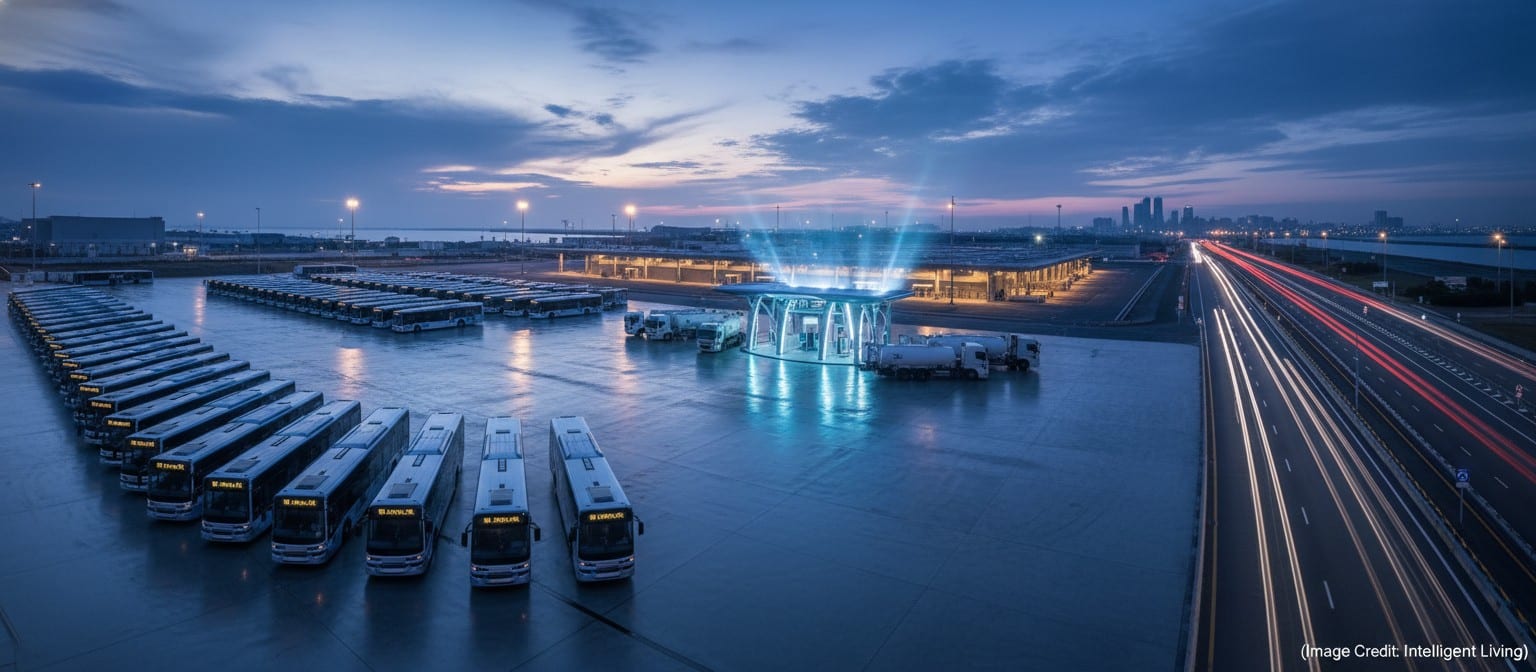
The Blueprint for a Hydrogen-Powered Future
The momentum behind commercial hydrogen fuel cell trucks and buses isn’t built on speculative expansion but on the repeatability of the daily grind. As we’ve seen in Southern California and Savannah, success hinges on identifying the exact points where logistics density and high-capacity infrastructure meet. This corridor-first strategy allows the industry to build a foundation of reliability, proving that heavy-duty decarbonization is possible without disrupting the flow of global trade.
Looking ahead, the expansion from these isolated hubs into broader regional networks depends on maintaining this structured approach. As hydrogen fuel supply agreements stabilize and production scales, the quiet pattern of adoption will extend through regional freight networks. The transformation is happening one port, one depot, and one predictable route at a time, paving a clear path toward a zero-emission freight network that actually works.
Essential Guide to Hydrogen Fleet Operations
What are the Primary Benefits of Hydrogen-Powered Fleet Adoption?
Fleet operators choose hydrogen for its rapid refueling and high payload capacity, especially in heavy-duty duty cycles where battery downtime is unacceptable.
Why are Commercial Hydrogen Fuel-Cell Trucks Preferred at Ports?
Ports provide high-density, short-haul routes that allow for centralized fueling, maximizing station utilization and lowering the cost per kilogram.
How do Hydrogen Offtake Contracts Stabilize Fleet Costs?
These agreements lock in fuel prices and volumes over several years, giving fleet operators the same financial predictability they currently have with diesel.
Can Hydrogen Powered Buses Handle Full Service Days?
Yes, current transit data shows that fuel-cell buses match the range and availability of traditional buses, even in demanding urban environments.
What is a Phased Zero-Emission Corridor Rollout?
It is a strategy that first builds infrastructure in heavy-traffic hubs, then connects those hubs via corridors to eventually form a nationwide network.


