
The transition of ocean-based carbon from a conceptual buzzword to a significant financial metric represents a definitive maturation of climate finance. Marine ecosystems are now recognized as essential assets for achieving global sustainability targets rather than mere theoretical possibilities.
Sophisticated carbon accounting and the demand for high-integrity credits are driving a market where coastal preservation is valued as a durable climate solution. The current pricing signal underscores the transition from general environmental advocacy to a rigorous, results-oriented blue carbon market. Market indices now reflect this value, as seen in the DBC-1 blue carbon benchmark, which recently reached record highs due to constrained supply.
Levels sat far above the broader voluntary carbon market average in 2023, which hovered in the mid-$6 range per ton. Comprehensive voluntary carbon market data from 2023 shows averages near the six-dollar mark.
Recent blue carbon pricing trends indicate that mangrove-focused credits are commanding a significant premium. The widening price gap exposes fundamental market realities: scarcity, biological complexity, and the substantial capital required to validate climate claims through precision auditing.
Scientifically, coastal blue carbon refers to the atmospheric CO2 removed by marine habitats and sequestered in their biomass. Focus remains on the core blue carbon ecosystems like tidal marshes and seagrass meadows.
A coastal project developer once described blue carbon credits in simple terms: “It is not just planting trees in water. It is proving what stays there.” Notice how this distinction signals a broader market pivot. Buyers are increasingly prioritizing credits anchored in robust accounting, particularly within ecosystems that align with national climate inventories.
Kelp forests introduce unique variables to this equation. These ecosystems grow with remarkable speed and absorb carbon with high efficiency, though quantifying durable storage pathways at scale remains a technical challenge. Ongoing research highlights that oceanic carbon absorption may be twice as effective as previously documented. Results show a field moving from hype to pilots, from promise to mathematics.

Blue Carbon Credit Pricing Signals and the Integrity Premium
Quick Facts: Blue Carbon Credit Prices, MRV Signals, and What Counts Today
- The introduction of blue carbon price transparency helps clarify value for secondary market participants through daily assessments.
- The a 2024 market recap of voluntary carbon transactions confirmed that while overall volumes dipped, high-quality nature credits remained resilient.
- Scientific assessments of credit issuance show that supply risk is often localized by geography, with retirement patterns concentrated in specific coastal regions.
- Japan’s success stems from restoring coastal satoumi habitats to integrate seagrass absorption into national climate tallies, marking a global first for inventory transparency.
The Price Signal: Why Blue Carbon Credits Trade Higher than Most Offsets
Scarcity and Verification Drive Premiums
Market premiums aren’t accidental; they reflect a market where supply remains tight while the criteria for measurement grow increasingly rigorous.
In voluntary markets, a credit is often treated as one ton of CO2e avoided or removed on paper, but the credibility comes from how that ton is measured, audited, and tracked over time. Measurement burdens in the blue coastal space are exceptionally demanding. Scientists must track carbon stored in living biomass while simultaneously monitoring deep-sea sediments for structural stability.
Blue carbon habitats like mangroves, seagrass meadows, and tidal marshes store carbon in deep sediments that remain locked away for decades or longer under protection.
Coastal habitats also buffer shorelines from storm surge, reduce erosion, and support vital fisheries. Beyond carbon, mangrove seawall defenses provide natural protection against rising tides. Ecological health improves when mangroves stabilize coastlines while simultaneously sequestering atmospheric carbon.
Common voice-search queries highlight a growing public awareness: why invest more in the same carbon unit? Premiums aren’t paid for a generic ton; they are paid for sequestration results that are nearly impossible to fabricate.
What the Premium is Really Buying
Determining the value of a high-integrity credit requires evaluating specific operational expenses. The price premium reflects several essential cost layers:
- Establishing rigorous baseline data
- Conducting long-term ecological monitoring
- Performing detailed leakage assessments
- Managing methodological uncertainty
- Securing independent third-party verification
Complex blue carbon finance opportunities in coastal ecosystems often combine carbon revenue with traditional conservation funding, including results-based payments for environmental performance.
High-integrity climate finance depends entirely on the concept of additionality—the proof that carbon storage would not have occurred without direct intervention.
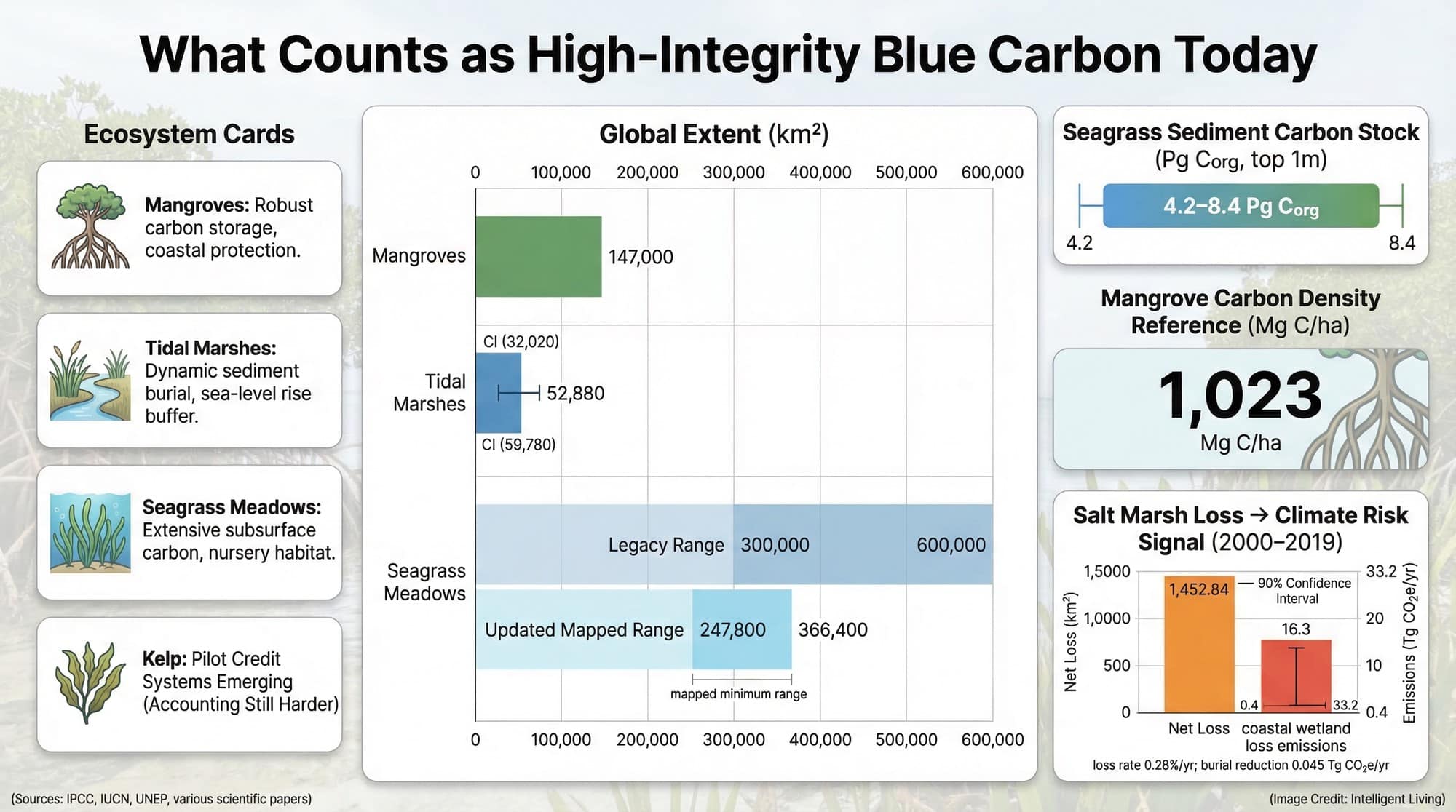
Defining High-Integrity Blue Carbon Ecosystems Today
IPCC-Recognized Coastal Carbon Ecosystems
National inventories do not treat every ocean ecosystem the same way. Official IPCC guidance for greenhouse gas accounting in coastal wetlands provides the methodological bedrock for national inventories, focusing on inventory-ready coastal habitats.
Practitioners rely on the blue carbon handbook on coastal carbon stocks and accounting to bridge the gap between restoration and climate finance. Linking the climate case to practical measurement ensures that data remains audit-ready.
Connecting projects to national reporting systems is a priority for policymakers and corporate leaders. Strategic inventory alignment ensures that project-level accounting feeds directly into the frameworks governments use to track climate progress.
The Carbon Math Behind Mangroves and Seagrass
Standard blue carbon accounting relies on three core metrics:
- Calculation of existing carbon stocks
- Measurement of annual sequestration rates
- Assessment of avoided emissions from degradation
Long-term storage hinges on a delicate balance: the depth of the sediment, the density of the biomass, and how well the water stays in place.
Studies confirm that mangrove soil density makes these habitats among the most carbon-dense on the planet. Similarly, seagrass can store carbon in sediment for decades to centuries and remains durable in ocean sediments for centuries, outperforming terrestrial forests in annual burial rates.
Inquiries into the mechanics of mangrove credits typically center on the issue of permanence. Achieving long-term storage requires several key environmental factors:
- Maintenance of stable sediment
- Strictly limited physical disturbance
- Sustained biological health of the ecosystem
Disturbance events such as dredging or land conversion can rapidly reverse gains.
Why Kelp and Macroalgae Are Harder to Certify
Kelp forests introduce unique variables to this equation. These ecosystems grow with remarkable speed and absorb carbon with high efficiency, though quantifying durable storage pathways at scale remains a technical challenge. Despite its potential, macroalgal sequestration math remains a point of significant debate among standards bodies.
Evidence of this uncertainty appears frequently in standards development. Take the archived seaweed aquaculture methodology as an example; it demonstrates the massive effort required to transition from a scientific concept to a globally recognized crediting rule.
Kelp also sits inside wider coastal engineering decisions. Modern engineering allows green marine infrastructure to foster kelp growth rather than replacing natural habitat.
Restoration efforts often highlight a deeper methodological debate. A Japanese seafood entrepreneur once framed kelp recovery as an act of ecological repair first, with carbon sequestration serving as a valuable secondary benefit.
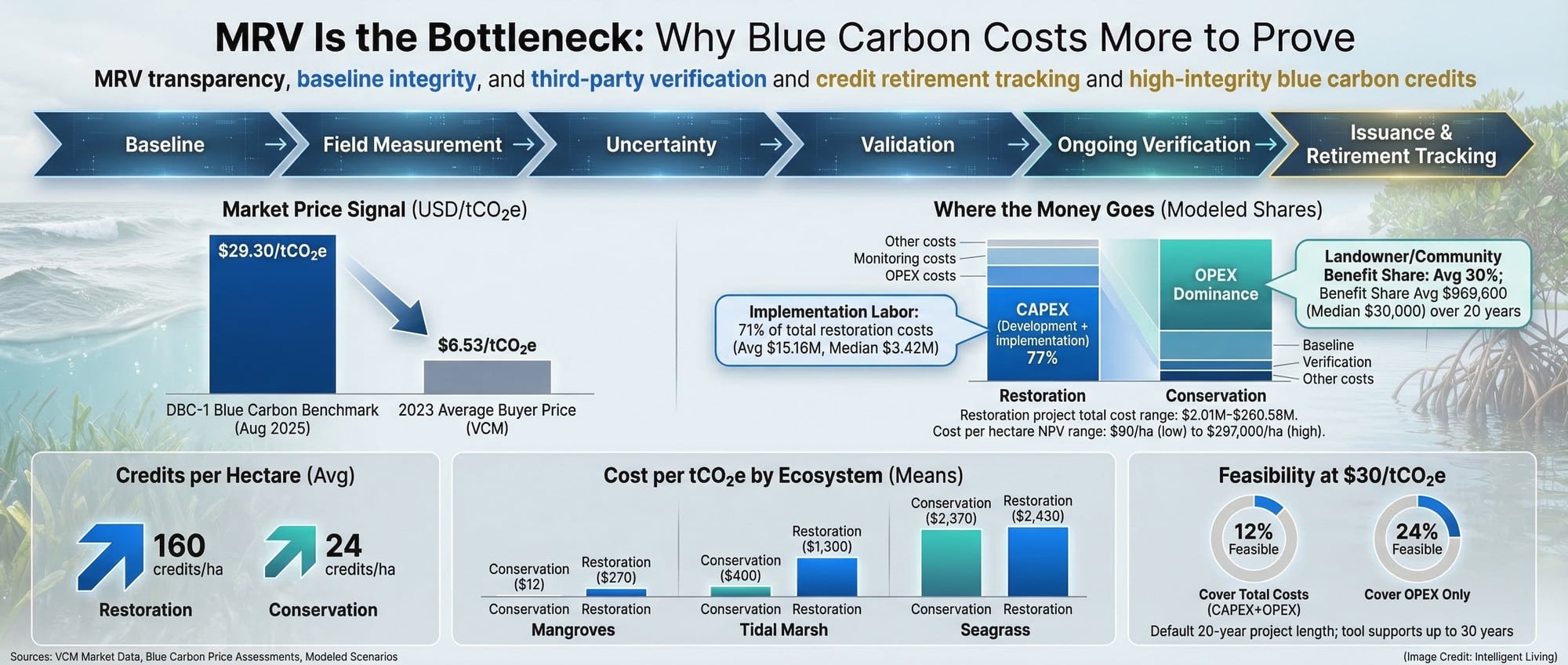
The MRV Bottleneck: Ensuring Transparency in the Blue Carbon Market
From Ecology to a Tradable Credit
Turning a restored wetland into a tradable carbon credit requires a rigorous, documented pathway:
- Detailed project design and baseline assessment
- Establishment of a long-term monitoring plan
- Independent third-party verification
- Formal issuance by a recognized registry
- Transparent tracking of credit retirement
High-integrity projects command top prices because the work of monitoring and verifying results is both painstaking and essential. Scientists apply rigorous blue carbon MRV to eliminate the risk of baseline inflation and ensure results survive serious scrutiny.
A familiar scenario shows up in the real world. A procurement team might have the budget for credits, but their legal counsel will still ask for measurement methods, baseline logic, and independent verification documentation before signing off.
Baselines and Additionality
Baselines define what would have happened without the project. Overly generous baselines can inflate credit volumes. Conservative baselines reduce that risk but may limit financial returns.
Specific carbon credit additionality tests verify that climate benefits are directly tied to the project investment, laying out barrier analyses used to judge genuine outcomes.
A project auditor reviewing coastal credits once noted that transparency often matters more than optimism. If assumptions are visible and independently tested, buyers can make informed decisions even when outcomes vary by site.
Transparency and Reseller Risk
Secondary market structures often hide significant complexities. Intermediaries purchasing and reselling credits without transparent origin data or retirement status leave buyers unable to verify true environmental impact.
Integrity begins with nature protection and management, ensuring that restoration is built on a stable foundation and follows a stable order of operations.
Technological shifts in remote carbon sensing now allow for real-time verification of ecosystem recovery, anchoring claims in observable change across coastal landscapes.
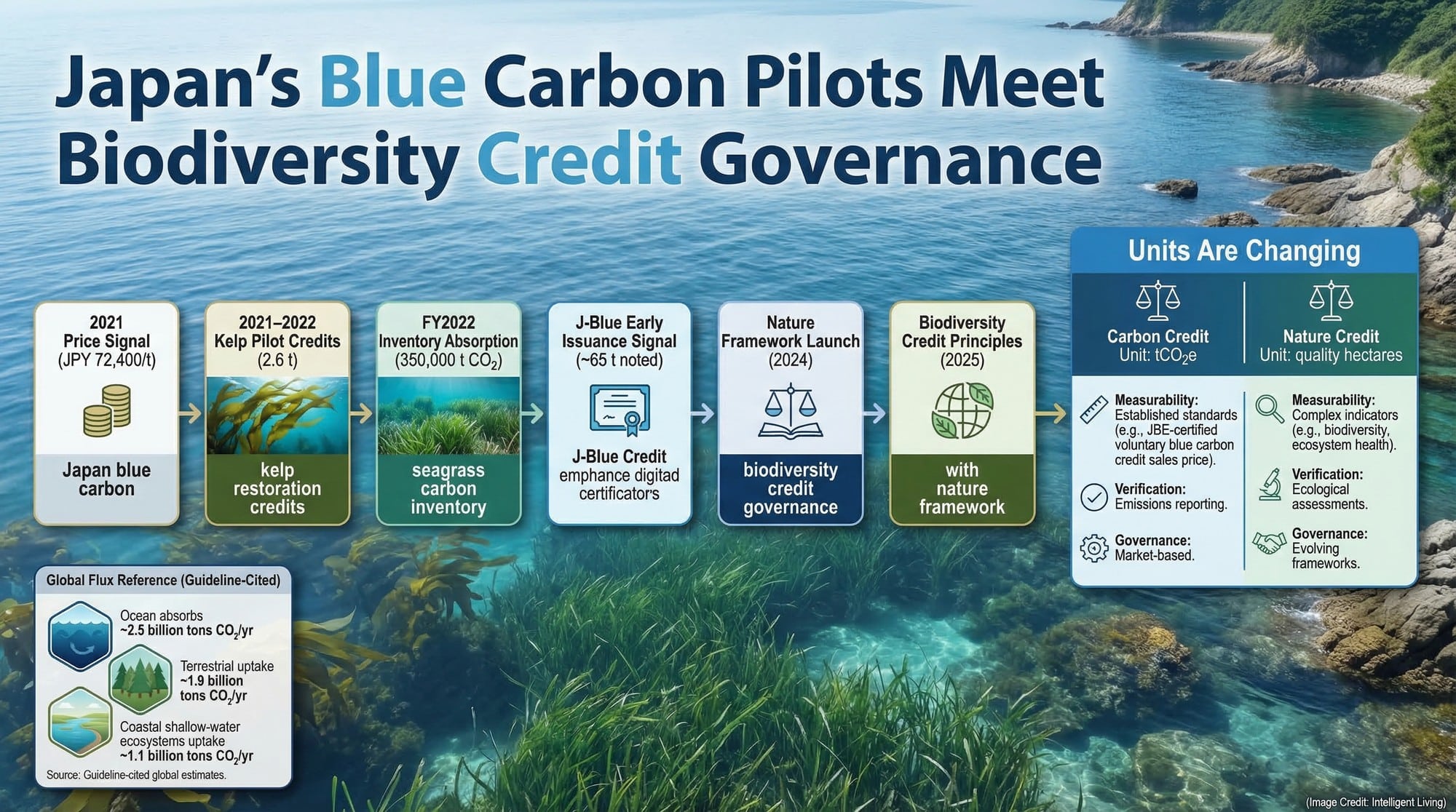
Japan’s Blue Carbon Pilot Lab and Biodiversity Credit Governance
Japan’s Blue Carbon Pilot Lab
The World-First Kelp Restoration Credit
Market signals are emerging through restored kelp credits, which represent a significant pilot for marine sequestration and the formalization of coastal carbon.
The issuance was modest in volume, but symbolically important. It demonstrated that a defined methodology could recognize kelp restoration as a measurable climate activity under specific rules.
Inventory Inclusion and National Signaling
Policy momentum shifted when national carbon accounting was expanded to include offshore vegetation, allowing estimates of fiscal-year absorption to enter national climate tallying.
Inventory inclusion signals that coastal carbon is not merely a voluntary offset experiment. It is part of national reporting architecture.
J-Blue Credit and Institutional Scaffolding
Japan’s certification pathway is not vague. Developers must follow J-Blue Credit certification standards to ensure measurement accuracy across all coastal sites.
Industrial innovation now focuses on large-scale seaweed bed recovery as a strategic infrastructure goal rather than a symbolic gesture.
“Blue Carbon” Is Not Just Carbon: The Biodiversity Co-Benefit and the Governance Risk
Biodiversity Credits and Nature Frameworks
Standards now support measurable biodiversity crediting that prioritizes habitat quality over simple offsets, quantifying outcomes in quality hectares.
Design choices here ensure that biodiversity is not treated as interchangeable the way CO2 is. Voluntary nature credits are framed around measurable local outcomes rather than swapping losses for gains elsewhere.
The transition to a circular economy relies on documented biodiversity improvements that provide tangible environmental proof instead of invisible emissions arithmetic.
Governance Challenges and Market Guardrails
The integrity question does not disappear when the unit changes from carbon to habitat conditions. Global biodiversity credit safeguards prevent the market from drifting toward unverified claims by focusing on transparency and benefit sharing.
A land steward evaluating a biodiversity pilot once described the process as less about offsets and more about stewardship metrics. Without clear metrics, markets can drift toward claims that sound measurable but are not.
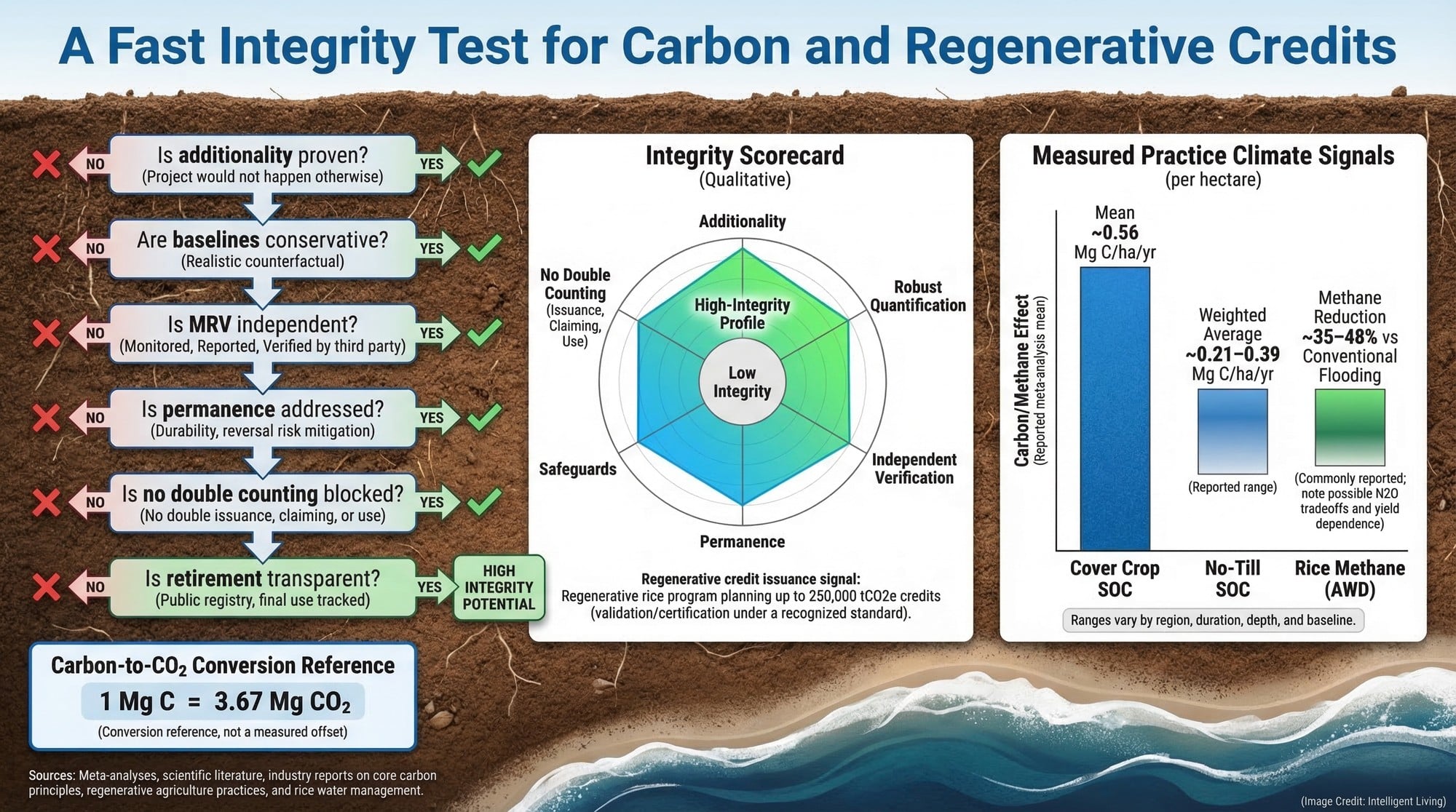
Vetting Carbon Sequestration and Regenerative Agriculture Credits
The Convergence Trade: Carbon, Nature Credits, and Regenerative Agriculture
Regenerative Agriculture as a Measured Outcome Pipeline
Land and ocean markets are starting to converge around the same requirement: outcomes must be measured. Industrial shifts are evident in regenerative rice credit programs, which integrate agricultural output with climate targets.
Advanced soil carbon verification protocols require repeat sampling to validate long-term sequestration through field measurement.
A familiar human moment sits behind these systems. A farmer might notice the soil holding water longer after shifting practices, but markets require that observation to be translated into measured change if it is going to be credited.
Avoiding Double Counting in Stacked Credits
As carbon and biodiversity credits converge, careful accounting becomes essential. Carbon gains should not be counted twice under separate labels, and biodiversity improvements should not be marketed as carbon offsets unless methodologies clearly support that claim.
Nature finance allows regenerative agriculture incentives to fund transitions that improve yield resilience and habitat conditions.
At the household scale, the same logic appears in a simpler form: individual stewardship can achieve negative carbon emissions when landowners prioritize measurable soil health.
Social momentum grows when sustainable farming pioneers demonstrate the economic viability of regenerative techniques.
Financial systems are evolving as nature-based economic accounting enters mainstream corporate decision-making.
A Practical Integrity Checklist: How to Tell Real Pilots From Marketing
- Does the project publish a clear methodology and baseline?
- Is monitoring data updated regularly and independently verified?
- Are credits issued and retired through a recognized registry with transparent tracking?
- Does the project address leakage and permanence risks explicitly?
- Are co-benefits, such as biodiversity gains, measured rather than assumed?
Integrity benchmarks, such as the Core Carbon Principles, set the bar for additionality and governance.
A coastal investor once summarized due diligence in simple language: read the assumptions before reading the marketing claims.

Conclusion: The Math is Getting Better and that is the Real Good News
Blue carbon credits are not immune to hype. But they are increasingly grounded in accounting frameworks, registry oversight, and transparent data.
Mangroves and seagrass meadows sit within recognized inventory systems. Kelp remains methodologically complex but is entering pilot frameworks in places such as Japan. Biodiversity and regenerative agriculture credits are building parallel guardrails.
The premium pricing in blue carbon markets is less a speculative bubble and more a signal that credible measurement carries real cost. As methodologies mature and transparency improves, the difference between marketing language and measurable climate value becomes easier to see.
Durable climate progress often stems from slow, meticulous work. Restoration success depends on treating these ecosystems as long-horizon investments rather than short-term marketing campaigns. Long-term restoration remains the goal for ocean recovery strategies aiming for 2050 targets.
Essential Insights: Navigating the Blue Carbon Market
What makes blue carbon credits different from standard offsets?
Coastal ecosystems like mangroves and seagrass meadows store immense amounts of carbon in soil and biomass for centuries, offering higher density and permanence than many land-based forests.
Why are blue carbon credit prices reaching record highs?
Record premiums reflect high demand for high-integrity projects combined with the extreme scarcity and high cost of rigorous measurement and verification (MRV).
Can kelp forests be reliably credited in today’s market?
Kelp is currently in a pilot phase; while it absorbs carbon rapidly, proving long-term burial in ocean sediments remains a significant methodological hurdle for credit registries.
How does MRV ensure the validity of a blue carbon project?
Monitoring, reporting, and verification (MRV) provide the data-driven proof that carbon sequestration is actually occurring according to strict, third-party scientific standards.
Are biodiversity benefits included in the price of these credits?
High-quality credits frequently include biodiversity ‘co-benefits,’ though emerging frameworks are now developing standalone nature-based solutions to reward specific habitat restoration goals.


