
When renewable energy generation from wind farms is higher than the demand in the city, it gets cut short. Since the grid cannot absorb it and there’s no way to use or store it for later use, it just goes to waste. One suggestion, aside from battery storage, has been to use the excess renewable energy by diverting it into the production of green hydrogen (H2). Now, a trio of Belgian companies has announced they will be doing just that, with HYPORT Oostende.
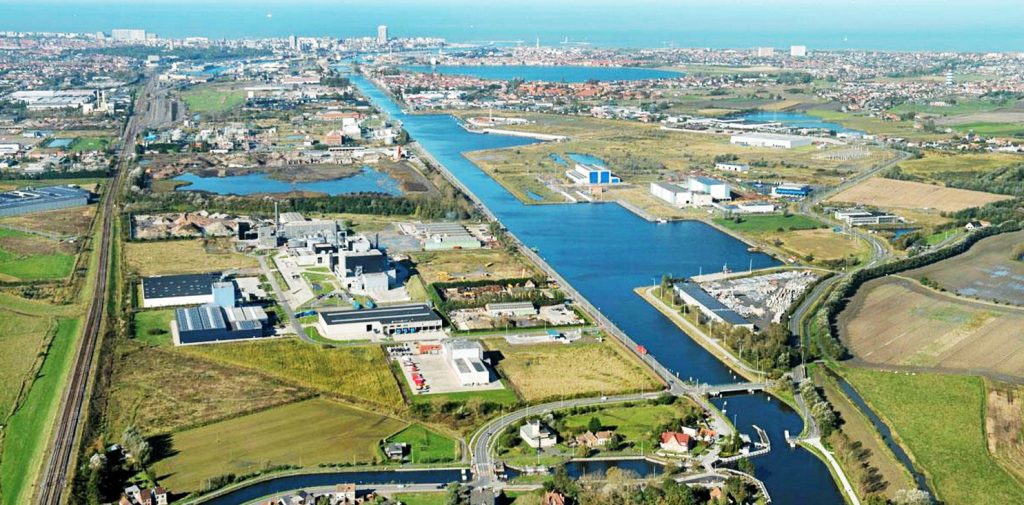
DEME Concessions, the Port of Oostende, and PMV are joining forces to boost the energy transition in Flanders with the world’s first commercial-scale green hydrogen plant. The 50MW demonstration project at the Plassendale 1 port area in Ostend will be powered solely by surplus offshore wind energy.
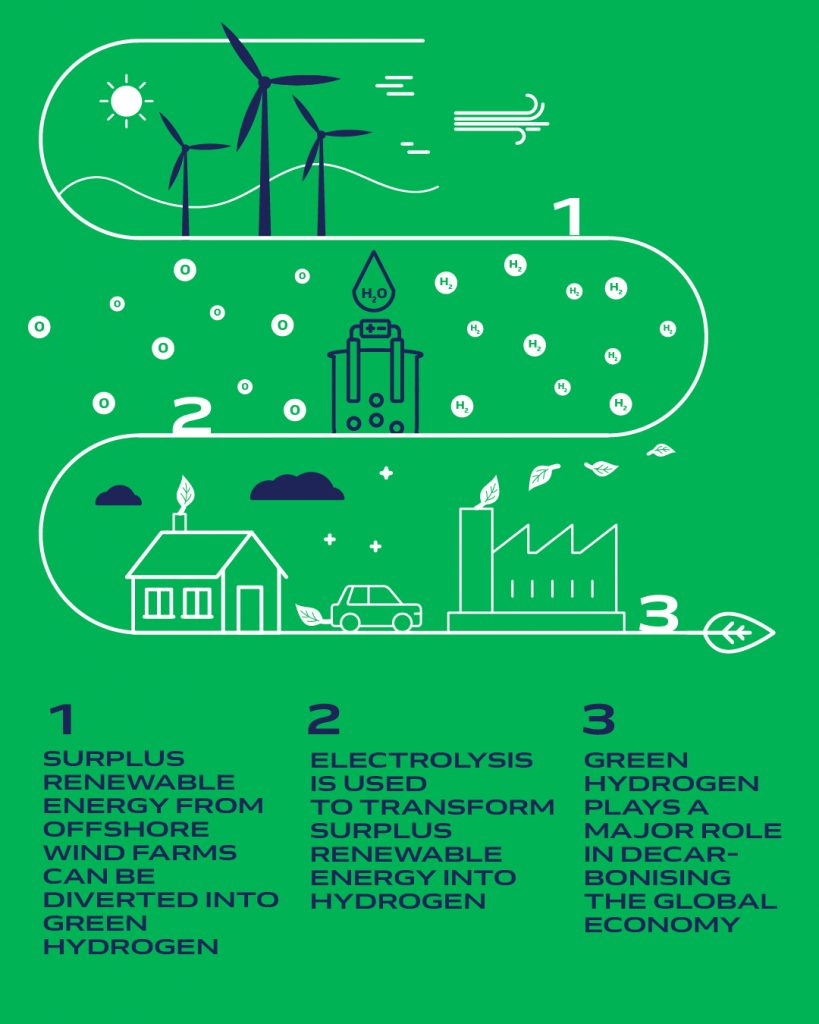
It will be the largest electrolyzer plant on the planet powered by renewable energy, only to be followed by another even bigger commercial-scale unit in 2025. Electrolysis is the process of using electricity to split water molecules into hydrogen and oxygen.
The project, called HYPORT Oostende, will contribute significantly to achieving the Belgian and European climate objectives. Once complete, the green hydrogen plant will result in a CO2 reduction of around 500,000 to 1,000,000 tons per year.
By the end of 2020, the country will have 2.26GW of offshore wind installed, with an additional 1.75GW to be developed. Altogether there will be times when more wind energy is produced than the Belgian grid can absorb.
The company explained, “However, the wind turbines’ production peaks rarely coincide with consumer demand peaks, meaning that there is an opportunity to compensate for the discontinuity between production and consumption. The green hydrogen at the Hyport Oostende project will serve as an energy source for electricity, transport, heat and fuel purposes and as a raw material for industrial purposes.
With our energy transition in mind, we need to be able to temporarily store our green energy surplus using hydrogen as an energy carrier or to use hydrogen as an alternative raw material for converting the industry away from fossil fuels.”
Hydrogen can be converted into electricity by burning it like natural gas to produce power (via a turbine) or heat or by using a fuel cell. Both processes emit only water vapor. A compressorless hydrogen turbine recently demonstrated a more efficient path, generating electricity from detonation waves instead of a mechanical compressor. As hydrogen can be stored indefinitely, it is being touted as a long-term form of energy storage.
For now, green hydrogen is costly, but the more hours per day the electrolyzers are operating, the cheaper it becomes to produce. Hydrogen is used in fertilizer production, oil refining, and other sectors where H2 is a critical component of the creation of a product.
Approximately 69 million tons of H2 are produced every year, and 99% of it is derived from fossil fuels. The process releases 830 million tons of CO2 into the atmosphere every year, according to the International Energy Agency. That’s more than Belgium, France, and the UK combined.
Steam methane reforming is the current method used to produce hydrogen, and it releases 9 to 12 tons of CO2 into the atmosphere for every ton of H2. This “grey hydrogen” costs around $1.50 per kilogram, which is far cheaper than “green hydrogen” that costs five to ten times more. However, studies suggest that by 2030 green H2 could become cost-competitive with grey through economies of scale.
Green hydrogen is produced without releasing CO2 and is therefore fully renewable and aligns with the group’s energy transition goals.


