
In the future, plugging a phone in at night may seem old-fashioned, as wireless charging is becoming more common in phones, earbuds, smartwatches, and other small electronics. Eventually, widespread wireless charging could keep our devices topped up indefinitely. Japanese researchers have recently developed a breakthrough in that field – a system that can turn an entire room into a wireless charger.
Wireless charging is usually advertised as ‘more convenient’ than using a cable; however, that’s not always the case. Most of the time, the device has to be placed on a specific pad or surface, which makes it challenging to use while it’s charging. However, you can still use the device normally with a wired charger, at least as far as the cord extends.
To properly achieve the freedom promised by wireless charging, the technology needs more range. And that is precisely what researchers at the University of Tokyo did in a new study published in the journal Nature Electronics. They created a system that can charge devices anywhere within a room.
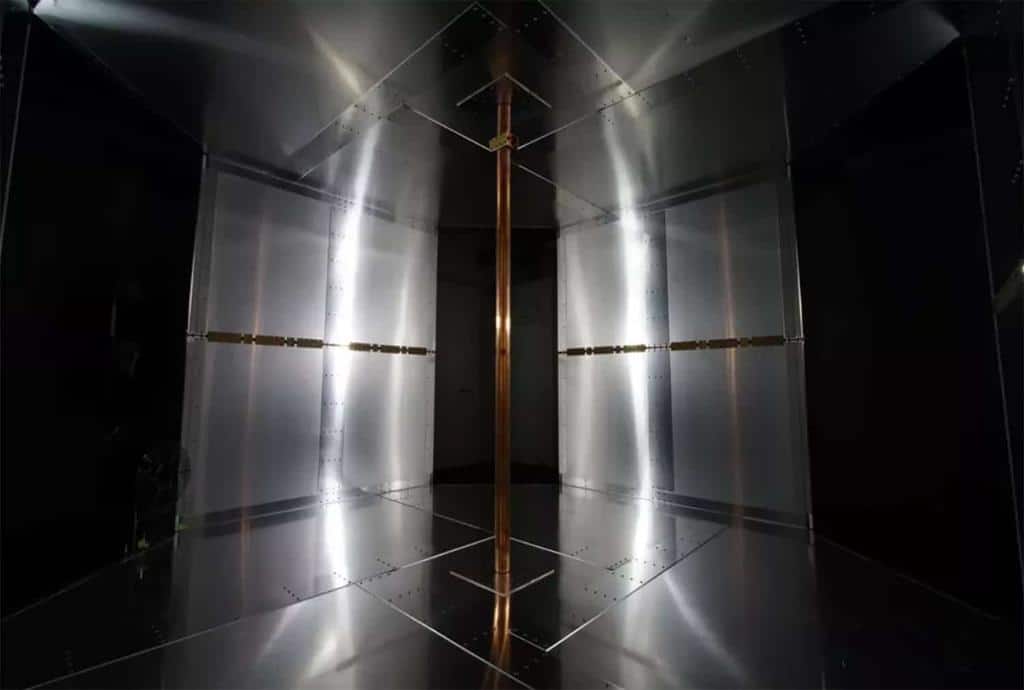
The technology is called multimode quasistatic cavity resonance. Components known as lumped capacitors are embedded into holes in the walls, which themselves are made with conductive surfaces. As a result, this projects a three-dimensional magnetic field into the room while keeping the electric fields confined within the capacitors. The magnetic field subsequently circulates clockwise and counter-clockwise around a copper pole in the center of the room. Coil receivers attached to phones, laptops, lightbulbs, or other small devices can then pick up this magnetic field to draw energy from them.

The team demonstrated the new system in a purpose-built aluminum test room measuring around 10 feet by 10 feet. Tests revealed that at least 50% power delivery efficiency was available in 98% of the room volume. In the remaining 2% of the room, the signal never dropped below 37%. Signals were found to be strongest when the receiver coil was at a right angle to the magnetic field, although it still works if it’s not, and it even works while moving around. The team claims that the output could be as high as 50 W or more.
Most importantly, the magnetic field patterns within the room were harmless for humans, with danger levels well below the guidelines from the Institute of Electrical & Electronics Engineers and the Federal Communications Commission.

While this isn’t the world’s first room-scale wireless charging system, it does iron out some of the issues of previous versions, such as the one demonstrated by Disney Research four years ago. The Japanese team even figured out how to remove the central copper pole in a few setups. In addition, unlike Disney’s system with one magnetic field swirl, the new system has the magnetic field swirling in two directions simultaneously, which helps eliminate dead zones for coverage in the room.
However, even if this system proves viable, it’s not likely that the average consumer would want to put up copper poles and aluminum walls in their homes to build a wireless charging living room. Instead, the team suggests the technology could be used in smaller areas such as a cabinet where devices could be placed inside or large commercial buildings like factories that can power equipment without running a bunch of cables all over the place.
That said, consumers might prefer other prototype devices, such as a flat-screen wall panel that beams microwaves at devices up to 33 ft (10 m) away or Xiaomi’s Mi Air Charge box, when and if they ever make it available to the public.
Last year, robotics researchers at SNU demonstrated another way to wirelessly charge phones, creating a smartphone case with tiny robotic legs that allow the phone to crawl its way to a wireless charging pad.
Another great wireless charging development, but for the outdoors, is a technology by researchers at Stanford University that allows cars to charge while driving. This is different than existing charging pads, which require an electric vehicle to be parked above the device to charge. Instead, the Stanford charger would be built into the road itself so cars could charge their batteries on the go.


