
The modern food system relies on water as its critical, quiet engine. When water supplies tighten, the impact is immediately felt by communities, leading to rising food prices and shrinking harvests. Agriculture accounts for the largest share of freshwater withdrawals worldwide; maximizing the efficiency of every liter used is now a global imperative.
Recirculating agriculture offers a viable solution to this imperative. Instead of losing water to runoff and evaporation, these systems keep water moving through loops of pumps, filters, and living biology. The result is a practical way to grow produce and fish with dramatically less water while bringing food production closer to the people who need it.
Readers will learn the major types of recirculating agriculture, how they achieve large water savings, their current relevance, and how neighborhoods can use these systems to become resilient food engines. The content provides clear definitions, plain-language explanations, and realistic design tips, empowering readers at home, in schools, and in city halls to take the next step with confidence.
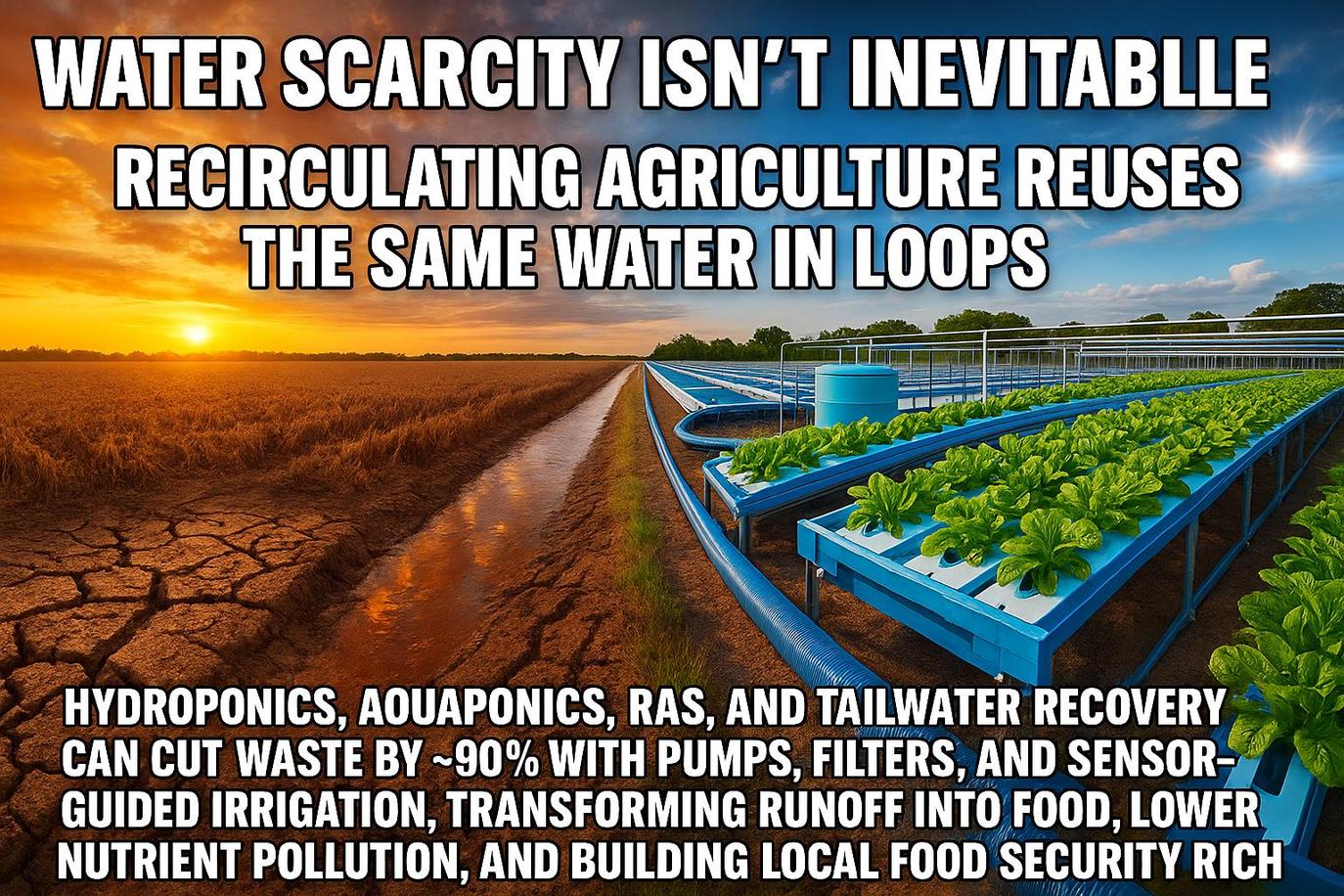
Key Facts: Water Savings and System Components
- Recirculating farms reuse most of their process water; many systems routinely retain 90 percent or more during daily operation.
- Hydroponic and vertical farm designs can cut water use by roughly 80 to 90 percent compared with conventional soil growing when systems are tuned and managed well.
- Aquaponics pairs fish and plants in one loop; fish waste becomes plant nutrients, plants clean the water, and pumps keep the cycle moving.
- Recirculating aquaculture systems (often called RAS) raise fish on land with filtration that returns clean water to the tanks; daily water exchanges are minimal.
- Tailwater recovery captures field runoff in a basin, filters it, and pumps it back to irrigation lines; farms report large gains in application efficiency and reduced nutrient loss.
- Neighborhood-scale projects can stack these approaches in warehouses, rooftops, parking decks, and floating platforms to create steady local harvests and green jobs.
Defining Recirculating Agriculture and Core System Families
Recirculating agriculture refers to food production methods designed to keep water within a managed loop, maximizing water use efficiency. The managed loop uses pumps to move water through filters and grow beds, while sensors guide dosing and flow, and efficient designs minimize exposure to sun and wind that would otherwise waste water.
The Four Main System Families
Recirculating Hydroponics:
Plants grow in channels or buckets supplied by a nutrient solution that returns to a reservoir, gets filtered, and is reused. The principles of hydroponics basics confirm how soilless growing cuts water use in closed loops with pumps, reservoirs, and dosing controls.
Aquaponics:
Fish and plants share a loop. Mechanical screens remove solids, biofilters convert dissolved ammonia into plant-available nitrate, plants absorb those nutrients, and cleaner water returns to the fish. The loop reduces both water withdrawals and waste discharge.
Recirculating Aquaculture Systems (RAS):
Land-based fish farms that reuse the great majority of water through filtration and oxygenation. RAS can locate near cities, shorten cold-chain costs, and reduce pressure on freshwater bodies when designed responsibly.
Recirculating Irrigation and Tailwater Recovery:
In fields or greenhouses, runoff is captured in a basin, filtered, and pumped back into drip or micro-sprinkler lines. This approach improves water application efficiency and limits nutrient losses to waterways.
Tip for small spaces:
Lack of a yard does not end the conversation. Many readers start with compact containers, rooftops, or simple hydro towers that apply no-yard growing methods.

How Recirculating Systems Save So Much Water
The effectiveness of water recirculation stems from its control over key water loss points: evaporation from exposed soil, runoff from over-irrigation, and deep percolation beyond the root zone. Closed loops capture and reuse water, and precise dosing gives plants what they need without excess.
Where Farms Lose Water Today
- Evaporation from bare surfaces: Open furrows and unshaded soil heat up and shed moisture to the air.
- Runoff during irrigation: When water is applied faster than the soil can absorb it, it escapes the field, carrying nutrients with it.
- Deep percolation: Water sinks below root depth before plants can use it.
- Inefficient delivery: Uniform “set and forget” watering schedules often apply more water than plants require.
Hydroponics and Vertical Farms: Squeezing More from Each Drop
How the loop works. A reservoir feeds channels or buckets; return lines carry unused solution back for filtration and reuse. Because roots and water are shielded from wind and sun, evaporation is far lower than in open soil. A recent review finds water use can drop by more than 90 percent in well-tuned greenhouse hydroponics.
Design choices that amplify savings:
Specific design choices amplify the water savings achieved by Vertical Farming and hydroponic systems. These adjustments ensure maximum efficiency and minimal waste in the process water loop:
- Limit heat gain: Use covered channels or opaque buckets that limit light and heat gain.
- Maximize capture: Incorporate recapture trays beneath gutters to catch every drip.
- Curb evaporation: Ensure reservoirs are closed with simple lids to curb evaporation.
- Optimize dosing: Group plants by similar water and nutrient needs for precise crop planning.
By implementing these low-cost design features, operators significantly enhance the water use efficiency and overall sustainability of their operation.
Quality and consistency:
Recirculating hydroponics gives steady moisture and nutrients, which supports uniform growth and reduces losses from stress. Industry momentum highlights emerging vertical farming trends that pair automation with energy-aware irrigation in controlled environments.
Aquaponics and RAS: Fish and Plants in a Shared Loop
Aquaponics in practice:
Fish tanks produce solids and dissolved ammonia. Published reviews confirm up to ~90 percent water-use efficiency in properly balanced aquaponic loops. Mechanical screens remove solids, biofilters convert dissolved ammonia into plant-available nitrate, plants absorb those nutrients, and cleaner water returns to the fish; the entire loop reduces both water withdrawals and waste discharge.
RAS fundamentals:
In recirculating aquaculture, highly efficient mechanical and biological filters maintain water quality so that only small amounts of makeup water are needed, with daily exchange often under 1 percent in mature designs. Oxygenation and gentle flow keep fish healthy while conserving water.
Keys to real-world performance:
- Right-sized pumps and pipes that avoid energy waste from excessive head pressure.
- Backup aeration for resilience during power outages.
- Routine testing of pH, dissolved oxygen, and nitrogen compounds to keep the loop balanced.
Recirculating Irrigation and Tailwater Recovery
Why it matters:
Even modest capture basins can transform irrigation efficiency by turning yesterday’s runoff into today’s supply, and documented programs show irrigation efficiency gains of roughly 25–30 percent. Filtration removes sediment and pathogens; low-horsepower pumps lift water back to lines without the energy burden of high-pressure systems.
Simple upgrades that add up:
- Tailwater basins with gentle slopes for easy maintenance.
- Sand or fabric filters ahead of the pump to protect emitters.
- Drip or micro-sprinkler lines tuned to crop stage and soil moisture.
Complementing tailwater recovery, broader water-smart irrigation practices modernize on-farm water use.

Urban Application: Building Local Food Security Infrastructure
Recirculating systems fit where people live. These systems become powerful tools for improving food access, education, and local job creation.
Communities can convert rooftops, warehouses, school courtyards, and idle waterfronts into steady harvests that circulate money and skills close to home.
What this Looks Like on the Ground
- Rooftop and warehouse farms: Modular hydroponic or aquaponic racks produce greens, herbs, and seedlings year-round near urban markets. Household-scale indoor hydroponic growing systems show how consumer kits support leafy greens in small apartments.
- Floating platforms: Coastal and lakeside cities pilot solar-pumped greenhouses that draw from brackish or rain-harvested water. A critical example of this concept is the modular floating greenhouse concept, demonstrating feasibility for urban deployment.
- Compact vertical gardens for schools and clinics: High-density towers demonstrate water loops, nutrition, and plant science in small footprints. Hands-on vertical garden towers demonstrate density and compost integration in a small footprint.
Building for True Sustainability
- Energy first: Favor daylight, reflective surfaces, and insulation before adding lights or cooling. Where electricity is needed, pair efficient pumps with solar where feasible, and apply envelope strategies from energy-efficient modern buildings.
- Water sourcing: Blend rain capture with recirculation. In coastal or arid regions, modular solar desalination can supplement supply without grid power.
- Local training and jobs: Partner with schools, workforce boards, and nonprofits so operations develop local talent in horticulture, aquaculture, plumbing, and electrical work.
Getting Started as a Community
- Map underused spaces such as rooftops, empty buildings, and parking decks.
- Begin with a pilot rack or classroom-scale aquaponics loop to build skills and trust.
- Track savings and yields with simple logs so funding partners can see progress.
- Expand in stages:
- add a tailwater basin for nearby gardens
- then a small RAS unit
- then a greenhouse that ties the pieces together.
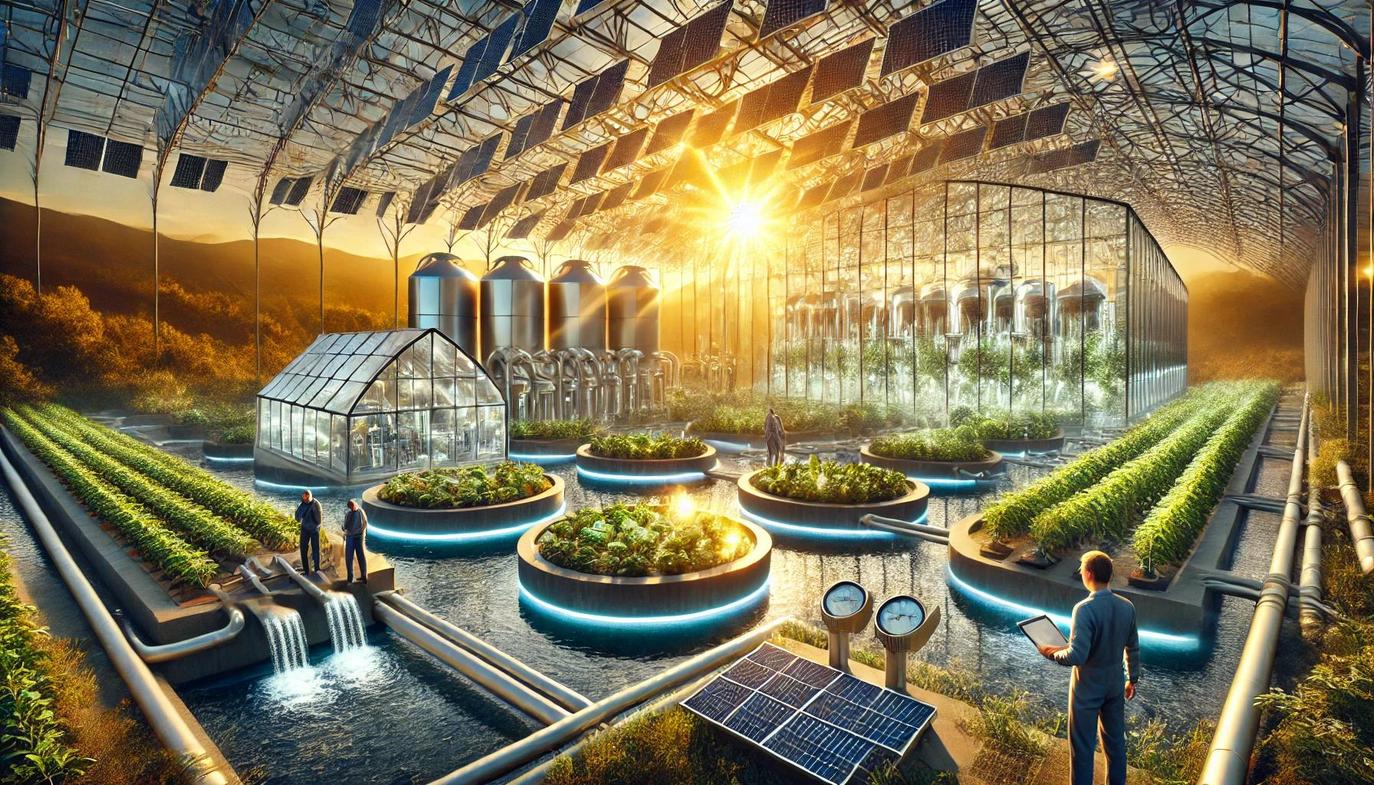
Design Principles: Energy, Water, and Long-Term Sustainability
Achieving water savings requires balancing the entire system, ensuring long-term efficiency. Good projects plan energy, biology, and operations together so that savings on one side do not create burdens on another.
The following design rules of thumb keep projects resilient and responsible.
Right-Size Energy from Day One
- Use daylight first with reflective surfaces, light shelves, and shade screens before adding electric lighting.
- Choose high-efficiency pumps, short pipe runs, and gentle elevation changes to avoid wasted head pressure.
- Where possible, align pump cycles with local solar production and add simple timers. Design choices, such as using appropriate building envelopes and layouts detailed in efficient farm buildings, significantly improve performance.
- Add basic power backup for aeration so fish and microbes stay safe during outages.
Water Quality and Biosecurity
- Filtration must be treated as a chain: solids removal, biofiltration, and polishing filters are distinct steps, each protecting the next.
- Test pH, temperature, dissolved oxygen, and nitrogen compounds on a routine schedule. Simple meters and logs are enough for small systems.
- Quarantine new fish or seedlings and sanitize tools between tasks to prevent disease transfer.
Materials and Layout that Prevent Waste
- Cover reservoirs and channels to limit evaporation and light-driven algae.
- Group crops by similar nutrient and water needs so dosing stays precise.
- Design floors with floor drains and capture trays so every spill returns to the loop.
- Employing precision irrigation and sensor controls to avoid overwatering aligns with core tenets of sustainable construction practices that reduce resource use across the built environment.
Governance, Permits, and Finance
- Check local codes for water reuse, greywater handling, and aquaculture. Health departments and environmental agencies often have clear guidance for small projects.
- Track water, energy, and yield data from the start. Funders and city partners respond to real numbers.
- Combine grants for water efficiency with workforce training funds to support local hiring.
- Conventional fields can participate too by adding tailwater basins and drip lines, an approach that aligns with green eco-industrial planning, where water, energy, and permitting intersect.
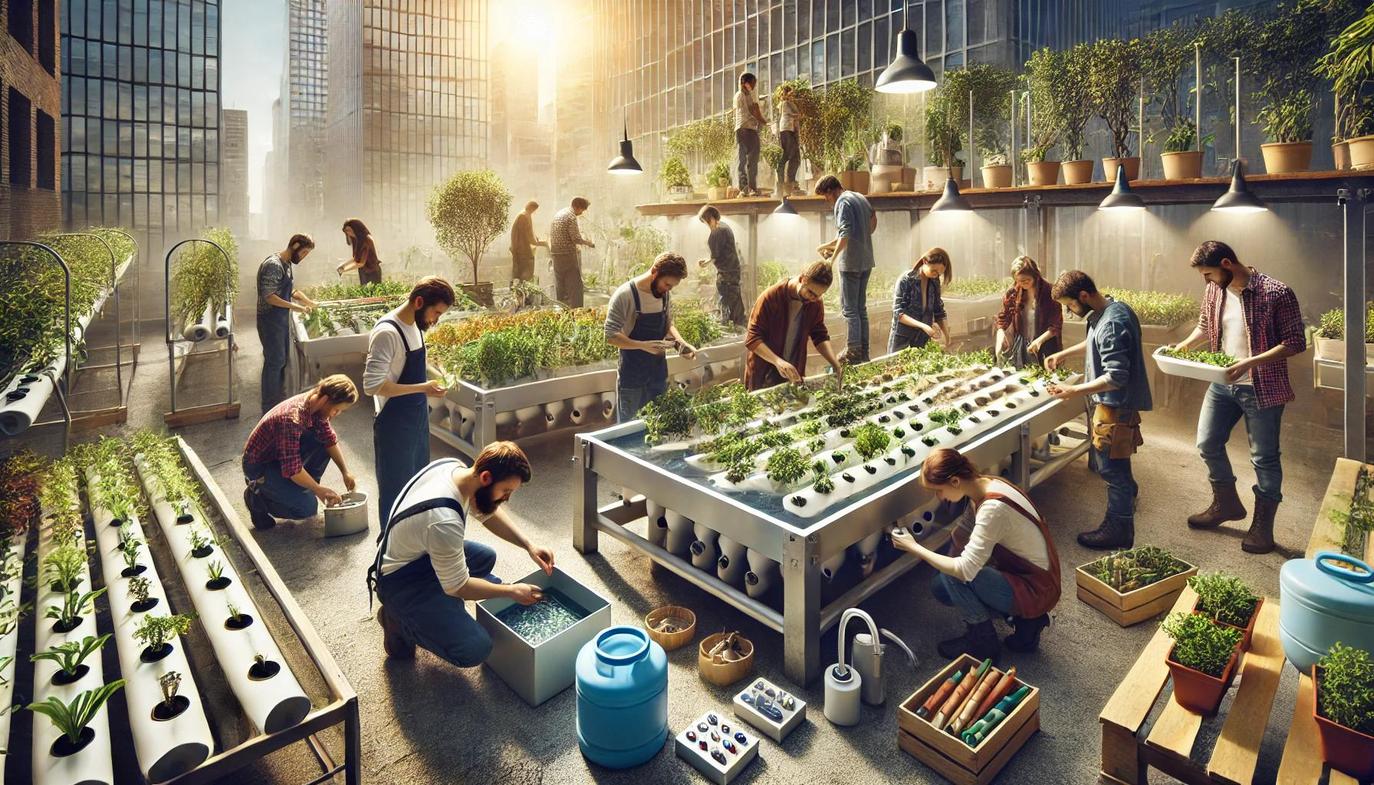
Getting Started: A Step-By-Step Guide for Producers and Communities
Successful projects always start as a focused learning system. Start with a loop small enough to manage and focus on collecting data and sharing results. Once proven, you can safely scale what works.
Start Small and Learn the Loop
- Countertop or balcony hydroponics that teach nutrient mixing, pump care, and sanitation.
- A tiny aquaponic planter that demonstrates how fish, microbes, and plants work together.
- For yards with wet soils, try time-tested Aztec-style chinampa beds that put water to work rather than fighting it. For space-saving ideas, a vertical garden tower design supports up to fifty plants in four square feet.
Scale what Works
- Add a second rack, a small greenhouse, or a tailwater basin for a community garden.
- Pair a modest RAS unit with leafy-green troughs so fish and plants support one another.
- Use simple dashboards or shared spreadsheets so volunteers and partners can see weekly trends.
Build the Team and Training
- Partner with schools, libraries, and local nonprofits for classes in horticulture, aquaculture, plumbing, and electrical basics.
- Plan paid internships for youth and career-changers to keep knowledge in the neighborhood.
- Learn from peers who already practice regenerative methods. A specific resource documents farmer-led approaches: young farmers pioneering sustainable regenerative agriculture.
Funding Paths and Partnerships
- Mix small grants, city resilience funds, and community investment notes.
- Ask water utilities and watershed groups about incentives tied to reduced withdrawals and cleaner discharge.
- Approach restaurants, schools, and hospitals early so product specs and food-safety needs shape the design.

Blue-Green Circular Economy: Water and Nutrient Synergy
Recirculating farms are not only efficient with water, but they are also engines that keep resources circulating. The concept relies on two core loops working in tandem.
The blue loop keeps water moving through filters and grow beds so that withdrawals stay low and discharges stay clean. The green loop turns fish waste and plant residues into nutrients that feed the next round of growth.
When designs connect both loops with sensible energy choices, the result is a compact circular economy for food.
Water and Nutrient Loops, Explained
- Water quality as the driver: Water quality drives the loop: Mechanical screens pull out solids, biofilters convert dissolved ammonia into plant-available nitrate, plants absorb those nutrients, and cleaner water returns to tanks or reservoirs.
- Nutrient capture instead of nutrient loss: In open systems, nitrogen and phosphorus often wash away. In a loop, those same nutrients produce leaves, fruit, and fish rather than pollution.
- Stacked functions: Warm exhaust air can preheat incoming air. Grow lights can be scheduled to match off-peak solar production. Spent plant roots can become compost tea for soil beds.
Linking Blue-Green Loops to Infrastructure
Circular farms integrate seamlessly into other community systems. Rain capture and on-site treatment shrink withdrawals. Efficient pumps paired with rooftop solar lower operating costs. In coastal or arid places, modular electricity-free solar desalination can top up supply without grid power. One circular farm infrastructure case links clean energy with water purification and fertilizer synthesis.
The Local Food Future: Recirculating Systems for Water Resilience
Water scarcity limits modern food production, making recirculating farms essential infrastructure rather than just clever techniques. By keeping nutrient loops and water cycling efficiently, these systems secure local food security, create steady jobs, and dramatically reduce strain on rivers and aquifers.
Whether the first step involves a countertop hydro tower or a rooftop greenhouse, the path forward remains consistent: master the loop, track water use efficiency numbers, and scale the design that proves its worth. When communities treat these blue-green loops as vital infrastructure, drought evolves from a dead end into a design challenge.
Essential Questions About Recirculating Agriculture and Water Use Efficiency
Water Savings: Quantifying Efficiency in Small-Scale Hydroponic Systems
Savings vary by design and climate, but many well-run home hydroponic and aquaponic systems use a fraction of the water of container soil gardens because they capture and reuse what plants do not take up.
Sustainability Metrics Beyond Water Use Efficiency
They are more sustainable when energy and materials are planned alongside water. Daylight, efficient pumps, short pipe runs, and renewable power keep footprints low. Poorly planned lighting or oversized pumps can erase water gains.
Contribution to Neighborhood Food Security and Supply
They work best as a backbone for perishable produce and some fish protein, integrated with soil farms and regional producers. The goal is a steady, nearby supply rather than total replacement of all imports.
Core Skills Required for Recirculating System Beginners
Basic water testing, pump and filter maintenance, clean handling, and simple record-keeping. Most readers learn these skills quickly by starting small and scaling gradually.
Selecting the Right Crops to Start Growing First
Begin with fast, forgiving crops such as leafy greens, basil, and herbs. Add fruiting crops after you have consistent temperature, light, and nutrient control. If adding fish, start with hardy species recommended by local extension agents.
Resources for Further Planning and System Design
Planning resources for structures and space-efficient systems includes commercial greenhouse design insights and design guides for compact home gardening systems.


