
Spain and Morocco have restarted technical work on the Spain-Morocco fixed link under the Strait of Gibraltar, a move that establishes a vital Mediterranean trade corridor, evolving beyond a mere transport symbol into a permanent pillar of intercontinental connectivity. Strategic infrastructure serves as a trade route insurance policy against economic shocks following blocked shipping lanes. When a narrow channel tightens, the economic impact of global trade bottlenecks reshapes freight pricing immediately, forcing companies to pay a high price for logistical certainty.
Market-driven logic regarding global maritime reliability keeps corridor planning active even while the subsea rail infrastructure remains years away. In warehouses far inland, advanced logistics inventory management software reduces damage when arrival dates slip, allowing managers to lean on multimodal transport redundancy rather than logistical guesswork.
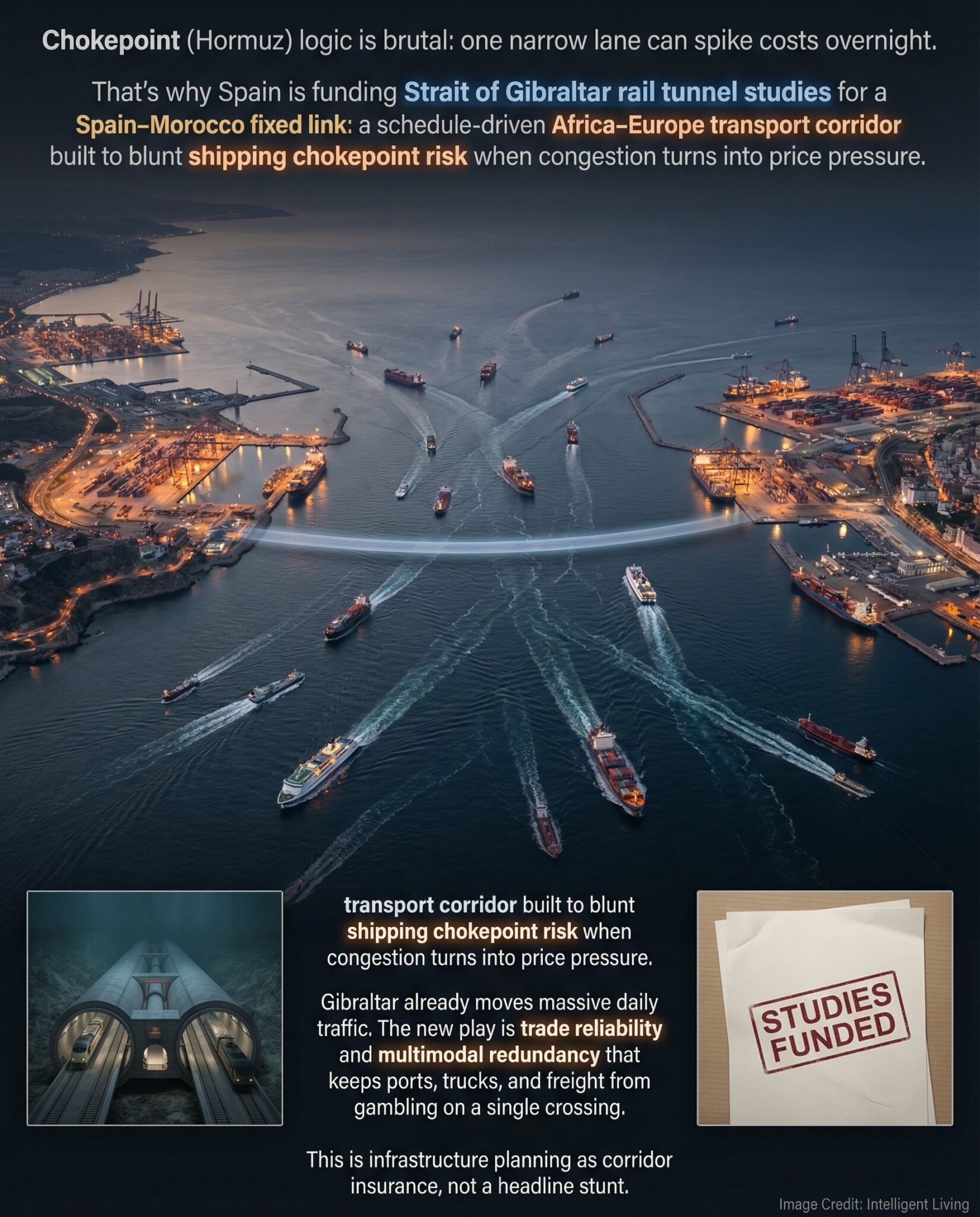
Strategic Signals: Funding Technical Studies for the Spain-Morocco Fixed Link
SECEGSA Technical Advancements: Recent Project Pipeline Updates
Spain recently authorised new money for Spain’s technical studies for the Mediterranean corridor, revisiting a proposal that has resurfaced periodically within diplomatic and logistics circles for decades. Allocated funding focuses on engineering precision rather than imminent construction. This targeted approach ensures project viability before physical excavation commences.
Expert engineers now focus on mitigating the structural and financial variables that often jeopardise large-scale infrastructure projects. Primary research targets include alignment accuracy, seabed geology, and overall project cost.
Quiet steps of this nature usually precede serious procurement. A published agreement on marine geology research in the Strait of Gibraltar helps explain why the project persists across governments. Technical work remains focused on measurement and uncertainty reduction, signalling a steady push toward viability. Industry veterans recognise the pattern when multiple research tracks converge on the same corridor, signalling a shift from study to implementation.
Current Project Status: High-Value Quick Facts and Funding Signals
Minor funding signals often mask massive strategic shifts, revealing the pipeline status despite modest initial budgets. Current milestones define the project’s specific pipeline placement, separating documented reality from conditional engineering forecasts.
- Status: Study phase, where the official preliminary design update for the fixed link keeps the blueprint active inside formal planning channels.
- Study Funding: Current allocations sit in the low millions, and SECEGSA’s public research coordination mandate helps explain why early money goes to studies, not excavation.
- Reported Lengths: The 38.7-kilometre reference alignment describes one plausible concept, while other reporting counts longer approach corridors as part of the total system.
- Cost Range: Popular estimates cluster around a 15-to-20-billion-euro corridor price tag, yet the number changes depending on whether you include terminals, approach tracks, and national upgrades.
- Expected Horizon: Analysts increasingly frame first operations as a mid-to-late-2030s outcome. This perspective aligns with Spanish technical backing for the Morocco rail tunnel while accounting for inevitable schedule shifts.
These metrics define a project moving through a rigorous validation cycle. Converting these data points into a buildable sequence remains the primary hurdle for intercontinental connectivity.

Infrastructure Resilience: Technical Logic of the Subsea Rail Infrastructure
Subsea Alignment and Design: Technical Specifications for Rail Connectivity
Planning a subsea rail tunnel of this scale demands more than a shortest-distance crossing; it requires a complex negotiation with geological reality. Geological formations and seabed depth dictate both the alignment and the excavation approach. These technical constraints often shape the nuanced, sometimes diverging, narratives shared by public officials during early-stage development. In tunnel planning, a few kilometres of deeper, weaker ground can change ventilation needs, emergency egress strategies, and the tunnelling technology required.
Global logistics patterns reflect the inherent constraints of the Gibraltar project, where avoiding weak geological formations remains the only buildable route. A Gibraltar tunnel alignment has a similar constraint, because the path that avoids the worst rock and the deepest trench can be the path that keeps the project buildable.
Rail First: Operational and Safety Logic
Rail is the default technical choice for a long subsea link because it simplifies key safety challenges that become harder at extreme length and depth.
Electrified rail eliminates the burden of managing massive exhaust and heat loads inherent in long-distance subsea crossings. This mode supports predictable scheduling for both passengers and freight, ensuring high-frequency reliability. Time-sensitive cargo requires more than a simple crossing; it demands the repeatable reliability of a schedule-driven rail corridor. A rail-based fixed link is designed to deliver that kind of repeatable reliability.
Network Integration and Interoperability
A fixed link remains viable only if trains connect to national networks without constant workarounds. Spain’s rail modernisation includes Spain’s shift toward standard-gauge high-speed rail to align with European interoperability standards.
Simultaneously, Morocco has demonstrated capacity through the Tangier–Kenitra intercity high-speed rail corridor, proving that long-distance rail attracts riders at scale. Integrated networks provide the necessary endpoints for the tunnel, ensuring it serves a broader continental trade corridor rather than acting in isolation.
Logistics Redundancy: Addressing Global Maritime Chokepoint Risks
Risk math remains the primary driver behind the project’s persistent resurfacing within global logistics circles.
Narrow maritime channels concentrate global flows. Disruptions in these lanes trigger fuel price shocks and fragmented schedules, forcing companies to maintain costly inventory buffers. Risk management focus shifts toward visibility, redundancy, and decision speed when variability threatens margins. Innovative supply chain resilience fixes that hold up under stress prioritise adaptability over rigid forecasting models.
Economic pressure fuels recurrent corridor politics, positioning the tunnel as a strategic buffer when delays outweigh distance costs. The tunnel is not being pitched as a replacement for ships. It is being discussed as a strategic option, a way to turn a volatile crossing into a timetable-driven one when delays become more expensive than distance.
Gibraltar Already Behaves Like a Global Gate
Beyond theoretical risks, the Strait of Gibraltar functions as a high-volume maritime artery, moving roughly 300 ships daily through a critical global bottleneck, a daily volume that keeps the corridor on every planner’s map. That baseline traffic is why the corridor attracts strategic attention even when a tunnel is still years away.
Beyond commercial shipping, the crossing functions as a vital seasonal corridor for intercontinental transit, absorbing massive surges in families, freight, and border system traffic. When that pressure builds, reliability stops being an abstract concept and turns into missed departures, delayed deliveries, and costly reroutes.

Trade Corridor Logistics: Ports, Peak Seasons, and Subsea Engineering Constraints
Unified Gateway Strategy: Integrating Tanger Med and Algeciras Hubs
Logistics hubs across the African and European shores, Tanger Med and Algeciras, operate as a unified gateway system on an immense scale. The Moroccan hub has expanded into a high-throughput platform managing intense passenger and freight surges. Specifically, Tanger Med’s 10 million container milestone captures the rapid scaling of this regional supernode.
Latest 2024 Tanger Med activity figures highlight intense passenger movement and operational scaling across the African hub. Tightening supply chains turn these operational metrics into a critical insight: while capacity and demand are present, the primary scarcity remains time-certainty.
Algeciras: The Ro-Ro Freight Bridge in Plain Numbers
On the European side, more than 460,000 heavy goods vehicles per year pass through Ro-Ro lines that connect Algeciras with Ceuta and Tanger Med, a reminder that this corridor already functions as a working freight bridge. A single missed slot cascades across yard schedules and driver hours, manifesting quickly as invisible but significant bottom-line costs.
Where a Rail Link Changes the Decision
When variability hits, third-party logistics coordination can reduce the damage by rerouting loads, consolidating paperwork, and tightening handoffs across borders without forcing shippers to rebuild their entire network. A fixed rail link would not erase weather or congestion, but it could add an option whose value comes from repeatability.
Engineering Feasibility: Navigating the Strait of Gibraltar’s Geological Constraints
Long subsea tunnels are feasible with modern technology, but feasibility does not mean simplicity. Rock quality, layered sediment, and faulting risks determine the pace of a tunnel boring machine. geoscience collaboration tied to SECEGSA studies emphasises that mapping and measurement must precede excavation.
Exploratory boreholes, seismic mapping, and rigorous alignment refinement now dominate the project’s immediate technical agenda. That sequence also explains the timeline realism. Before any national budget can justify billions, the project must prove it can move from concept to buildable engineering, with evacuation planning, service access, and risk management mapped in detail.
In factories and distribution centres, automated smart manufacturing decision tools prioritise shorter decision loops, acknowledging that missed slots can halt a production line faster than traditional models predict.
Cost Variance and Funding Pathways
Cost estimates swing because different figures refer to different scopes. Some reports bundle corridor upgrades, terminals, and long approach sections together, while other numbers isolate national shares or near-term preparation.
In freight circles, a practical divider is whether an estimate counts just the tunnel bore and core systems or also the approach lines and terminals, a distinction highlighted in analysis regarding rail freight reporting on the Herrenknecht feasibility study that frames the project as complex but possible.
Seasonal Logistics Management: The Summer Migration Stress Test
Every year the crossing between Spain and North Africa becomes a mass-movement exercise of people and vehicles, where peak vehicle transit during Operation Crossing the Strait shows why reliability feels personal.
Seasonal peaks push ports, ferries, and border processing systems into concentrated surges. These peaks turn timing into the critical difference between a smooth trip and a long, stressful wait. Spain’s official reporting on Operation Crossing the Strait 2024 totals documents millions of passengers and hundreds of thousands of vehicles moving in a defined summer window. Anyone who has timed travel around a narrow departure slot knows how quickly a small delay becomes a crowd.
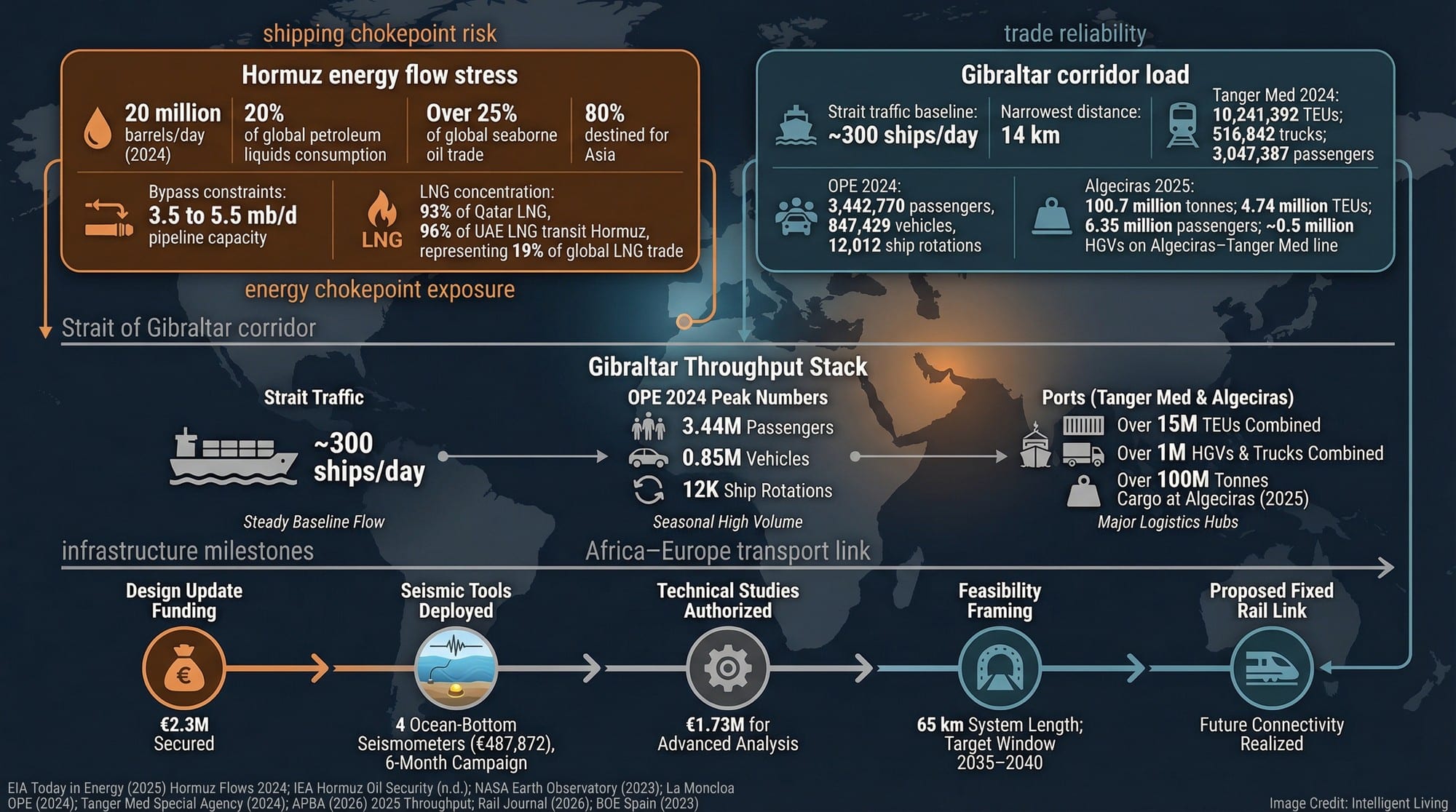
Global Trade Nexus: Current Operational Uses and Infrastructure Milestones
Multimodal Gateway Operations: Current Usage of the Gibraltar Corridor
Logistics planners currently manage immense pressure across the Gibraltar gateway through multiple high-volume channels. Existing infrastructure supports a complex mix of passenger, freight, and maritime traffic that defines the region’s strategic value:
- Seasonal mass mobility moves on a multi-million passenger scale during peak windows, as evidenced by OPE 2024 crossing totals.
- Roll-on/roll-off trucking lanes function as a working bridge, with APBA traffic statistics reflecting heavy goods demand.
- Tanger Med’s container growth turns the Strait into a global routing supernode.
- Daily ship traffic makes the Strait a persistent maritime artery sensitive to delays.
- Proposed rail infrastructure would act as a reliability multiplier for prioritised freight.
Transitioning to a rail-based model offers the necessary redundancy to protect these critical trade routes from future volatility. This infrastructure pivot directly addresses the growing vulnerability of resource supply chains across the globe.
Resource Resilience Nexus: Energy, Food, and Critical Mineral Security
Chokepoints hit different parts of the economy in unique ways. Geopolitical shocks combined with packaging compliance risks reshape supply chains, often transforming a transport narrative into a broader national resilience story. Fuel price volatility touches every sector, making energy flows a primary indicator of chokepoint-driven economic stress.
The U.S. Energy Information Administration notes that 2024 Hormuz oil flows averaged about 20 million barrels per day, which is why any disruption narrative instantly becomes a global pricing event. When freight insurance spikes and rerouting adds days, the shock can show up in consumer goods long before it shows up in headlines.
Structural bottlenecks like those described in the IEA profile of Strait of Hormuz risk demonstrate how limited bypass capacity amplifies global economic stress. While the straits differ, the Gibraltar project addresses the same fundamental economic aversion to single points of failure.
Fertiliser and Food Inputs Carry their Own Fragility
Food systems carry their own version of chokepoint risk. The heightened food security risks of fertiliser inflation link shipping volatility directly to staple price increases, a chain that can raise the cost of basic staples without a single farm changing what it grows.
Critical Minerals Behave like Precision Bottlenecks
Critical minerals behave like precision bottlenecks. The logistics vulnerability of critical mineral supply chains illustrates how constraints in refining or export licensing can rapidly throttle high-tech manufacturing and defence capabilities.
Why Gibraltar Still Matters in that Bigger Picture
Industrial exposure is rarely one-dimensional, as shown in the analysis of China’s strategic Hormuz chokepoint exposure, where planners quantify vulnerability across refineries and freight margins. The Gibraltar conversation sits in that same mental model, a corridor where redundancy is not a slogan – it is a cost control tool.
Project Implementation Roadmap: Key Milestones to Watch Next
- Formal delivery of the updated pre-project design represents a critical milestone, signalling a move toward buildable engineering sequences, a process described in the INECO roadmap for the Strait tunnel update.
- A clarified location for the Spanish-side terminal and its rail connection plan would signal that the project is moving from concepts into land use and network integration decisions.
- Published results from seafloor mapping campaigns and the associated data management work would reduce uncertainty about the physical environment that the tunnel must cross.
- Any procurement package that separates early investigative works from the main bore contract would indicate that budgeting has started to match construction sequencing.
- A public financing structure that clarifies the split between national funds and European mechanisms would be a decisive indicator that the project is being positioned for long-horizon delivery.

Strategic Trade Certainty: How the Africa-Europe Transport Link Redefines Reliability
A fixed link under the Strait of Gibraltar represents a fundamental shift in infrastructure planning, treating the Spain-Morocco fixed link as high-stakes risk insurance rather than a standard transport upgrade. The revived SECEGSA technical studies prove that decision-makers are now willing to invest in strategic corridor planning to bypass the inherent volatility of the world’s narrowest shipping lanes. Positioning this corridor as a logistics supernode allows planners to turn a historically unpredictable crossing into a repeatable, schedule-driven asset.
Investing in this Africa-Europe transport link signals a move toward multimodal transport redundancy that transcends local transit. Current technical analysis quantifies the value of logistical certainty amid mounting global chokepoint pressures. As the Mediterranean trade corridor matures, the value of a subsea connection will be measured not just in tonnes of cargo moved but in the stability it offers a fragile global economy.
Technical Insights: Spain-Morocco Subsea Rail Infrastructure FAQ
Is the Spain-Morocco fixed link currently approved for construction?
Authorised construction remains pending as teams focus on the infrastructure de-risking phase and updated strategic corridor planning models.
Why do the cost estimates for the Spain-Morocco subsea rail link vary?
Discrepancies in cost estimates for the Spain-Morocco subsea rail link typically stem from differing scopes, such as whether reports include terminal construction and inland rail modernisation.
Would the Strait of Gibraltar rail tunnel replace existing ferry services?
Rail connectivity complements existing ferries by offering a high-capacity reliability option for time-sensitive freight shipments, while ferries maintain flexible volume for seasonal peaks.
What are the primary engineering challenges of subsea tunnels under Gibraltar?
The engineering challenges of subsea tunnels under Gibraltar revolve around extreme depths and complex Strait of Gibraltar geology, specifically fault zones and sediment stability.
How long is the Strait of Gibraltar rail tunnel reference alignment?
Primary blueprints utilise a 38.7-kilometre reference alignment, though total corridor length expands when factoring in approach tracks and land-based connections.


