
In Fukuoka, a pioneering seawater desalination center is transforming industrial discharge into a reliable source of 24/7 electricity. Mamizupia was built for water security first, maintaining a seawater desalination capacity of 50,000 m3/day that stabilizes local taps when rainfall becomes unpredictable.
The site’s recent expansion introduces a sophisticated osmotic recovery system that activates after the primary desalination cycle. Instead of treating concentrated brine and treated wastewater as separate end points, the site uses osmosis to recover net power from a salinity difference that already exists inside the city’s water system.
Implementing this advanced pressure-retarded osmosis (PRO) cycle enables Fukuoka to model a circular resource recovery infrastructure. This architecture converts high-salinity discharge into a reliable, decentralized power source for the surrounding municipal grid. This transition from disposal to generation represents a critical shift in how coastal cities can stabilize their electrical loads during extreme weather events.
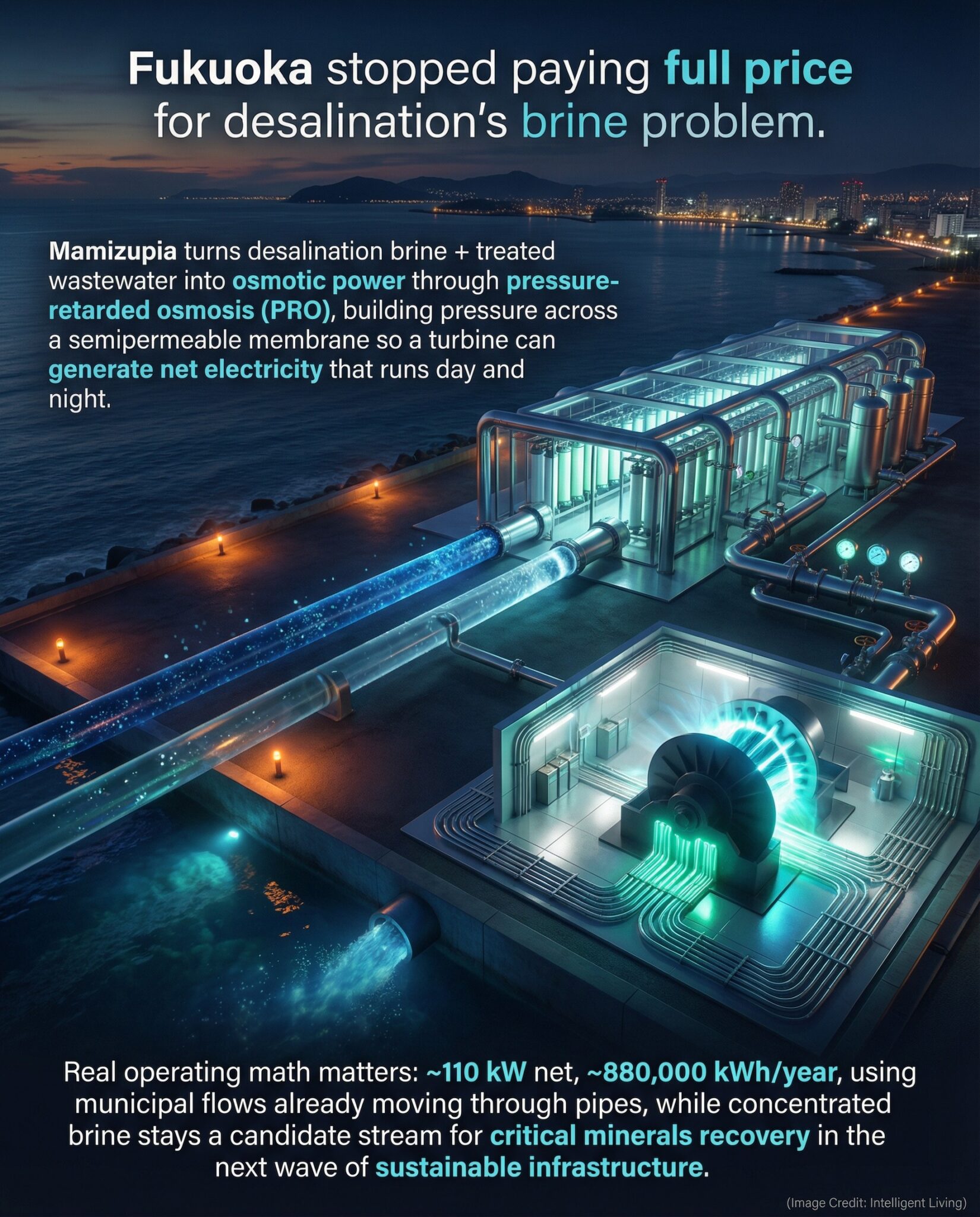
Mamizupia Project Framework: Operational Metrics and Strategic Value
Key Performance Data: Japan’s Salinity-Gradient Power Plant Metrics
These operational figures delineate the specific capabilities of Japan’s newest energy recovery asset. While the project produces a modest net kilowatt output, it offers critical insights into salinity-gradient power and industrial brine management. This data confirms the stability of a 24/7 renewable energy profile that municipal utilities can reliably schedule.
- Location and operator: At the Uminonakamichi Nata Seawater Desalination Center, the Fukuoka osmotic generation pilot program integrates energy recovery into daily utility operations.
- What it uses: The system utilizes a specialized salinity-gradient membrane module to pair concentrated desalination discharge with treated wastewater, creating the necessary hydraulic pressure.
- Net output target: Official operational notices for the osmotic unit confirm a net output of approximately 110 kW, ensuring that generation consistently exceeds the energy consumed for control and pumping.
- Annual generation estimate: The same notice frames a maximum annual output on the order of 880,000 kWh and an equipment utilization near 90%.
- Daily flow context: The throughput scale is defined by documented waterworks flow volumes that show daily processing of 10,000 m3 of brine and 9,000 m3 of treated wastewater.
Two specific metrics deserve attention because they describe operational behavior rather than hype: high utilization and net output.
When a salinity-gradient power system runs consistently throughout the year and clears pumping losses, it shifts from an experimental demo to a functional municipal asset.
Strategic Infrastructure Analysis: Evaluating the Fukuoka Utility Add-On
Scalable Utility Solutions Over Megawatt-Scale Generation
Japan did not build a megawatt-class osmotic power plant. Instead, it engineered a repeatable utility add-on that transforms brine disposal into a steady energy recovery loop.
Conceptualize the facility as two high-volume pipelines once viewed as liabilities. This infrastructure is now enhanced by an energy-capturing module strategically placed before the final discharge point.
Impact of Brine Salinity Gradients on Osmotic Pressure Efficiency
Data from the Mamizupia pilot program summary highlights that concentrated seawater can reach 8% salt, enabling steadier generation regardless of the time of day. In simple physics, a bigger salt gap can create a stronger osmotic pressure gradient, which is the pressure source the turbine tries to harvest.
Circular Infrastructure Models for Multi-Output Resource Recovery
This is why the project feels bigger than its kilowatts. It achieves a multi-output ocean-refinery model where a single intake supports both water production and hydrogen generation.
The strategy also aligns with emerging solar canals over existing waterways as another water-plus-energy design that builds on infrastructure people already maintain. The common thread is practical: reuse the corridors, pumps, and rights-of-way that cities already pay to keep alive.
Municipal Reliability and Grid Stability During Peak Demand
During a dry summer, the conversation shifts from membranes to municipal reliability and rising utility bills.
A system that quietly harvests energy from existing discharge flows helps stabilize operations. This buffer is especially valuable when local electricity prices spike during extreme heat waves. Steady output from the sea is drawing interest elsewhere as well: ocean thermal energy conversion, which generates power from the temperature difference between warm surface water and cold depths, put its first purpose-built offshore platform in the water off the Canary Islands in 2026.

How the Mamizupia Osmotic Power System Works and Performs
Fluid Dynamics and Membrane Technology at the Fukuoka Site
Core Mechanics of Pressure-Retarded Osmosis (PRO) Technology
Osmosis is the tendency of water to move through a special membrane from a less salty solution to a more salty one. In pressure-retarded osmosis, engineers add controlled pressure on the salty side so the incoming water increases the flow and pressure enough to spin a turbine.
The pressure-retarded osmosis membrane mechanism functions as a controlled gate for water molecules. This process converts salinity differences into mechanical work through several key behaviors:
- Hydraulic Pressure Battery: The system continuously recharges as long as a salinity gradient exists.
- Energy Conversion: Inflowing water increases pressure on the salty side to spin a turbine.
- Stable Resource Loop: Concentrated brine and wastewater maintain the necessary salinity difference.
Leveraging High-Salinity Brine for Net-Positive Energy Yields
While natural river and seawater gradients offer limited potential, concentrated industrial brine significantly amplifies the salinity difference.
This heightened osmotic pressure drives the logic behind Mamizupia’s operations. Utilizing desalinated discharge over standard seawater ensures the system can overcome internal energy hurdles.
Active utility deployments must mitigate fouling, manage precise pretreatment protocols, and adhere to strict membrane replacement schedules. Maintaining long-term stability requires addressing technical pressure-retarded osmosis bottlenecks, specifically related to membrane fouling and organic buildup. This is also why pretreatment and cleaning schedules can be as important as the turbine.
Defining Net Power Density in Active Utility Environments
If a turbine produces electricity only for pumps to consume the majority, the facility’s energy balance remains stagnant.
Consequently, official reporting focuses on net power. This figure represents the electricity remaining after all internal pumping and control loads are subtracted from the gross output using a net power density calculation that accounts for every internal load.
Quantitative Performance Review: Documented Net Energy Production
Core Performance Indicators for Municipal Energy Recovery
The facility’s operational success is best defined by three core performance metrics. These figures place the project into a realistic context within the larger Fukuoka waterworks infrastructure:
- Net Output: Approximately 110 kW of power after accounting for all internal loads.
- Annual Yield: Roughly 880,000 kWh per year, supported by a 90% utilization rate.
- Daily Throughput: Processing tens of thousands of cubic meters of combined brine and wastewater.
These performance markers establish the facility as a dependable generator. The plant operates as a high-precision energy recovery loop embedded within Fukuoka’s extensive desalination and wastewater network.
Thermodynamic Limits and Practical Energy Capture Ratios
Thermodynamics sets an upper bound on how much energy is available when fresh and salty water mix. Current feasibility reviews of PRO technology indicate that real-world plants capture a specific slice of theoretical energy due to membrane resistance and pump consumption.
Benchmarking Osmotic Recovery Against Thermoelectric Water Consumption
It is tempting to compare osmotic power to coal or gas, but the honest comparison is not fuel chemistry. The more relevant contrast is water stress. While standard thermoelectric power generation consumes water through massive evaporation, Mamizupia’s osmotic recovery cycle recycles flows that the utility already processes and discharges.
Why This Matters and Where Osmotic Power Goes Next
Mitigating Desalination Energy Burdens and Brine Waste Challenges
Analyzing Electrical Loads in Industrial Seawater Reverse Osmosis
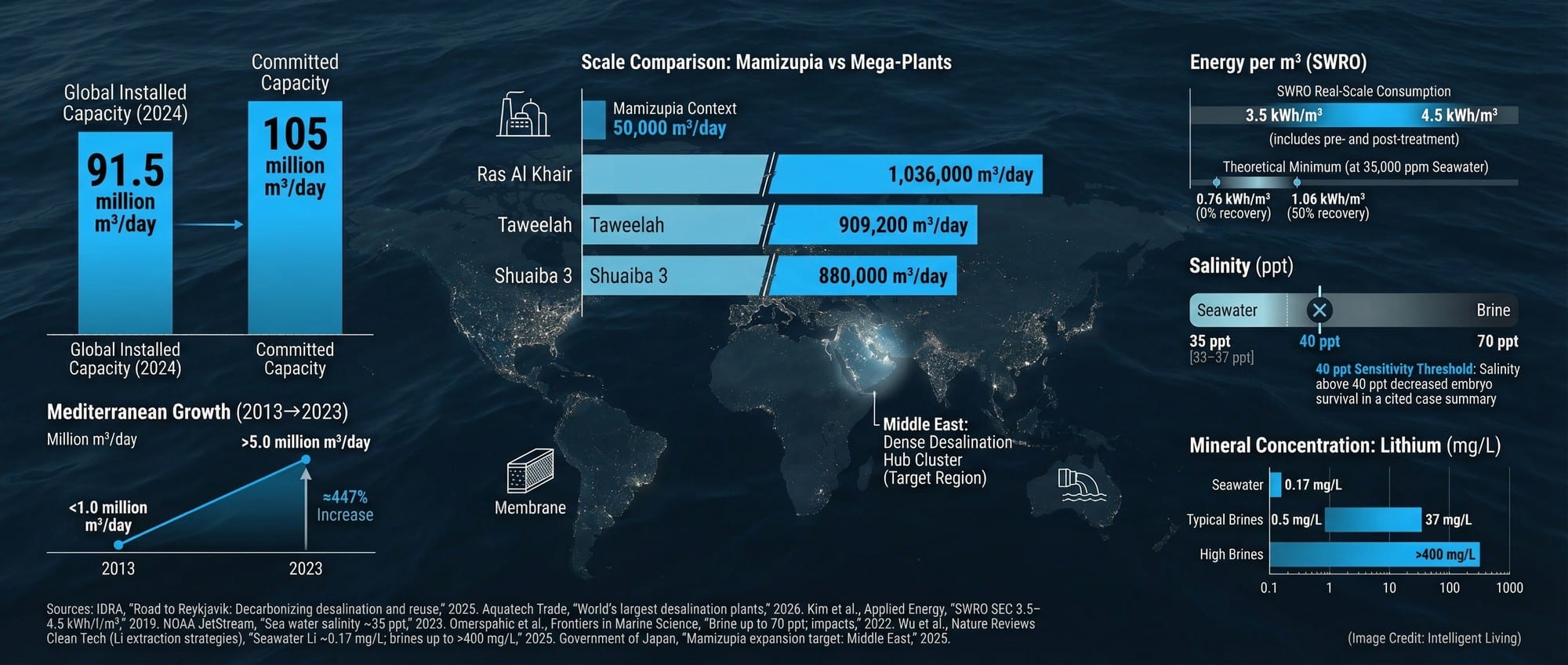
Desalination offers a drought-proof alternative to traditional reservoirs. However, this reliability often comes at the cost of a significantly increased regional electrical load.
The process also creates complex brine management challenges. In Texas, the high energy costs of desalination during drought periods have highlighted how water security concerns directly impact regional power demand.
At the technology layer, a useful benchmark is specific energy per cubic meter. While plants vary, many seawater reverse osmosis systems sit in a multi-kWh per m3 range once pretreatment and pumping are included. Emerging methods, including nanoporous ion-pump desalination technologies, continue to seek lower-loss separations to further reduce these industrial energy burdens. Even incremental net power recovery yields significant municipal gains when integrated with high-throughput daily volumes.
Environmental Stewardship: Reducing Marine Salinity Impacts Through Energy Recovery
Discharging concentrated brine without proper mixing can cause local salinity spikes that stress fragile marine ecosystems.
Studies regarding marine chemistry changes near desalination outfalls explain why managing salinity, temperature, and residual chemicals is vital for ecosystem health.
This circular infrastructure design approach treats brine management as a primary operational constraint rather than an environmental afterthought. In practice, it nudges utilities toward better dilution control, diffuser design, and discharge timing alongside energy recovery.
Integrating Critical Mineral Extraction and Resource Circularity
That same logic shows up in resource recovery. Utilities are increasingly exploring critical mineral extraction from brine streams to offset the costs of desalination and sewage treatment.
Advanced processes like salt-free electrodialysis metathesis aim to shrink final brine volumes while maximizing the yield of usable resources.
Global Deployment Patterns and Future Scalability for Desalination Hubs
Identifying Site-Specific Opportunities for Municipal PRO Replication
Mamizupia achieves this operational synergy by co-locating the seawater desalination center with a sewage treatment facility, allowing the two discharge streams to function as a unified energy source.
Denmark’s SaltPower deployment reached roughly 100 kW, and early deployments, such as the 100 kW osmotic milestone in Mariager, demonstrate the viability of using high-salinity streams for small-scale energy recovery.
Future Market Competition: Solar Desalination and Off-Grid Innovations
Large desalination hubs with heavy brine flows are obvious candidates, especially where electricity costs are high and coastal discharge rules are tightening. At the same time, the sector is also seeing growth in off-grid solar desalination technology, which offers a competing decentralized model for water-plus-energy infrastructure.

Reality Check and What to Watch Next for Osmotic Power
Validation Milestones: Distinguishing Field Success From Lab Theory
Technical Significance of the 110 kW Net Production Milestone
Viewing the 110 kW output as a replacement for conventional grid power is a common misinterpretation. Instead, this project achieves a far more significant technical milestone.
It proves that a pressure-retarded osmosis (PRO) system can maintain net-positive output in a live utility setting. Achieving high availability in the field is a much higher hurdle than achieving results in a controlled lab environment.
Identifying Efficiency Bottlenecks: Fouling and Pressure Losses
Primary operational challenges involve membrane maintenance and long-term stability. Establishing utility-scale osmotic power parameters is critical, as net output and maintenance constraints must be treated as first-order design factors.
Emerging Trends in Hybrid Desalination and PRO Systems
Techno-Economic Analysis: Payback Periods and Operating Costs
Monitoring the techno-economic performance of hybrid configurations—those integrating desalination and pressure-retarded osmosis (PRO) into a single train—is essential for future adoption. Analysis of hybrid desalination and PRO payback periods suggests that commercial adoption depends heavily on membrane durability and local brine concentration.
Next-Generation Membrane Performance and Structural Stability
Future developments will likely focus on power density milestones and long-term operating stability. Recent reviews of Japan’s PRO power density focus on how much on-site energy these systems can reliably offset during long-term continuous operation.
Securing the Future: Scaling Salinity-Gradient Power for Sustainable Desalination
Beyond simple kilowatt counts, Mamizupia serves as a high-efficiency proof of concept, proving that even small-scale generation can stabilize municipal infrastructure. Its value is that it makes desalination and wastewater feel less like separate civic systems and more like one shared resource loop.
Strategically, this system addresses the long-standing challenge of brine disposal’s marine impacts. By utilizing concentrated brine for power before discharge, the plant facilitates better dilution and reduces the local salinity spikes that typically stress coastal ecosystems. This dual-purpose design ensures that water production and environmental stewardship are no longer at odds.
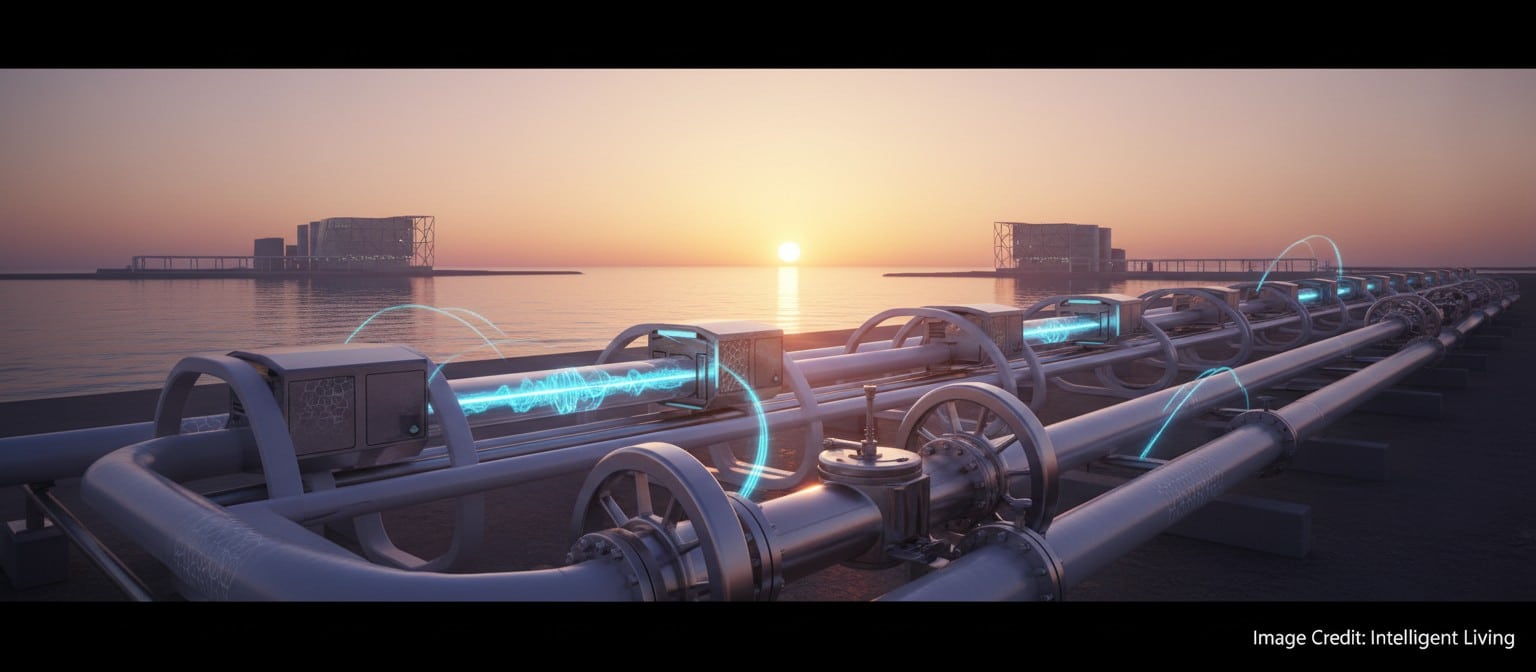
Modern infrastructure design increasingly rewards multi-use thinking. This evolution manifests in water pipelines that carry energy overhead and no-water hydropower energy storage concepts. These innovations are reshaping how gravity and fluids contribute to a resilient power grid.
Common Questions: How Osmotic Power Generates 24/7 Renewable Energy
How does Japan generate power from seawater brine?
The Mamizupia plant uses pressure-retarded osmosis (PRO) to mix concentrated desalination brine with treated wastewater, creating a pressure gradient that spins a turbine.
What does pressure-retarded osmosis mean?
This process applies controlled hydraulic pressure on the high-salinity side of a membrane, allowing the natural osmotic flow to drive mechanical work and energy production.
Why use desalination brine instead of normal seawater?
Brine offers a significantly higher salt concentration, which amplifies the osmotic pressure difference and makes harvesting net-positive energy more technically feasible.
How much electricity does Mamizupia generate?
Official data indicates a net output of approximately 110 kW, with an annual yield nearing 880,000 kWh due to remarkably high equipment utilization rates.
What are the benefits of salinity-gradient power?
It provides a 24/7 renewable energy source that is unaffected by weather, helps manage brine waste, and offsets the high electricity costs of water desalination.


