
The risk of drought is increasing around the globe due to climate change. Solar panels can help reduce water loss through evaporation by shading canal water. In addition, solar canal installations can benefit from the cooler climate because it keeps them from overheating, which makes them perform even better. It also lessens habitat loss by installing panels in already-dedicated manufactured spaces rather than clearing new land.
Solar Canals in California
California will be the first U.S. state to install solar panels over canals to alleviate the severe drought conditions affecting the state. California is ideally situated to address its water scarcity with this innovative developing idea of “solar canals.” It has the world’s largest irrigation canal network and approximately 290 days of average sunshine annually.
“Solar canals are an example of an energy-water nexus that offer multiple sustainability benefits. Using water canals for solar infrastructure conserves water while producing renewable electricity and avoids converting large tracts of land to solar development,” Brandi McKuin, an environmental engineer at UC Merced, said. “The cooler microclimate next to the canal mitigates panel heating, which enhances PV efficiency, and shade from the panels mitigates aquatic weed growth, which is a major maintenance issue.”
Following the success of two projects in India, California was motivated to construct solar panel canopies over canals. In 2014, 750 meters of irrigation canals were covered with solar panels as part of a pilot project in Gujarat, India, to reduce water evaporation. This led to India creating an entire canal-topped solar plant in Vadodara District and another over the Narmada River, totaling 100 megawatts. Indian experts found that the water beneath those panels cooled them considerably, preventing overheating and resulting in an average efficiency boost of 2-5%.
Project Nexus
Project Nexus is a partnership between Turlock Irrigation District (TID), the Department of Water Resources (DWR), Solar AquaGrid, and the University of California, Merced. Solar AquaGrid, a Bay Area development company specializing in cutting-edge solutions for issues with water and energy, initiated the demonstration project, which was first unveiled in February.
The state-funded $20 million pilot program will consist of three sections of TID canals in Central California, covered by around 8,500 feet of solar canopies. The installation procedure will begin in 2023 and end in 2024.

Project Nexus will assess renewable energy generation and the reduction of water evaporation due to the shade provided by the solar canopies and reduced wind. The team expects the water quality to improve and the costs of maintaining the canal to decrease due to reduced vegetative growth. The team will monitor the water quality and maintenance costs throughout the project.
“The Solar AquaGrid model provides a combined, integrated response to addressing our water-energy nexus,” said UC Merced Professor Roger Bales. “It helps address California’s underlying vulnerabilities while meeting both state and federal level commitments to produce renewable energy, preserve natural lands, lower greenhouse gas emissions, and mitigate climate change.”
The Project’s Goals
TID says that the project aims to combine water and energy management. The initiative aims to boost renewable energy production while decreasing nearby vegetative growth and water evaporation.
According to TID, the initiative will act as “proof of concept” for future investigations into “solar over canal design.” Covering the roughly 4,000 miles of public water delivery system infrastructure in the state with solar panels could result in high energy savings and around 63 billion gallons of water saved annually, according to a 2021 study by the University of California, Merced. According to TID, this would be enough water savings to meet the needs of 2 million people or irrigate 50,000 acres of farmland. Constructing the solar arrays over canals could also prevent 80,000 acres of natural habitat and farmland from being converted to solar farms.
“Covering canals with solar panels can reduce evaporation and avoid disturbing natural and working lands while providing renewable energy and other co-benefits.” said McKuin.
In addition, TID claims that the project will help fulfill California Governor Gavin Newsom’s goal of having 60% of the state’s electricity come from renewable sources by the end of this decade. “According to the study, the 13 gigawatts of solar power the panels would generate each year would equal about one-sixth of the state’s current installed capacity,” TID highlighted. About half of the 13GW capacity is enough to meet the state’s decarbonization goals.
In addition, energy storage installations will support the electric grid when solar generation is suboptimal due to cloud cover. “By conserving land and water while providing clean electricity with solar canals, Project Nexus has the potential to ease some of the most pressing challenges that face the Central Valley,” McKuin said. “As a Central Valley native and resident, I’m really excited to be involved in a project that is relevant to my own community.”
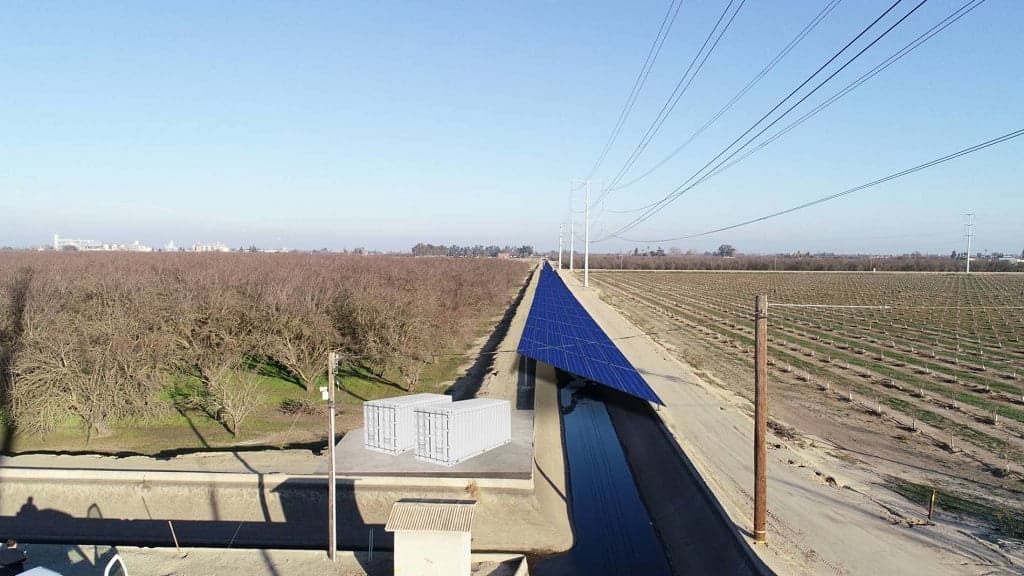
California has been experiencing severe drought conditions over the past few years. These new solar canals can help to protect the state’s valuable water supply for residents and farms to mitigate the risk of severe droughts. They can also help to reduce the cost of electricity, provide cleaner air, save on land requirements and help the state reach its decarbonization goals.
The state has taken several steps to reduce residential water usage and mitigate the effects of the climate crisis. For example, the state advanced its plan to phase out the sale of new gas-powered vehicles by 2035. And, officials revealed last week that California would get $310 million in federal assistance to help with droughts.


