
Modern desalination, geothermal production, and legacy wastewater facilities are pivoting from waste management to resource centers. These industrial streams represent the next frontier for resource independence. Advanced electrochemical filters, selective membranes, and hybrid recovery trains are now turning concentrated brines into critical minerals essential for the energy transition that modern infrastructure requires. Strategic water-to-minerals pivots ensure the clean energy transition maintains a reliable supply of lithium and magnesium, often while producing usable fresh water as a strategic co-product.
Adopting a resource-circulation framework allows industrial facilities to extract minerals from desalination reject streams that were previously considered waste. The shift toward Direct Lithium Extraction (DLE) and the move toward domestic lithium independence facilitates regional feedstock development, weakening the grip of fragile global supply chains. While electrochemical technologies move from lab-scale prototypes to industrial hardware, the economics of critical metal recovery are becoming increasingly bankable for geothermal and municipal operators.

Brine Mining Quick Facts: The Water-to-Minerals Shift Overview
- The GAO brine-mining snapshot indicates that desalination brines contain significantly higher mineral concentrations than raw seawater. Increased mineral density facilitates earlier scaling than open-ocean harvesting.
- Federal permitting and siting pathways for geothermal brine projects guide how geothermal-brine projects move from concept to buildable pathways.
- Battery-style selectivity is moving from theory to hardware where ceramic-supported solid-state electrolytes demonstrate lithium-preferring transport concepts that leave most competing salts behind. The newest example mimics biology itself: cell-inspired nano-channels now filter lithium 2-5x better than recent artificial transporters.
- Co-production trains can pair clean-water recovery with mineral concentration through integrated brine valorization systems that function as integrated plants rather than add-on equipment.
- Planning pressure is rising alongside high supply risks for energy-critical elements that make unconventional sources like brines vital.
- Operational stability remains the hard constraint in every field trial. Reliable performance requires that membranes, electrodes, and pretreatment systems withstand months of intense scaling, biofilms, and volatile brine chemistry.
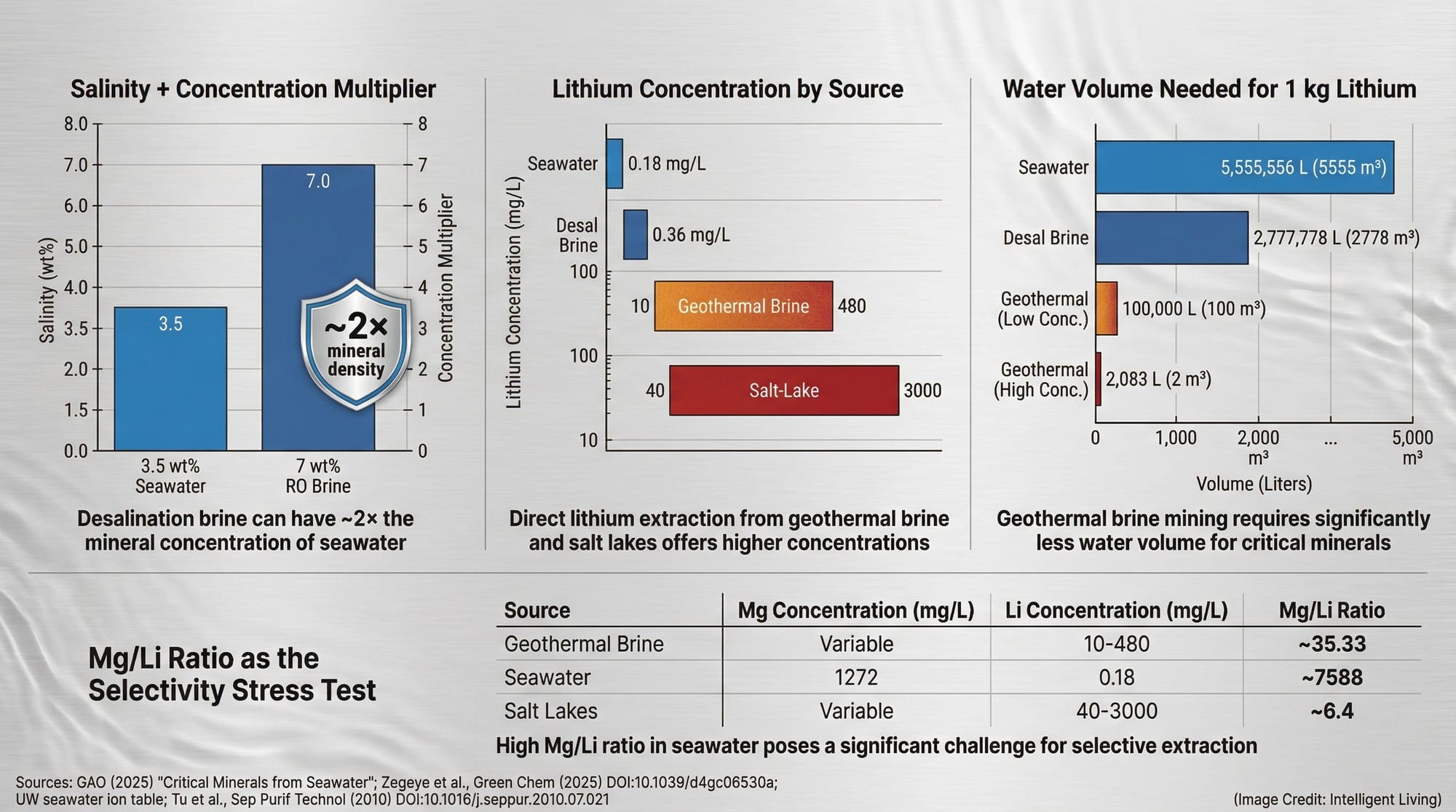
Strategic Brine Mining Blueprint: Concentration and High-Value Targets
Brine Mining Physics: Why Mineral Recovery Hinges on Ion Concentration
Resource scalability hinges on a fundamental physical law: ion concentration dictates extraction efficiency. As feed abundance increases, the fluid volume required for recovery drops, significantly lowering the energy overhead per unit of product.
Investigating the economic viability of brine-based metal recovery reveals that the water source often dictates success more than the separator.
Analyzing the Dilution Penalty in Seawater Extraction
Seawater lithium is extremely dilute. Seawater lithium concentrations averaging 180 parts per billion make many promising lab materials impractical if the low concentration requires extreme volumetric throughput to yield commercial quantities.
A familiar comparison helps. A pinch of kitchen salt is easy to notice in a glass. The same pinch spread across a swimming pool makes the taste disappear, even though the total salt volume remains identical.
The Three Gates: Selectivity, Throughput, and Purity
Navigating the technical landscape of brine mining requires clearing three specific hurdles to ensure industrial viability. These gates determine whether a recovery train can compete with traditional mining costs:
- Selectivity: The system must prefer target ions over chemically similar elements to ensure high efficiency.
- Throughput: This metric governs the total fluid volume processed per hour, dictating the plant’s overall capacity.
- Purity: Final products must meet battery-grade specifications to enter the clean energy supply chain.
Successful projects balance these three variables to maintain operational stability and product value.
Throughput Dynamics: The Primary Economic Driver for DLE Scaling
Throughput dominates because industrial scaling requires stability. Consider a municipal water system during peak summer demand. Treating a few thousand liters differently is manageable. However, treating millions of liters daily with predictable maintenance is where engineering discipline wins.
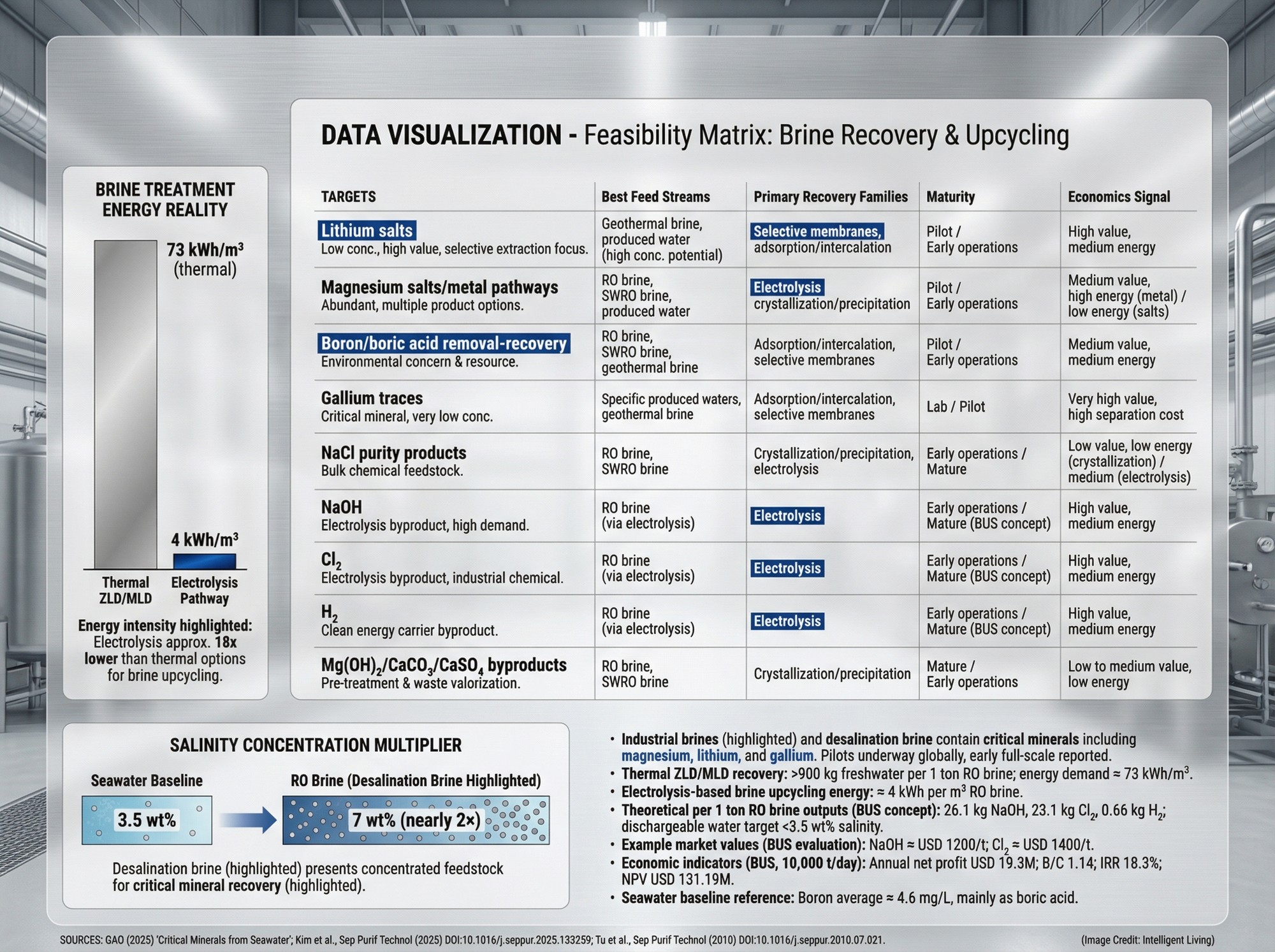
Feasibility Analysis: Which Minerals Are Recoverable from Industrial Brines?
Near-Term Opportunities: High-Concentration Brine Metals
- Lithium: Serving as the primary target for brine recovery, geothermal fluids and industrial concentrates harbor lithium levels that ensure commercial viability via DLE.
- The geothermal brine lithium independence push tests whether selective separation can compete with conventional supply.
- The target is usually lithium carbonate or lithium hydroxide.
- Battery supply chains require these specific chemical forms for cathode production.
- Magnesium: Found abundantly in numerous reverse osmosis (RO) concentrates.
- One pilot extracts magnesium metal from seawater-derived concentrates at a California facility producing magnesium metal from seawater-derived feeds.
- In brine-mining economics, magnesium is a high-volume candidate that matters when plants are already moving massive water volumes.
- Boron: Selective resins and staged electrodialysis can separate boron from RO brines.
- Evidence from boron separation pathways in desalination streams shows why brine mining starts with elements already present in meaningful quantities.
- Desalination plants already pay to separate water from salts, making boron an additional output rather than a burden.
Remediation Recovery: Turning Wastewater Streams into Profit Centers
Acid mine drainage and contaminated process water carry toxic but valuable metals. Research into recovering minerals from acid mine drainage frames the opportunity: the same unit operation that purifies water can generate recoverable concentrate. Integrated recovery trains convert environmental remediation costs into revenue-generating projects by mitigating long-term liabilities while reclaiming high-value metals.
Long-Horizon Objectives: Tapping Ultra-Dilute Ocean Resources
Uranium and open-ocean lithium fall into this class. The ocean contains vast totals but at parts-per-billion concentrations. Current development of adaptive polymer capture materials demonstrates progress, yet dilution and fouling remain significant scaling gates. Plausible ocean pathways likely piggyback on existing infrastructure like large desalination facilities.
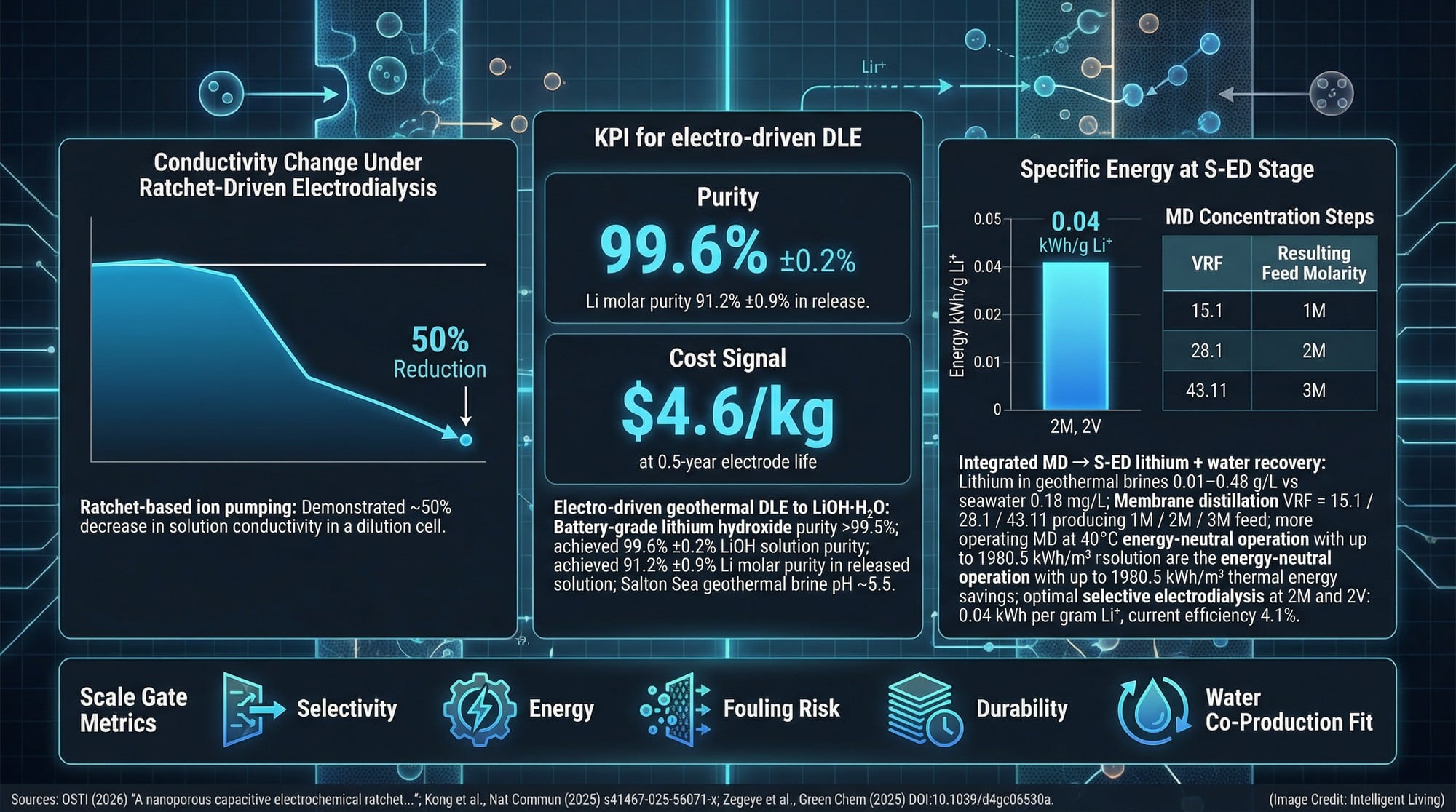
Emerging Technologies: Breakthroughs in Selective Mineral Recovery
Redox-Free Ratchet Ion Pumps: Advancing Continuous Ion Sorting
A new nanoporous ion-pumping architecture enables continuous ion flux without classical Faradaic redox chemistry. This device uses time-modulated potentials across a porous wafer to bias ion transport while minimizing side reactions. Investigating continuous ion separation without degradation reveals why continuous separations have been difficult to implement without degradation. Modular, electrically powered architectures offer a significant leap in selective separation efficiency, provided they meet rigorous industrial durability benchmarks during extended operation.
In desalination terms, pumping architecture for selective ion sorting frames the path beyond basic salt removal.
Intercalation-Driven DLE: Geothermal Brine Lithium Recovery
Teams have developed integrated trains using intercalation materials to capture lithium from geothermal brine, converting it to battery-grade lithium hydroxide through bipolar membrane electrodialysis. The battery-like step isolates lithium from magnesium and sodium.
Documentation on electro-driven lithium extraction from geothermal fluids reports successful conversion and includes a techno-economic model. “Battery-grade” is a rigorous specification problem; impurity thresholds can make or break cathode chemistry.
Solid-State Electrolyte Membranes: Achieving High Selectivity Designs
Solid-state lithium-conducting layers on robust supports create physical paths that lithium prefers. Innovations in solid-state transport for high-selectivity membranes apply ion transport to water streams. Scaling requires manufacturing defect-free membrane areas large enough for industrial flows.
Hybrid Membrane Distillation: Integrating Selective Electrodialysis Trains
Hybrid trains using membrane distillation to reduce brine volume followed by selective electrodialysis answer the clean-water question. A dual-output pathway using hybrid membrane distillation describes a process producing distilled water as a product while improving the economics of downstream separation. Systemic tradeoffs involve balancing energy consumption per unit recovered against membrane cleanliness during sustained brine exposure.
Integrated devices for harvesting lithium and hydrogen represent practical archetypes built on the idea that a single intake stream supports multiple strategic outputs. Co-location is key; the Rizhao seawater-to-hydrogen ocean refinery pilot shows how water, energy, and brines can share an integrated site.
RO Brine Mineral Recovery: Boron and Magnesium Pathways
Selective resins and electrodialysis staging have increased boron concentration from RO brines to levels where conventional production is realistic. A technical guide for recovering minerals from salt streams maps how pressure-driven and electro-driven steps vary based on the target salt or specialty chemical.
Remediation Trains: Extracting Value While Cleaning Water
Electrochemically activated limestone systems treat acid mine drainage while collecting metals. Remediation becomes a recovery project when capture and neutralization occur in the same train, changing the incentive structure for communities facing legacy mine orange water runoff.
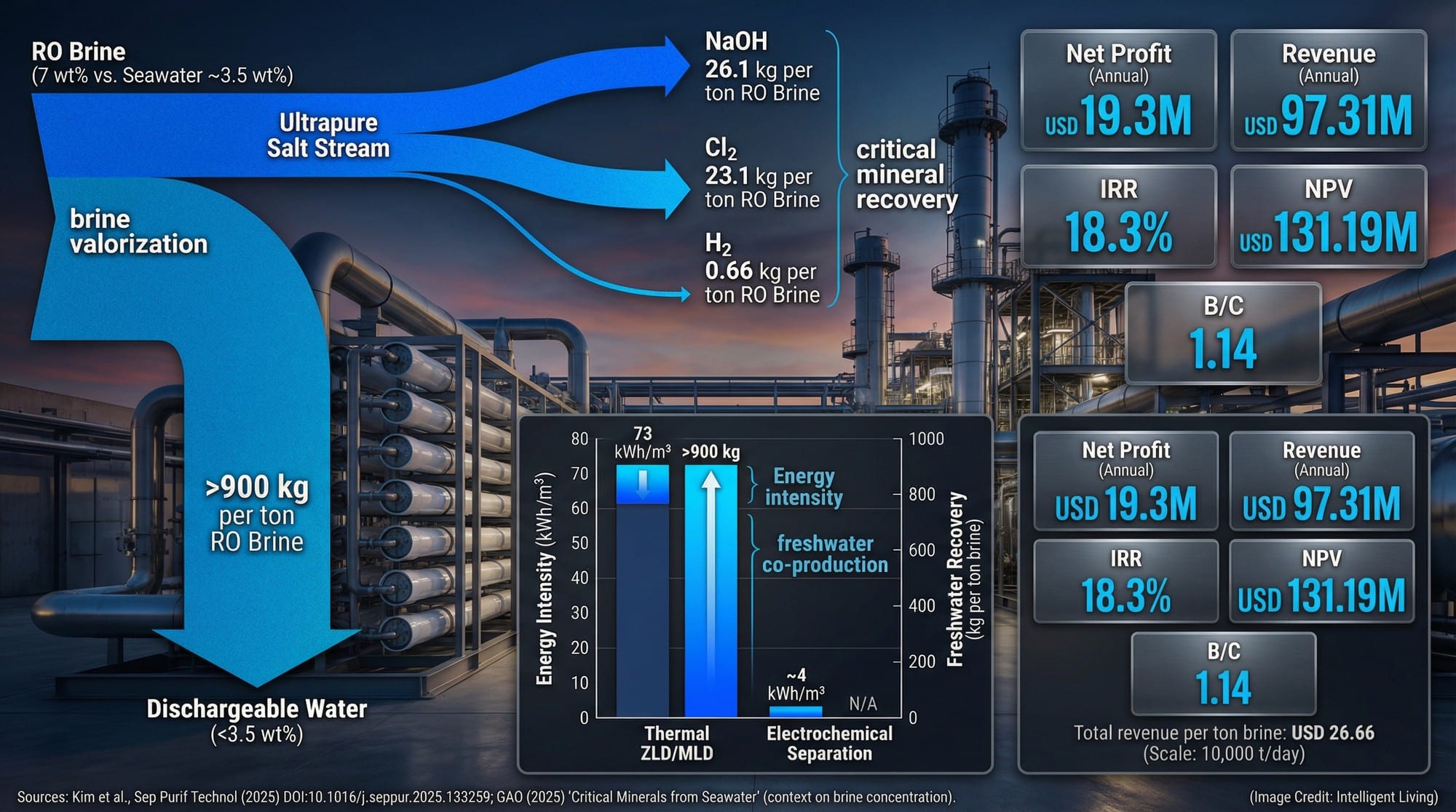
Water Co-Production Synergy: Environmental and Strategic Impacts
Simultaneous Co-Production: Recovering Fresh Water and Minerals
The best co-production pathways concentrate the brine first and choose separation steps that prevent water contamination by regenerants.
Resource-Circulation Framework: Integrating Water, Minerals, and Energy
Integrated treatment of water and mineral recovery as a single system requires engineers to merge heat and pretreatment costs into a single, comprehensive balance sheet.
Engineering Design: Maintaining High-Purity Water Co-Products
- Membrane distillation produces distilled water, sometimes paired with electrodialysis polishing.
- Electrochemical capture can reduce chemical overhead, preserving water quality.
- Remediation effluents often meet reuse standards after metal capture, benefiting mining communities.
Managing brine chemistry through salt-free electrodialysis illustrates why chemistry management is as vital as the separator. In arid coastal regions, harnessing low-grade solar heat for desalination shows why waste heat is a decisive variable.
How this Scales: Strategic Impacts
Supply Chain Security: Diversifying Regional Feedstock Inventories
Large-scale recovery fortifies regional resilience by establishing local feedstocks, thereby diversifying procurement and reducing reliance on single-source supply chains. In Arkansas, the Smackover brine DLE demonstration plant converts industrial brines into lithium feedstock at a demonstration plant. USGS machine-learning work already maps that same formation: our AI mineral exploration report explains the 5 to 19 million ton in-place lithium estimate for the Smackover, and what that number does and does not promise. In Europe, the integration of geothermal heat and brine adsorption in the Upper Rhine Valley coordinates heat and brine chemistry.
Ecological Advantage: Reducing the Environmental Footprint of Mining
Brine mining can reduce surface footprints and freshwater consumption compared to open-pit mining. The calculus depends on post-processing brine handling and power sources. In comparison, ecological risks associated with seabed mineral extraction highlight the distinct ecological risks of the seabed.
Utility Evolution: Multi-Output Models and Mineral Recycling
Desalination plants could evolve into multi-output utilities producing water, hydrogen, and minerals. Multi-output utility models complement recycling; brine-sourced feedstocks, conventional output, and recycled chemicals will eventually balance demand. Strategies for addressing global lithium supply bottlenecks and urban mining plans for critical mineral recovery support this diversified inventory.
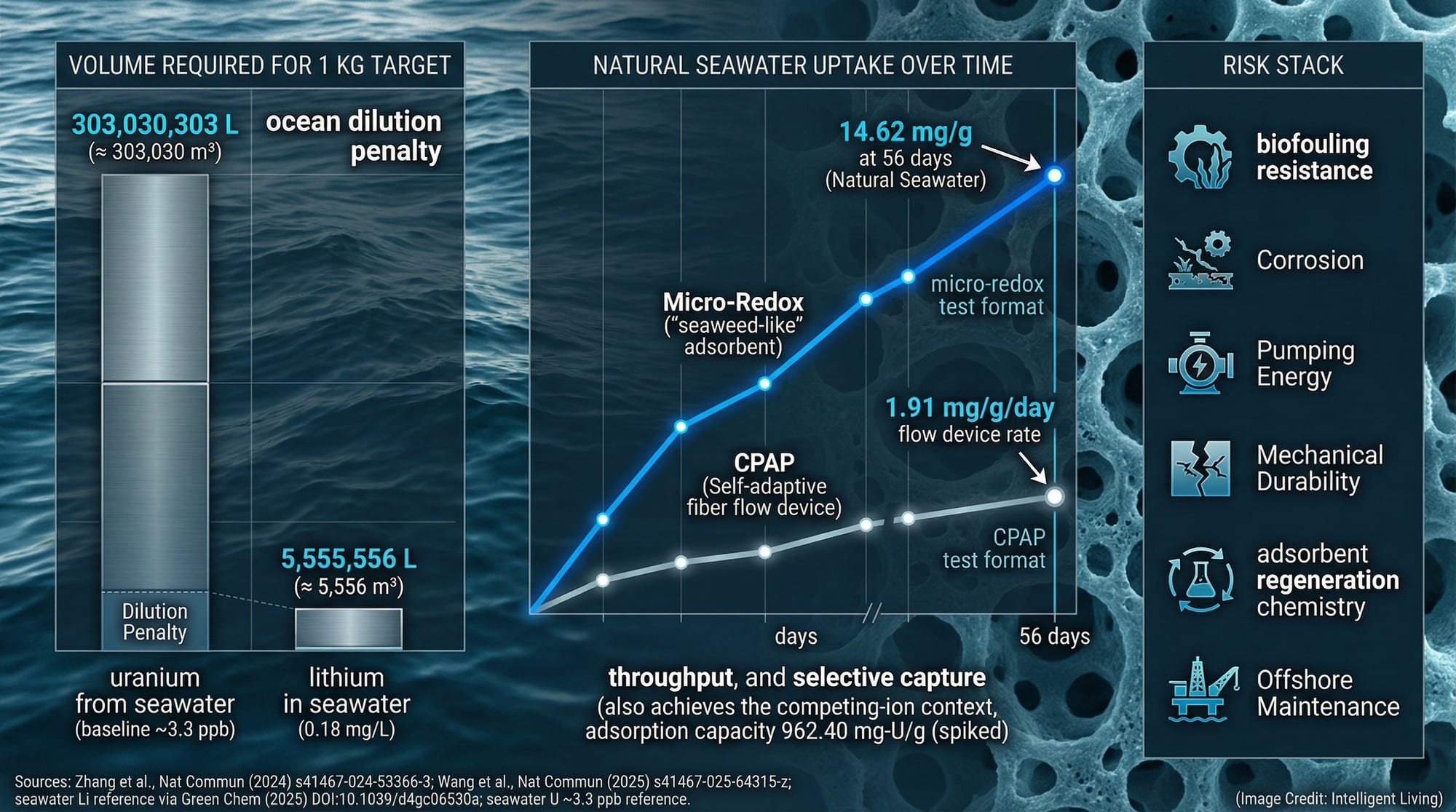
Operational Limits and Risks: Scaling Ocean-Based Mineral Recovery
Industrial Reality Check: Lab Performance vs. Field Stability
- Scale Matters: Lab performance often falters against field-level fouling and complex organics.
- Cost Rules: Capital and operating costs—including maintenance cycles—decide competitiveness.
- Co-product Purity: Delivering potable water requires strict separation from capture chemicals.
Field-scale data from geothermal lithium recovery pilots provides vital grounding with its data on hundred-cycle testing and lithium carbonate purity.
Ocean-Based Mineral Recovery: Long-Horizon Extraction Moonshots
The ocean’s dilution penalty is massive. Designing anti-fouling adsorbents for seawater uranium capture pushes performance limits for seawater uranium capture. The challenge remains long-duration operation without biofouling or expensive handling. Until solved, open-ocean extraction is a long-horizon bet.

Conclusion: The Path Forward
Industrial progress for brine mining requires moving beyond the ‘lab-success’ phase and into durable, large-scale deployment. Success requires that materials demonstrate a scale lifetime that survives months of aggressive brine exposure without losing selectivity. Integrated product designs prove that simultaneous freshwater production and mineral revenue can coexist without cross-contamination, making the balance sheet for desalination and geothermal plants much more attractive.
The transition depends on bankable benchmarks where real-world operating data matches our most optimistic cost models. Diversifying global inventory through DLE and brine-sourced feedstocks reduces the environmental footprint compared to traditional open-pit mining. Brine mining represents a necessary evolution for a global economy that requires more minerals but demands less ecological impact.
Several milestones will determine the long-term viability of the water-to-minerals pivot as it moves into the mainstream. Industry leaders are focusing on three primary benchmarks:
- Demonstrated Scale Lifetime: Separation materials must survive months of aggressive brine exposure without degradation.
- Integrated Product Design: Systems must deliver simultaneous clean water and mineral revenue without cross-contamination risk.
- Bankable Benchmarks: Predictive cost models must align with real-world operating data from field pilots.
Meeting these requirements will move brine mining from a niche technical solution to a central pillar of global resource management.
Brine Mining FAQ: Critical Minerals and Resource Recovery
What minerals are realistic to extract from water today?
Lithium, magnesium, and boron are the primary near-term candidates. High concentrations within industrial brines and geothermal fluids make their recovery more economically viable than open-ocean harvesting.
Why is geothermal brine better than seawater for lithium recovery?
Geothermal brines offer lithium concentrations that are orders of magnitude higher than seawater. Elevated concentrations significantly reduce the volume of fluid that must be processed, lowering the energy costs associated with selective ion separation.
How does Direct Lithium Extraction (DLE) improve the environment?
This rapid isolation significantly lowers the physical footprint and overall water consumption compared to traditional solar evaporation ponds or hard-rock mining. Utilizing selective membranes or adsorbents allows DLE to isolate lithium in hours rather than months.
Can desalination plants produce drinking water and minerals simultaneously?
Yes. Hybrid trains like membrane distillation and selective electrodialysis recover high-purity distilled water while concentrating salts for mineral feedstock.
Is brine mining a bankable solution for the clean energy transition?
The technology is rapidly becoming one. Regional brine recovery provides a diversified, low-carbon source of battery-grade materials that are vital for electric vehicle production while mitigating supply chain risks.


