
Demand for the soft, slivery-white metal lithium (the lightest solid element in the periodic table) has skyrocketed with the rise of lithium-based batteries – and it’s only expected to grow. That’s because the race to zero carbon by 2050 will continually gather steam, requiring the electrification of transport that uses batteries for power. As a result, land-based lithium reserves will likely run out by 2080.
But land-based lithium reserves pale in comparison to what’s in the sea. According to researchers at King Abdullah University of Science and Technology (KAUST) in Saudi Arabia, there’s about 5,000 times more lithium in the oceans than inland deposits. Fortunately, they’ve developed a new technology that can extract it from the seawater cheaply enough to qualify while producing hydrogen and chlorine gas and desalinated water.
The KAUST research team has experimentally validated the device. It successfully desalinated the water and separated lithium ions while producing more than enough hydrogen and chlorine gases to cover the cost of its power bills.

The technology consists of an electrochemical cell that contains a ceramic membrane made from lithium lanthanum titanium oxide (LLTO), with tiny pores only wide enough to let lithium ions through, blocking larger metal ions.
Zhen Li, the post-doctorate researcher who developed the cell, said:
LLTO membranes have never been used to extract and concentrate lithium ions before. Its crystal structure contains holes just wide enough to let lithium ions pass through while blocking larger metal ions.

The team tested the device with unprocessed seawater from the Red Sea, which had a starting lithium concentration of only 0.2 parts per million (as all ocean water does). Then, they ran the water through the cell in five 20-hour stages to enrich lithium concentration to over 9,000 parts per million.
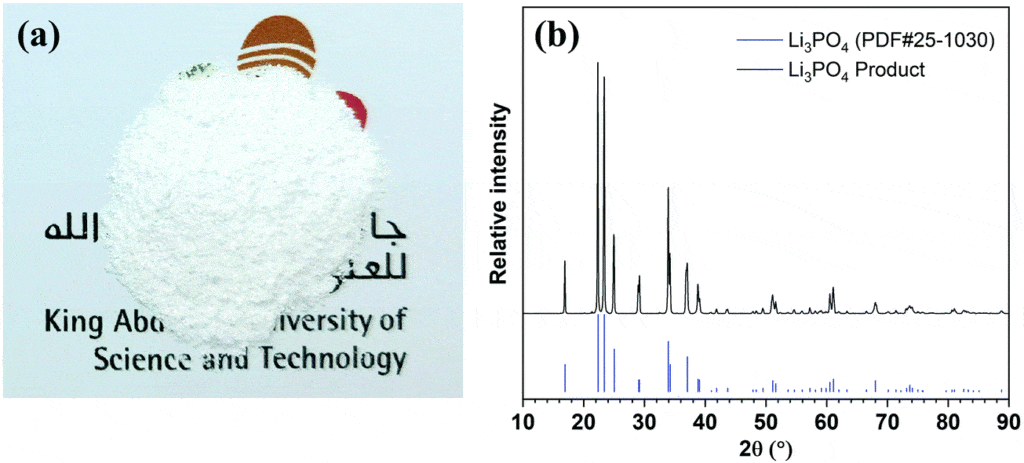
By the end of the process that involved pH adjustment, centrifuging, rinsing, and drying, the researchers had a lithium phosphate powder of 99.94% purity – enough to meet manufacturers’ standards for battery-grade lithium phosphate.
As a bonus, the value of hydrogen and chlorine gas produced by the cell during the process more than offsets the cost of electricity required to run the device. And the remaining water can be treated as freshwater, so the process even can integrate with saltwater desalination treatments to further enhance its economic viability.
The researchers say there’s generous room for optimization, so they will continue fine-tuning the membrane structure and cell design to improve the process’s efficiency further. They also hope to partner with the glass industry to manufacture the LLTO membrane at a large scale and lower cost.


