
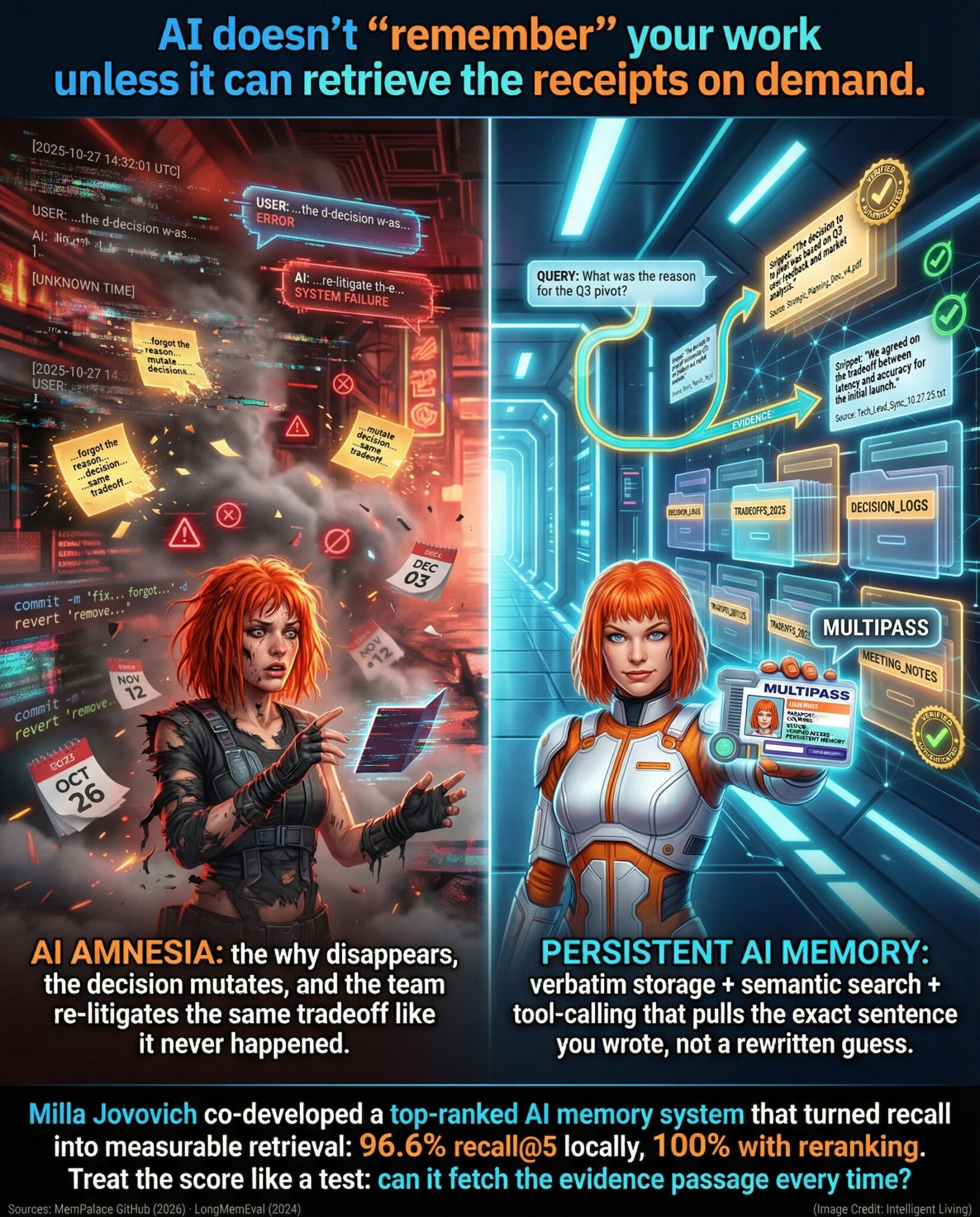
MemPalace arrived with a headline that demands attention: a local, open-source AI memory system promising to solve the persistent issue of AI amnesia through a verifiable benchmark. Builders prioritize the underlying retrieval logic while the wider market focuses on the headline scores.
High-profile launch cycles brought significant attention to Milla Jovovich’s collaboration with engineer Ben Sigman, a development recently chronicled in technical release reports. International technology reporting emphasized the same core driver: modern AI tools lose context far too quickly.
Practical details matter more than marketing excitement. Standard assistants remain brilliant during a single session but fail over long durations. MemPalace establishes a searchable store of past work, allowing for on-demand queries instead of repetitive manual context updates.
AI Memory Systems: Evaluating Benchmark Claims and the Impact of Amnesia
Key Metrics: Analyzing LongMemEval Scores and Local Retrieval Performance
AI memory systems frequently function as simple checkboxes in marketing copy. LongMemEval evaluates a specific capability: retrieving precise evidence from extensive datasets during later queries. Accurate details provide the foundation for these headline-grabbing scores.
The fastest way to keep this grounded is to separate modes. Raw mode is retrieval without extra model help. Hybrid mode adds a reranking pass that can raise accuracy but changes cost and assumptions.
Engineers seeking digital continuity should evaluate how MemPalace handles information extraction. Effective retrieval systems minimize the risk that summaries overwrite the original record. The following points detail the technical architecture and licensing:
- Verbatim memory systems rely on transparent codebases and architecture notes to ensure that future searches retain original proof instead of lossy summaries.
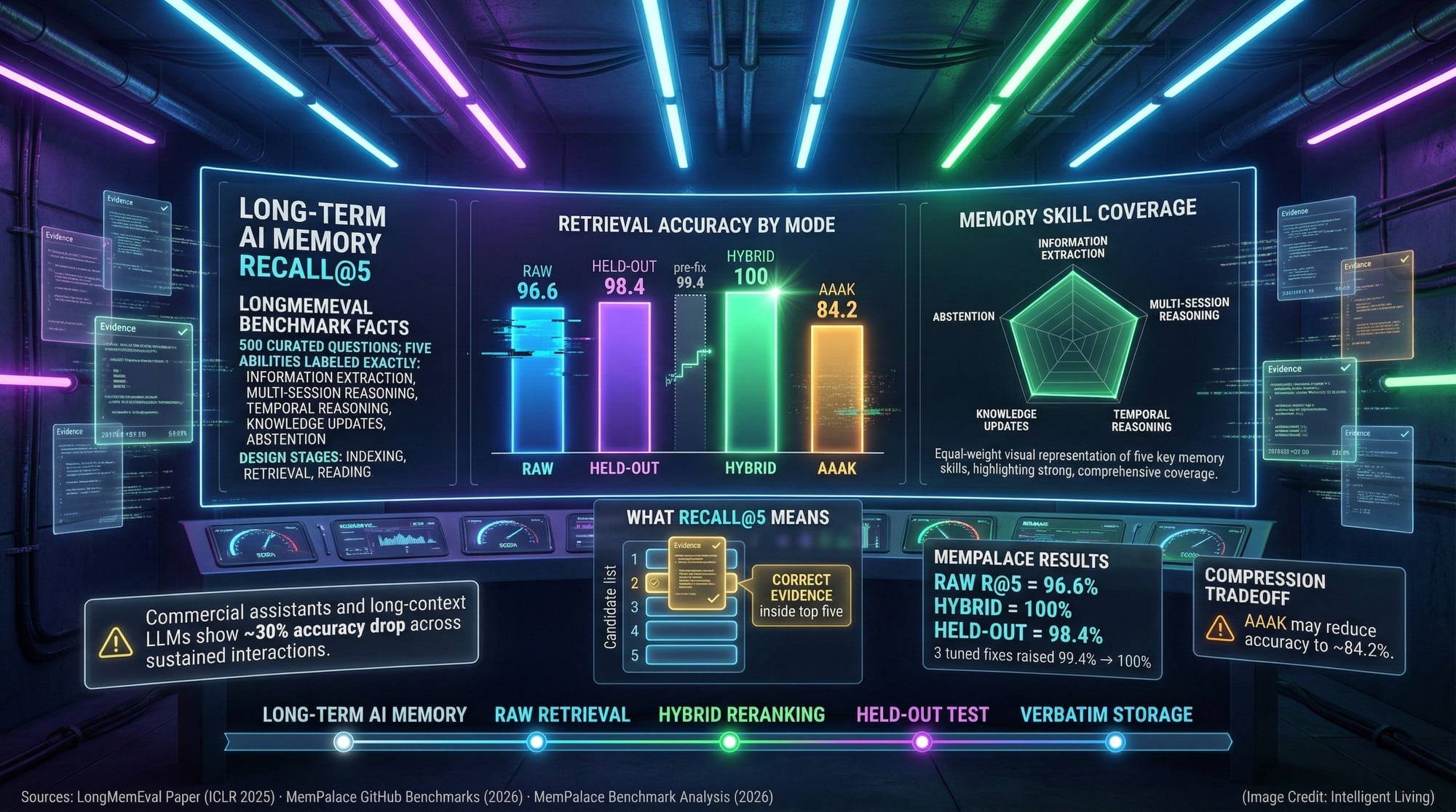
- Internal data tables and performance metrics report 96.6 percent recall at five in a raw retrieval mode and 100 percent in a hybrid pipeline that adds a reranking pass.
- The LongMemEval benchmark design defines the tasks and scoring so the headline number can be interpreted as retrieval performance, not magic memory.
- MemPalace exposes memory through a structured tool interface aligned with an MCP tool-call contract, which keeps tool inputs and outputs predictable.
- Its MIT license terms make it usable in commercial and personal projects with minimal friction.
Integrating these standards ensures that the local AI memory system remains portable across diverse development environments. This modular approach allows teams to prioritize verifiable evidence over model-generated guesses.
Expectations stay grounded when evaluating specific retrieval metrics. Recall at five identifies whether the correct passage exists within the top five candidates rather than measuring perfect model reasoning. Reranking offers power but remains a deliberate engineering tradeoff with associated costs.
If the sci-fi parallel fits, this is the moment. A Fifth Element-style shortcut would be instant perfect memory. Real engineering looks more like careful indexing, then repeatable retrieval, then trust built through tests.
The Resident Evil Problem: Why Your AI Forgets the Plot Between Sessions
Where AI Amnesia Shows Up in Real Work
Developers often compensate with copy-paste context dumps and scattered notes. Unfortunately, unread message threads rarely provide the clarity needed for long-term projects. Models left to prioritize memory autonomously often compress critical sentences, leading to discrepancies between clean decisions and costly revisions.
Sprint retrospectives often stall when an assistant provides a confident but inaccurate rationale for pinned dependencies. Silence follows when the AI’s explanation fails to match the original technical tradeoff. Minutes later, the team is forced to dig through legacy logs because the system prioritized ‘vibes’ over verifiable facts.
Why Longer Context Still Falls Short
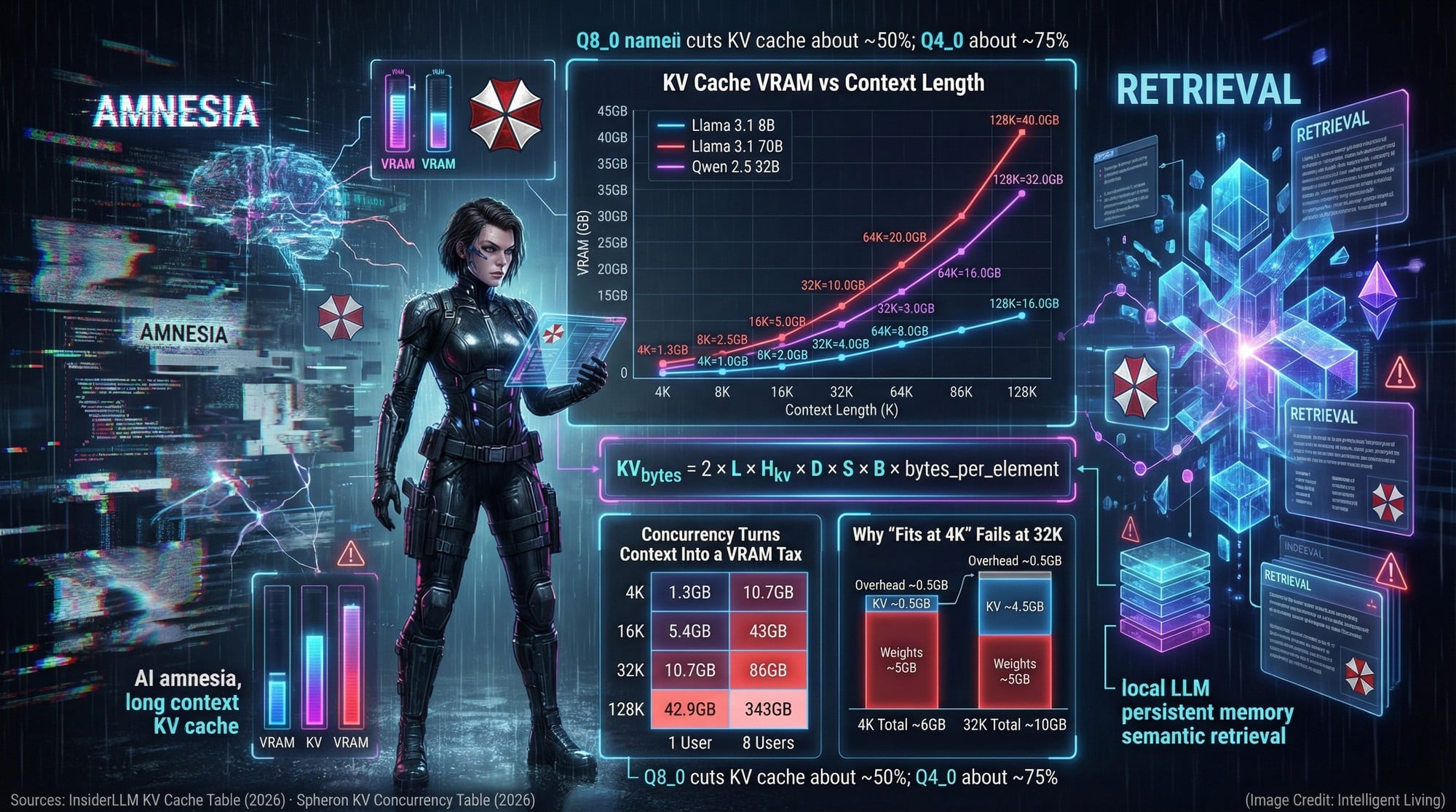
Expanded context windows allow for massive text ingestion, though compute costs and memory overhead persist in production environments. Analyzing hardware memory tiers and local constraints makes the context bottleneck visible by tying longer prompts to KV cache pressure.
Industry trends prioritize expanding context windows, particularly through efficient architectures designed for massive input. Highly scalable agentic frameworks still incur significant compute costs as token counts rise. HBM pressure on DDR5 availability creates additional friction for scaling memory-intensive local hardware.
Longer context is a bigger workspace. Durable memory is a system that can retrieve the right slice later without replaying the entire history.

Architecture Deep Dive: Understanding the MemPalace Retrieval Pipeline
Defining MemPalace: Prioritizing Verbatim Storage Over Model Summaries
Verbatim memory substrates preserve raw conversation and project data for easy retrieval. Architectural choices within MemPalace reject the assumption that memory must rely on lossy, model-generated summaries.
Standard workflows often suffer not from a lack of answers, but from a lack of evidence. Retrieval performance improves significantly when the system surfaces the original sentence that justified a specific design decision. Verbatim storage is a blunt fix to that, because it keeps the source text intact.
Two Stores: Vector Retrieval and a Knowledge Graph
Hybrid storage logic combines semantic retrieval with structured fact tracking. The semantic layer returns relevant passages regardless of specific wording, while the time-aware knowledge graph prevents updates from colliding with existing historical data.
The split is visible in code. The semantic search module handles similarity retrieval, while the time-aware knowledge graph module supports structured facts and temporal filters.
A Layered Recall Stack
MemPalace also describes a layered recall approach in its memory stack implementation, which is one way to keep identity, critical facts, and deep recall from getting mixed together.
Sci-fi metaphors provide a useful lens for understanding continuity. Real systems achieve this through disciplined storage, indexing, and retrieval. Observing biological inspiration for retrieval logic provides a structural model rather than a literal biological claim.
Technical Operations: Semantic Indexing and the MCP Tool Surface
Indexing: How Material Becomes Findable
MemPalace ingests transcripts, project files, and exported chats, then chunks the text into units that can be embedded and indexed. Building a localized search engine requires precise chunking decisions, which dictate the sharpness of retrieval results. Many local-first memory stacks use a vector store pattern leveraging efficient disk-backed querying to store embeddings locally without remote transmission.
Local indexing aligns with the strict requirements of private educational retrieval systems where reliability remains paramount. Reliable retrieval provides the difference between a grounded answer and a plausible-sounding miss.
Retrieval: Semantic Search and an Optional Rerank
Queries generate a targeted list of candidate passages. Raw mode pulls candidates directly from the semantic index using metadata filters. Hybrid pipelines apply a reranking pass to ensure the final context window prioritizes relevance over simple vector similarity.
The practical effect shows up in everyday questions. If the assistant is searching for a specific constraint, reranking can move the single decisive sentence above a handful of nearly-related passages that look similar but do not answer the question.
Reading: Serving Memory to Assistants Through a Tool Surface
A useful memory layer has to be callable. MemPalace is built for a world where assistants ask tools for context rather than pretending they have internal recall. Utilizing standardized schemas for tool definitions ensures that catalogs and input shapes remain consistent. Establishing universal connector protocols moved the industry toward treating tools as a first-class interface.
LongMemEval Audit: Why Verbatim Storage Ensures High Recall Performance
Performance Drivers: Why Structured Memory Rewards Information Extraction
Information extraction and multi-session reasoning form the core of the LongMemEval benchmark. Systems that reliably retrieve specific snippets excel in environments requiring temporal reasoning and knowledge updates. Accuracy in this setting separates professional tools from casual assistants.
Why Verbatim Storage Helps Recall at Five
Recall at five is a simple idea with serious implications. If the correct passage appears among the top five results, downstream answer assembly has a real chance to stay faithful to the original record. When the correct passage is not retrieved, the model can still answer, but the answer becomes a guess wearing a confident tone.
Quiet adoption of retrieval systems occurs when teams stop debating intent. Surfacing the exact sentence resolves conflicts immediately, allowing meetings to proceed.
Where Hybrid Reranking Changes the Game
Reranking is not only about scoring higher. It is a way to reorder candidates so the final context window contains the lines that actually answer the query. That can improve precision, yet it also introduces a new performance layer that teams should measure, monitor, and budget.
Modern strategies for prompt engineering and retrieval-augmented generation (RAG) prioritize a ‘retrieve first, then generate’ workflow.
Benchmark Reality Check: Interpreting Hybrid Scores and Baseline Accuracy
The Clean Baseline to Trust
The careful interpretation is that the benchmark numbers are meaningful inside the scope the project describes and conditional outside it. The 96.6 percent figure is tied to a raw retrieval mode that avoids reranking, and that is the conservative result to treat as baseline capability.
What Makes 100% Conditional
The 100 percent claim is tied to a hybrid pipeline that adds a rerank step, which changes cost, latency, and execution assumptions. In real deployments, the fastest way to lose trust is to hide those assumptions, because teams will notice when results shift under load.
How to Reproduce without Self-Deception
The project includes detailed technical documentation for validation describing how the runs were assembled. Reviewing the implementation of the scoring logic shows exactly how tasks are evaluated. A rigorous audit of reported findings explains how the project interprets results.
A fast, honest verification loop is small and brutal. Pick a month of your own chat exports, write twenty questions whose answers you can prove from the transcripts, and measure whether retrieval consistently returns the evidence passages. If it does, you have something you can operationalize. If it does not, a headline score will not rescue your day-to-day workflow.
Implementation Guide: Solo Dev Setup and Enterprise Memory Governance
Practical Deployment: Local Indexing and Assistant Tool Wiring
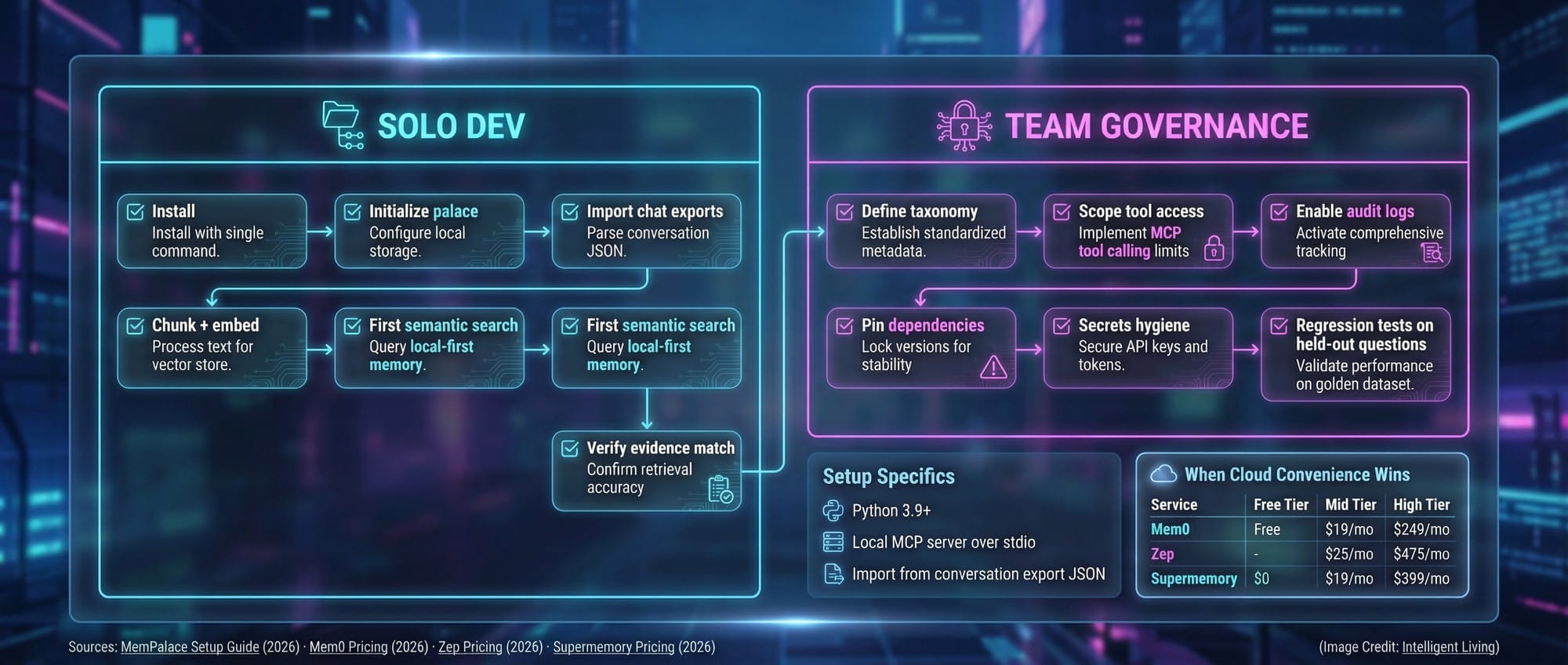
Initiate solo testing with small, controlled datasets to ensure manageable results. A practical first run uses a narrow dataset, such as a single project folder and a few weeks of exported chats, so you can spot retrieval noise quickly.
Following a streamlined installation process for coding assistants builds the first index quickly without creating a noisy dataset.
Wiring to an Assistant via a Tool Protocol
Once memory is indexed, the next step is making it callable. The difference between an assistant that remembers and one that pretends often comes down to whether it can issue a structured tool call and receive a bounded, inspectable response.
A quick sanity check is to ask a question whose answer you know is in your history, then verify the response includes the same evidence passage you would have chosen. If the evidence is wrong, treat that as a retrieval problem, not an intelligence problem.
Setting up a local AI memory system requires a tactical approach to data ingestion. Managing small, high-quality datasets prevents noise from overwhelming the semantic search logic. Consider these practical tips for your initial test:
- Start with one wing and two rooms rather than trying to index your entire work life.
- Tag chunks with simple metadata, such as project, date, and role, because filters are what keep retrieval from turning into a noisy pile.
- Keep a short set of test queries that you rerun after any chunking or embedding change.
Applying these constraints ensures that the assistant remains responsive and accurate during the solo development phase. Refining your indexing strategy early saves time during wider team deployments.
Scaling AI Memory: Security Protocols and Shared Taxonomy for Teams
Collaborative memory systems function best when they mirror existing organizational taxonomies. Mirroring repository structures within the memory layout leads to faster search wins. Abstract naming scheme usually results in friction that limits team-wide adoption.
A useful trick is to define a naming rule that survives stress. If a new hire can guess where a decision belongs without asking, your taxonomy is doing real work.
Audit Trails and Permissioning
Sensitivities arise when memory stores contain forgotten context. Tool-callable memory integrates directly into the production surface area. A governance-first view of integrated organizational workflows maps well here because tool access requires scopes and logs.
Security Hardening and Dependency Hygiene
A memory layer is not just storage. It is a system that processes untrusted text and executes integrations, so the default posture should look like production engineering, not a side project.
Adopting robust security measures for tool servers establishes a concrete baseline for trust verification. Safe execution boundaries are essential when treating tool calls as core operational behaviors.
Teams also need to treat dependencies and gateways as high-leverage risk points. The LiteLLM PyPI supply chain attack shows how a poisoned dependency can spread through automated installs and CI pipelines, and the lesson transfers cleanly. The same governance mindset shows up when agent ecosystems drift into loops and credential leaks because tool access and incentives get ahead of verification.
When Local Memory Is the Wrong Fit
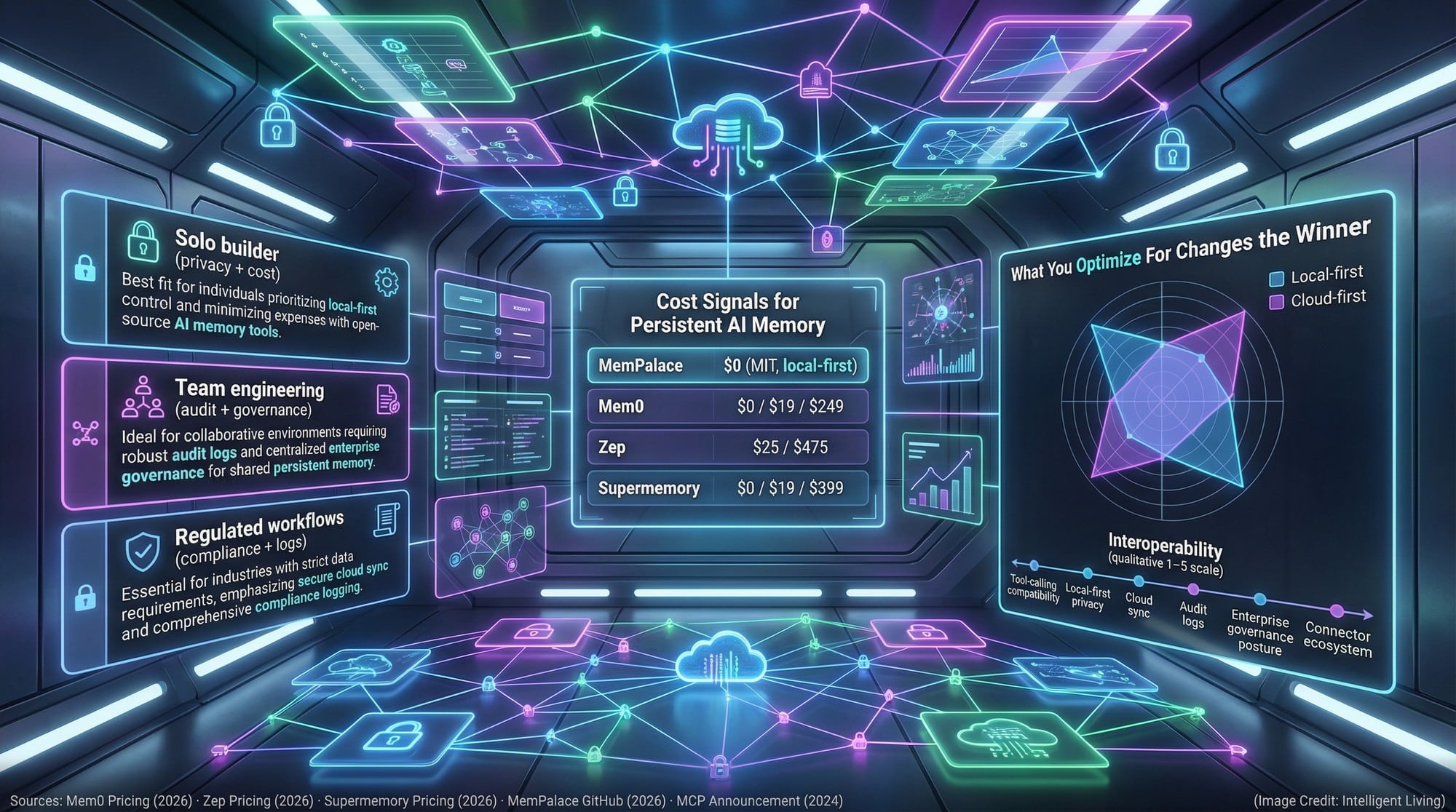
Local systems are strong when privacy and low latency matter, but they are not always the right fit for distributed teams that need a single, authoritative write surface and centralized governance.
Hosted memory platforms can be easier to standardize. Comparing a managed memory layer using architectures designed for persistent state with an API-driven storage service highlights the tradeoffs for multi-team synchronization.
A different alternative is to compile what matters into maintained documents. The version-controlled markdown knowledge base approach shows why some teams prefer memory that behaves like a codebase rather than a private store.
Strategic Use Cases: Interoperability and the Future of AI Memory
Operationalizing AI Memory: 10 Strategic Applications for Developers
A callable memory tool surface like the MemPalace MCP server implementation makes retrieval behave like an operation rather than a copy-paste habit, and that is why these use cases show up fast in real teams.
- Engineering Decision Logs that preserve exact rationale instead of a summary.
- Incident Timelines that surface mitigation steps from the moment they were written.
- Onboarding Threads that answer why systems look the way they do.
- Research Trails that keep critique and revision history intact.
- Contract and Compliance Notes where verbatim phrasing can matter later.
- Personal Productivity as a private work journal that is easy to query.
- Team Playbooks that capture the language that shaped a runbook.
- Agent State Stores that give tool-driven systems a stable memory substrate.
- Customer Preference Recall that reduces repeated questions in support loops.
- Benchmark and Regression Tests that detect memory drift over time.
These use cases demonstrate how a callable memory layer transforms AI from a chat feature into a persistent subsystem. Integrating verbatim retrieval into daily workflows reduces the time spent verifying past decisions.
In practice, the payoff often looks mundane. A team finds the exact sentence that justified a design decision, avoids reopening a settled debate, and ships a fix a day earlier than they would have otherwise.
Industry Outlook: Interoperability and Security Attack Surfaces
Interoperability
Two forces will decide whether memory systems like this become routine infrastructure: interoperability and security posture. Interoperability is about whether memory can follow you across tools without custom glue. A growing pattern is persistent memory layers in agentic workflows that treat memory as a first-class subsystem instead of a chat feature. Claude’s topic-based memory system, which unifies context across chat and Cowork with user-controlled transparency, is a recent example of this pattern at the consumer level.
The directory of competing memory frameworks maps how many patterns exist, from hosted memory to local-first stores, which helps teams avoid locking into a single idea too early.
Security Posture
Security posture is about whether teams treat memory and tool access as an attack surface from day one. Tool-driven systems are moving fast. Builders who win long-term will be those who treat logs, scopes, and dependency hygiene as part of the feature.

Mastering Local AI Memory: Building Trust through Verbatim Retrieval
MemPalace avoids magic because reliability remains the priority. Real retrieval architecture shifts how assistants recall data, proving that model weights matter less than stable indexing when fighting AI amnesia.
Adoption requires a measured sequence. Successful teams begin with localized datasets and verify retrieval accuracy through isolated testing. Expanding scope follows the addition of governance logs, while any reranking logic gets treated as a performance layer with cost and trust requirements.
Shifting focus from model scale toward memory precision ensures AI remains anchored in verifiable data instead of creative hallucinations. Referencing the original research on memory evaluation keeps focus on specific metrics, ensuring that claims of perfect memory stay grounded.
FAQ: Essential Insights on MemPalace and AI Memory Systems
What is MemPalace in simple terms?
Local software stores past conversations and project material so an assistant retrieves evidence passages on demand rather than guessing.
How does LongMemEval measure AI memory?
Testing focuses on information extraction, multi-session reasoning, and time-aware knowledge updates over extensive histories.
Why is “Recall at Five” a significant metric?
Successful retrieval occurs when the correct passage appears within the top five candidates, enabling faithful answer generation.
Is the 100% benchmark score achievable locally?
Hybrid pipelines adding a reranking step reach the 100 percent mark, while raw retrieval maintains a reliable 96.6 percent baseline.
How can teams prevent privacy risks with AI memory?
Local-first storage combined with scoped tool access ensures sensitive data stays within internal boundaries.


