
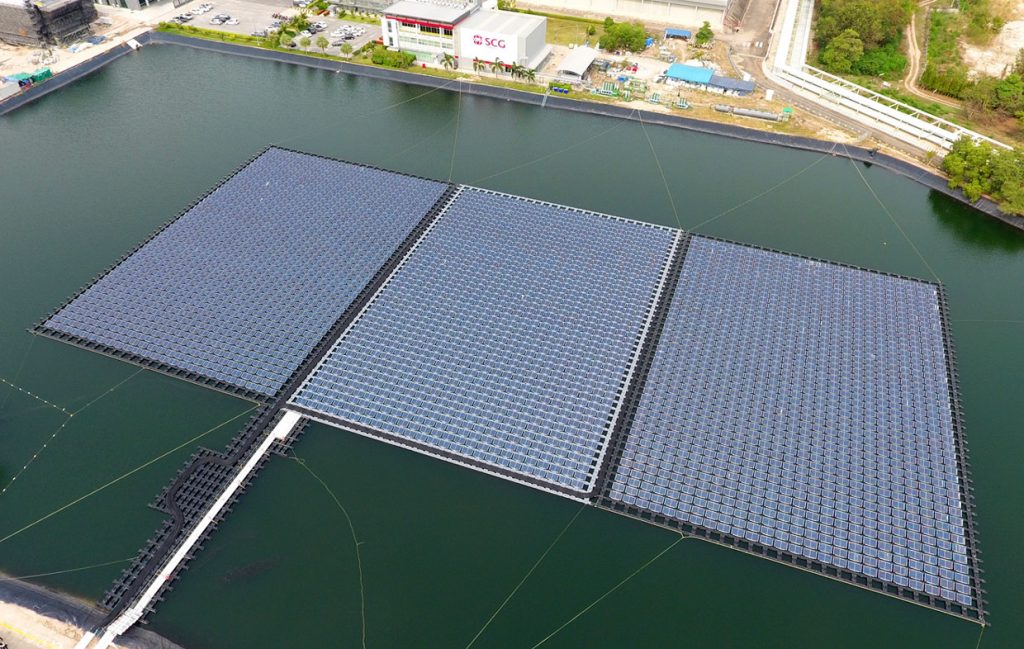
Solar power is a source of environmentally-friendly power. The main downside is that solar farms take up a lot of space. For every 1 megawatt of power generated, it requires 13 Rai of land (5.14 acres). Because of this, countries with large populations such as China, Japan, India, and South Korea turned to solar farms that float on reservoirs and dams. These floating farms conserve a lot of land space among providing many other benefits. Recently Thailand jumped in on the action too.
Thailand’s Siam Cement Group (SCG) is one of Southeast Asia’s largest building material companies. It has developed its own proprietary modular floating solar panels that it promises to build, install and also maintain. SCG hopes to win its first contract from the Electricity Generating Authority of Thailand (EGAT) to be the supplier for the installation of a 45-megawatt floating farm at Thailand’s Sirindhorn Dam.
Floating Solar Farms

Benefits:
- Solar farms help reduce the waste of land.
- They reduce evaporation since they are partially covering the water surface.
- The project helps to reduce carbon dioxide emissions by 2,143 tons per year.
- They are easy to install and decommission.
- A solar panel installation takes up to less than 1% of the total area of each dam’s reservoir.
Downfall:
- Solar floating farm systems are about 18% more expensive than land-based ones because of the need for floats and more resilient electrical components.
Features:
- SCGs panels are made of high-quality, high-density polyethylene resin that is strong, durable, and eco-friendly.
- The panels have a 50-year lifecycle. This helps reduce the costs associated with the maintenance of solar panels.
Future plans
Thailand currently generates 12 percent of its energy from hydropower and renewable sources. The government has set a goal to increase that up to 27% by 2037. From that, 6% of the country’s total power could come from floating solar farms.
EGAT hopes to begin construction as soon as April on the farm at Sirindhorn Dam. But this is just the beginning of their plans. EGAT will float an additional 15 solar farms by 2037. At the moment, the world’s largest floating plant is a 150-megawatt system located in China. However, half of the sixteen floating plants planned by EGAT will be larger than this. The biggest of these will be an impressive 325-megawatt farm located in Sirikit Dam in the north of Thailand. They plan to complete it by 2035. SCG wants to be a part of all of these plans.


