
Washington state Gov. Jay Inslee has just signed a measure that makes Washington the fourth state in the nation to establish a mandate to provide carbon-free electricity by a targeted date. It wasn’t the only measure he signed either. There were several environmental bills that Inslee signed at a park in Seattle, surrounded by climate advocates and others, paving his path to the White House on the message of climate change.
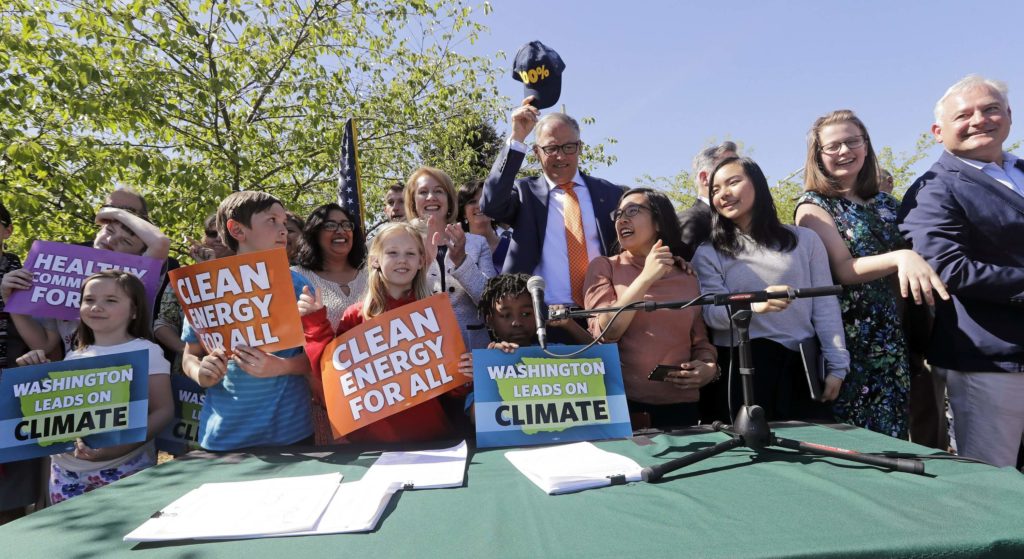
Just one week prior to the signing of this new state law, Inslee unveiled his first major policy proposal of his presidential campaign, in which he called for the nation’s entire electrical grid and all new vehicles and buildings to be carbon pollution-free by 2030.
He said: “We are determined to build a solar and wind and electrical system where people can access clean energy and cleaner air to breathe for our kids as long as Washington state is here. That’s a multi-generational commitment.”
As a first step toward a goal to provide carbon-free electricity by 2045, the new measure would require utilities to eliminate coal as an energy source by the end of 2025. Luckily, Washington currently relies heavily on hydroelectric power.
So, since the state already generates more than 75% of its electricity from carbon-free sources, including renewable energy, this shouldn’t be too difficult. The state pretty much has a whole 25 years to find carbon-free sources for the remaining 25% of its electricity needs.
There will be a penalty for noncompliance. A fine of $100 for each megawatt-hour will be charged to those who break the law. And the fine could go higher depending on the type of source, with coal penalties the highest.
The Other Bills
As part of his legislative agenda, Inslee signed several other bills, including:
- A measure that seeks to make large commercial buildings more energy efficient.
- A measure that establishes new minimum efficiency and testing standards for certain appliances, including portable air conditioners, showerheads, and water coolers. Several of the appliances covered under the law, including computers and computer monitors, must meet the state’s efficiency standards if they’re manufactured in or after 2021 in order to be sold to the state.
- A measure that restores a sales tax break for electric vehicles that had expired last year.
Opposition
As the measure advanced through the state Legislature, Republicans opposed it. They say it will raise electricity costs without impacting global climate.
Sen. Curtis King, a Yakima Republican, said during floor debate in the Senate (the same day that Inslee announced his presidential campaign):
“This bill’s going to raise the cost of energy and it will do absolutely nothing to improve the environment in our state or in the world.”
Clean Energy vs. Renewable Energy
Washington has now joined California, Hawaii, and New Mexico in establishing either renewable energy mandates or clean energy mandates with the 2045 target. Yes, there is a difference between clean and renewable!
What is it? The difference between a renewable energy mandate and a clean energy mandate is the resource portfolio the law requires, explained Megan Cleveland, an energy policy specialist at the National Conference of State Legislatures (NCSL).
Cleveland said:
“Clean energy mandates are less prescriptive than renewable portfolio standards, leaving room for other carbon-free energy resources to be included.”
With a renewable energy mandate:
- All the electricity sold in the state must come from renewable energy sources like wind, solar, geothermal, and hydropower.
- Hawaii, Puerto Rico, and Washington, D.C., all fall in this category. Washington, D.C. passed a bill establishing 2032 as the date for a 100% renewable energy mandate, while Puerto Rico established a 100% renewable energy mandate by 2050.
With a 100% clean energy mandate:
- All electricity is to come from carbon-free sources, which include renewable energy but also other resources, such as nuclear energy.
- The measures passed in California, New Mexico, and Washington all fall in this category.
6 Prospects
There are at least six states considering legislation to establish 100% renewable or clean energy mandates or goals. They include Minnesota, New Jersey, Massachusetts, Colorado, Illinois, and New York.


