
Plastic that has been found on the beaches, streets and in parks – collected from Cornwall, Devon, and Somerset – will be turned into something amazing at Glastonbury festival! They are calling this new space that will be made from plastic waste: the ‘Gas Tower’ dance arena.
The Gas Tower
The Gas Tower is a 360-degree arena that will feature big-name artists and electronic DJs. The project will require an impressive 10 tons of plastic to complete! Exeter City Council will be processing the gathered rubbish before it is passed on to be recycled into materials to build the stage.
The project’s aim is to “challenge people in politics and play.” The scheme is being run by the Orca Sound Project and Keep Britain Tidy, in collaboration with Shangri-La Glastonbury. Kaye Dunnings, the creative director of Shangri-La, called it an “important, pioneering project” and “a total game-changer.”
Allison Ogden-Newton, Keep Britain Tidy’s chief executive, said:
“This ground-breaking project will see tons of plastic removed from our environment – where it has such devastating consequences on our wildlife and marine life – and put to good use. By working together, we are showing the world that the plastic we no longer want or need can be recycled and turned into something that is both exciting and useful.”
No More Plastic Bottles

In addition to creating a new arena made out of plastic waste, the festival has also banned plastic bottles. Beginning at this year’s festival, which opens on 26 June, the sale of plastic bottles at Glastonbury will not be permitted.
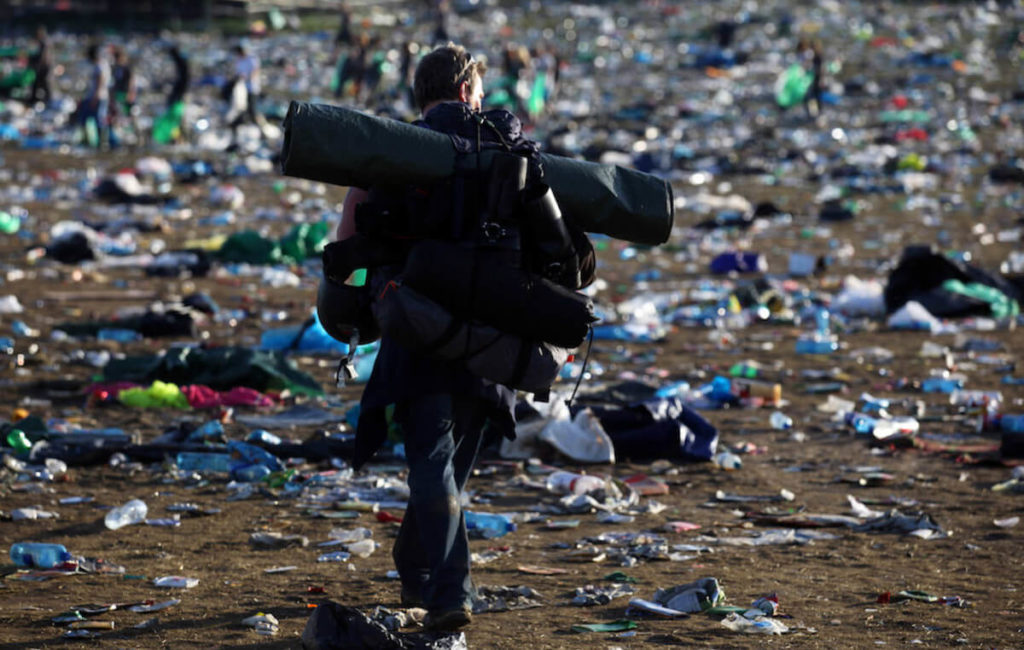
This ban is a step towards stemming the amount of waste used at the event. A much-needed effort since in 2017 alone it was reported that Glastonbury got through in excess of 1.3m plastic bottles.
Emily Eavis, an organizer of the Glastonbury festival, said:
“Obviously we are all fighting the fight against plastic, which is an enormous task but well overdue and we need to make steps in the right direction. A vast amount of plastic bottles were gotten through and when you see images of the arena completely covered in old plastic bottles it’s quite haunting. We have been working on this during the year off. We spent a lot of time in 2018 working on the logistic side of all this, speaking to suppliers and market managers, area organizers. We are tackling drinking bottles at the moment, water bottles … and we are encouraging people to bring their own reusable bottle but there will also be reusable bottles available on site.”
The New Way
Attendees won’t be able to buy non-reusable bottles anywhere on site. They will also no longer be supplied or available in the backstage, production, catering and dressing room areas. Instead, there will be many water refill stations scattered across the grounds so people can easily just refill their reusable bottles. Eavis encouraged ticket-holders to bring reusable bottles and said “hundreds of free water taps” will be available.
Campaign Against Single-use Tents
The organisers of Glastonbury festival and 60 other independent festivals have teamed up with The Association of Independent Festivals (AIF) to change tent advising. AIF says some places advertise them are “festival tents,” which gives the impression that you only need to use them once. This is perhaps the reason why more than 250,000 tents get left behind at UK festivals each year.
Paul Reed, AIF’s chief executive says “The research out there narrows it down to this – a third of abandoned tents at festivals can be traced back to major retailers like Argos and Tesco.”
AIF says the average tent is mostly made out of plastic which is equivalent to 8,750 straws or 250 pint cups. Many people believe that the tents are collected by charity organisations to be reused and resold, however, the truth is that most of them will end up in landfills.
Several retailers have changed their advertising practices but the results are yet to be seen.
Boomtown Festival in Winchester in August say they will have a near zero-tolerance policy when it comes to abandoning tents. Emily Ford, the festival’s sustainability coordinator, says there will be a campsite patrol at the festival. The Eco Camp plans to create a zero-waste space. Ford says: “If people aren’t living up to our ethos there’ll be a warning system and if people breach it, we may ask them to leave the Eco Camp.”
Other festivals are also changing and clarifying their tent purchasing and reuse policies.


