
These seven women all achieved significant milestones in their fields, but because they are black women their contributions to society have often been overlooked. We should not disregard the work these African-American women performed in their careers as it has helped many people and advanced the profile of black women both in the U.S. and around the world.
Shirley Ann Jackson
 Shirley Ann Jackson was the first black woman to earn a doctorate at MIT (in 1973) and the second to earn a Ph.D. in physics in the U.S. She was the only one studying theoretical physics while in university and once out she went to work at various laboratories, including AT&T Bell Laboratories, FermiLab and the European Organization for Nuclear Research (CERN). Her work mostly focused on subatomic particles. She has served as the president of Rensselaer Polytechnic Institute since 1999.
In 1995 she became the first woman and the first African-American to serve as the chairperson of the U.S. Nuclear Regulatory Commission after being selected by President Bill Clinton. Later on, in 2014, President Barack Obama chose her to co-chair the President’s Intelligence Review Board, a group that advises the president on “the quality and adequacy of intelligence collection, counterintelligence, and other intelligence activities.” That same year Obama also awarded her the National Medal of Science which is the highest honor the government can bestow to a scientist or engineer.
Mary Eliza Mahoney
 Mary Eliza Mahoney was the offspring of freed slaves living in Boston, born in the spring of 1845. When she was a teenager she decided that she wanted to be a nurse. From that moment on, she did everything she could to make her dream come true. Over the course of 15 years, she took on a variety of roles at the New England Hospital for Women and Children, including janitor, washer, and most importantly, nurse’s aide.
The hospital also operated a nursing school, and 33-year-old Mahoney was finally admitted to its professional graduate school. She was one of only four students that managed to complete the program out of the 42 that enrolled in the program (in 1878). Not only that but in so doing, she became the first black woman to earn a professional nursing license in the U.S. (in 1879). She became a private nurse, often to rich white families along the East Coast, in hopes of avoiding discrimination that was rampant in the public sphere. She also co-founded the National Association of Colored Graduate Nurses in 1908. The American Nurses Association inducted Mahoney into its hall of fame in 1976, followed by the National Women’s Hall of Fame which inducted her in 1993.
Mary Jackson
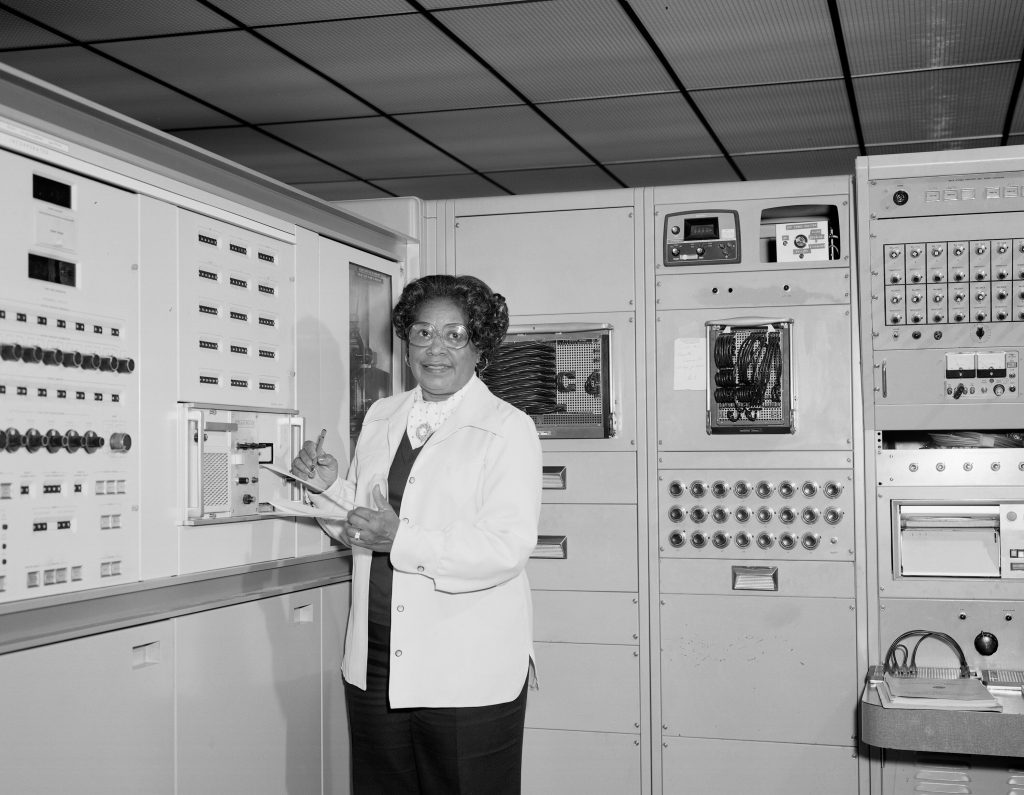 Mary Jackson received dual degrees in math and physical science in 1942. After teaching at a black school in Calvert County, Maryland, and working a few other jobs, including a receptionist and bookkeeper, she began her career at NASA as a mathematical researcher. It was in 1951 that she was recruited to work for National Advisory Committee for Aeronautics, the organization that would later be succeeded by NASA.
Here, she started off working as a research mathematician, or computer, at Langley Research Center’s segregated West Area Computing Unit. Just two years later, she began work with engineer Kazimierz Czarnecki on the Supersonic Pressure Tunnel – a 60,000-horsepower wind tunnel capable of blasting models with winds approaching twice the speed of sound.
After this, she went on to become an engineer. She got permission from the city of Hampton, Virginia, to attend classes with white students and in 1958, completed the program and became NASA’s first black female engineer. With her new position, she did extensive work, particularly on the behavior of the boundary layer of air around airplanes.
Marian Croak
 Marian Croak earned a Ph.D. from the University of Southern California in 1982, with an emphasis on social psychology and quantitative analysis. The same year she graduated, she joined AT&T’s Bell Laboratory, where she made a remarkable impact on the telecommunication landscape. Overall, she accumulated over 100 patents on Voice over Internet Protocol (VoIP) technologies – the process by which we transmit sound as data over the internet. For example, voting for “American Idol” over the phone or donating to a charity the same way. She oversaw the development of that technology. In 2014, she became the vice president of engineering at Google in 2014.
Alice Ball
 Alice Ball, born 1892, earned degrees in pharmaceutical chemistry and pharmacy from the University of Washington and became the first African-American and the first woman to earn a master’s degree in chemistry from the College (now University) of Hawaii. Within a year, she discovered a way to create a water-soluble solution from chaulmoogra oil. This was an incredible medical breakthrough as chaulmoogra oil was the main treatment for leprosy symptoms, but its taste often caused patients to vomit while taking it or they developed abscesses under the skin. Her discovery made it possible for it to be injected with minimal side effects.
In 1916, before she had a chance to publish the science behind her discovery, she died. Not only was it a tragedy because she was only 24 years old, but on top of that, the College president Arthur L. Dean continued her work and took all the credit. Up until the 1940s, her method proved the best treatment for leprosy and nobody knew that she was the true creator of the solution. Fortunately, another professor name-checked her in a 1922 medical journal and her development of the injection. Today, if you go to the University of Hawaii, you can see a dedication plaque honoring Ball’s contribution to medicine sitting under the only chaulmoogra tree there.
Mae Jemison

Mae Jemison entered Stanford University younger than normal at 16 years old (in 1973) and went on to later become the first black woman to serve as an astronaut. In 1977, she graduated with dual degrees in chemical engineering and African-American studies. Right upon graduating, she enrolled at Cornell University’s medical school, with a focus on international medicine. All the while, she volunteered in Thailand, studied in Kenya and graduated with her medical degree in 1981.
In 1983, she joined the Peace Corps and worked in West Africa on a few different projects, including a hepatitis B vaccine. That same year, she became inspired by Nichelle Nichols’ portrayal of Uhura on “Star Trek” and applied to be an astronaut. Amazingly, she was selected for the astronaut pool along with 14 other people in 1987.
At first, she worked on various launch-support tasks. Then, in 1992, she launched into space for a week-long stint aboard the space shuttle Endeavour. While aboard, she conducted multiple experiments. In 1993, she left NASA and started her own company dedicated to developing science and technology for everyday life.
Madam C.J. Walker
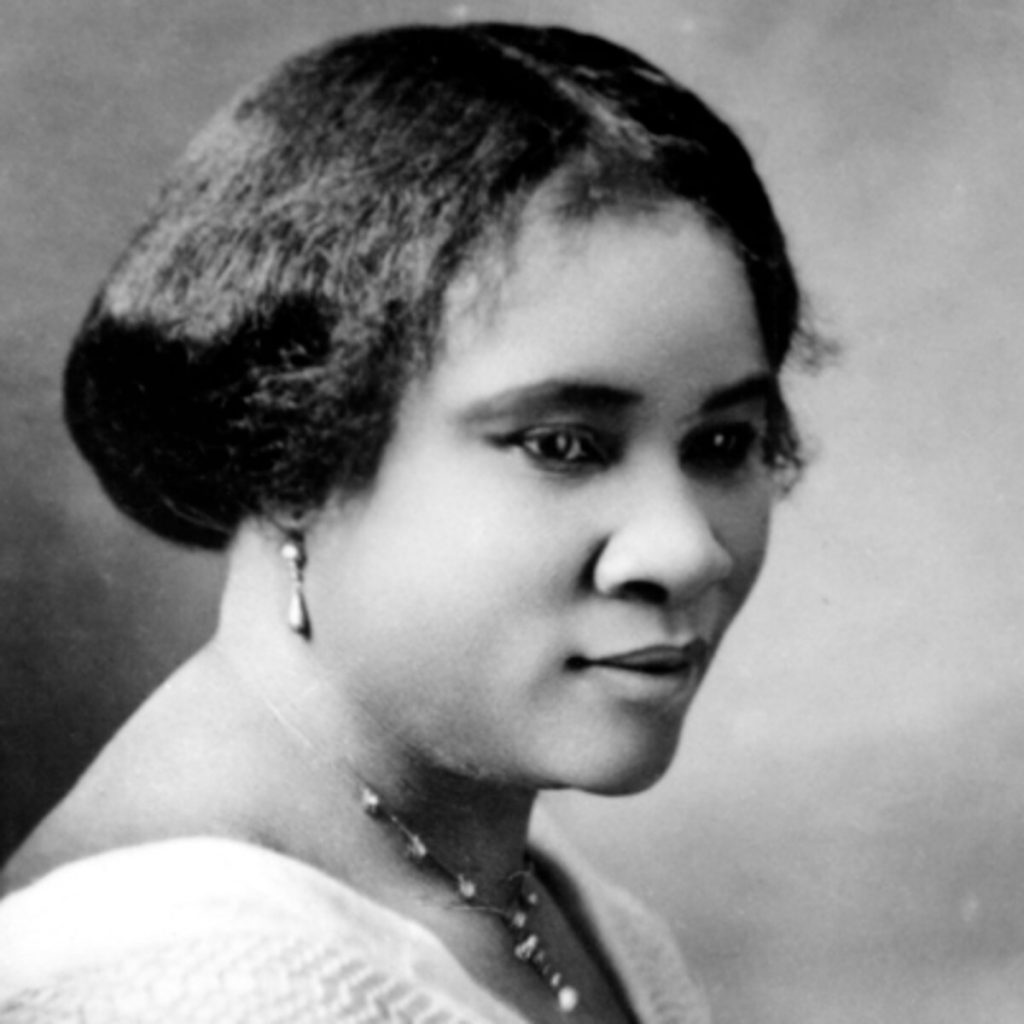 Born named Sarah Breedlove in 1867 as one of six children to slaves who became sharecroppers, Madam C.J. Walker struggled for much of her life. She was orphaned at the age of 7, then escaped an abusive brother-in-law by marrying at 14. She became a widow at the age of 20 with a 2-year-old daughter. She moved to St. Louis 2 years later where her four brothers set themselves up as barbers. While there, she worked as a cook and a laundress, married and divorced. Her health and finances were taking a toll on her life.
Things changed in 1904, at the age when she began using a product called “The Great Wonderful Hair Grower” by African-American businesswoman Annie Turnbo Malone. She joined the sales force, while still working for Malone she moved to Denver and married again to Charles Joseph Walker and launched her own line of cosmetic products, some slightly tweaked from Malone’s products.
Walker developed her business by setting up mail-order lists and training local women to act as sales agents using the “Walker System.” By the end of her life in 1919, she had a net worth of around $1 million (over $15 million in 2019 adjusted for inflation). She was the first self-made female millionaire. When she died she donated two-thirds of future net profits to charity. The company continued to run until 1981.
Alexa Canady
 Alexa Canady had a rough time with school growing up in the 1960s and 70s because no matter how hard she worked, her scores remained average. Turned out, it wasn’t because she wasn’t intelligent, it was because the teacher was swapping her grades with those of other students, giving Canady’s scores to a white girl in the same class. In the end, it didn’t matter because it just drove her to work harder and she went on to receive her medical degree in 1975 specializing in neurosurgery, a difficult field to break into as a woman and especially as a black woman.
In 1982, she became the first African-American and the first woman to become a pediatric neurosurgeon and by 1987, she was the chief of neurosurgery at the Children’s Hospital of Michigan. One of her most remarkable achievements includes the development of a shunt to help treat hydrocephalus or water on the brain.


