
The people of the Amazon rainforest face many challenges from big business. Deforestation has been going on for quite some time and is now becoming an even greater problem. This year’s ‘burning season’ has seen fires return at record-breaking levels.
After analyzing the fires, it has been reported that they are three times more common in beef-producing zones than in the rest of the Amazon. Cattle ranching is the main reason for deforestation for every country in the Amazon. It’s responsible for 80% of deforestation and Brazil is home to 200 million cattle. They supply nearly one-quarter of the beef for the global market.
The non-profit sustainability project called Chain Reaction Research designed a way to map the NASA fire alerts archive data. They looked at the legally defined area of the Amazon and what they found was that of the 554,000 alerts from July to September, nearly 70% or 376,000 were in the estimated beef buying zones. This area covers less than half of the legal Amazon.
Many of the world’s leading meat companies operate in the region, including JBS, which is the largest supplier for meat globally. More than 250,000 fire alerts were issued from the JBS buying zones alone. They are a known exporter to Europe, including companies located in the UK.
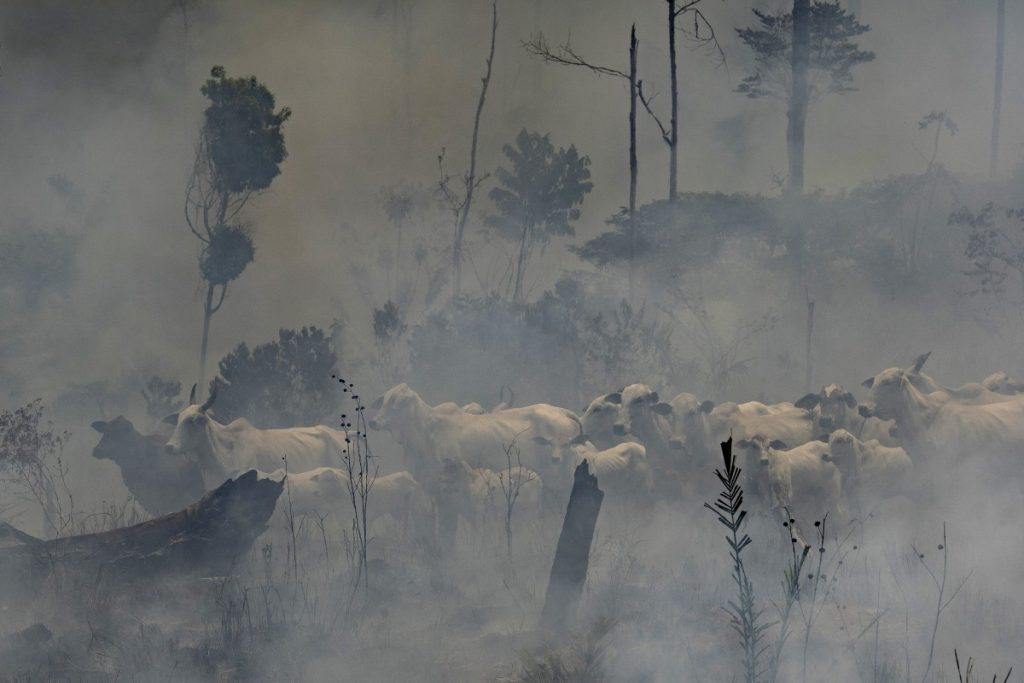
In the buying areas of Marfrig, who is the third-largest exporter of beef in Brazil, there were nearly 80,000 fire alerts. Add on another 66,000 fires in Minerva areas. According to Imazon, these three companies account for almost half of the slaughtered cattle in the region.
All three companies told the Bureau of Investigative Journalism (BIJ), they were committed to “zero-deforestation” supply chains, stating they monitor their suppliers to ensure this.
A JBS spokesperson commented:
Theoretical correlation based on estimates is not causation and is misleading. JBS is actively working to bring together other important stakeholders and companies to join forces to preserve the Amazon. If farms are deemed non-compliant with our sustainable sourcing policies for any reason, including deforestation, they are blocked from our supply chain… We are not involved in, nor do we condone, the destruction of the Amazon.
Marfrig said that they have been monitoring fire outbreaks since August and blocks any farms that are associated with deforestation. Marfrig said: “Whenever any overlapping of areas between the properties and the fire outbreaks is identified, there is an alert for the purchase to be reevaluated.”
Minerva said, “there is no proven connection with agribusiness activities,” and there was no evidence of them buying animals from ranches where fires had occurred.
The three companies admitted that it’s difficult to track the earlier ranchers in the supply chain. Many of the cattle come through indirect suppliers. The three companies are said to be working together along with governments and NGOs to address this issue.

Despite what these companies are claiming, one thing remains a fact. The highly deforested cattle areas of the Amazon account for the most fires. The French MEP Manon Aubry shared some good thoughts:
We need to change the rules with an international binding treaty forcing transnational companies to pay the price if they destroy the environment. The EU also has to question the impact of free trade agreements that are detrimental to both the planet and the people. A deal with the Mercosur would worsen the situation and accelerate deforestation in Amazonia.
In my opinion, this should be done across the globe, the big business companies that continue to destroy the planet, should be held accountable. They have been allowed to operate with no repercussions for far too long. These fires are destroying one of the most important ecosystems left on the planet. For more info on the Amazon, you can visit amazonwatch.org


