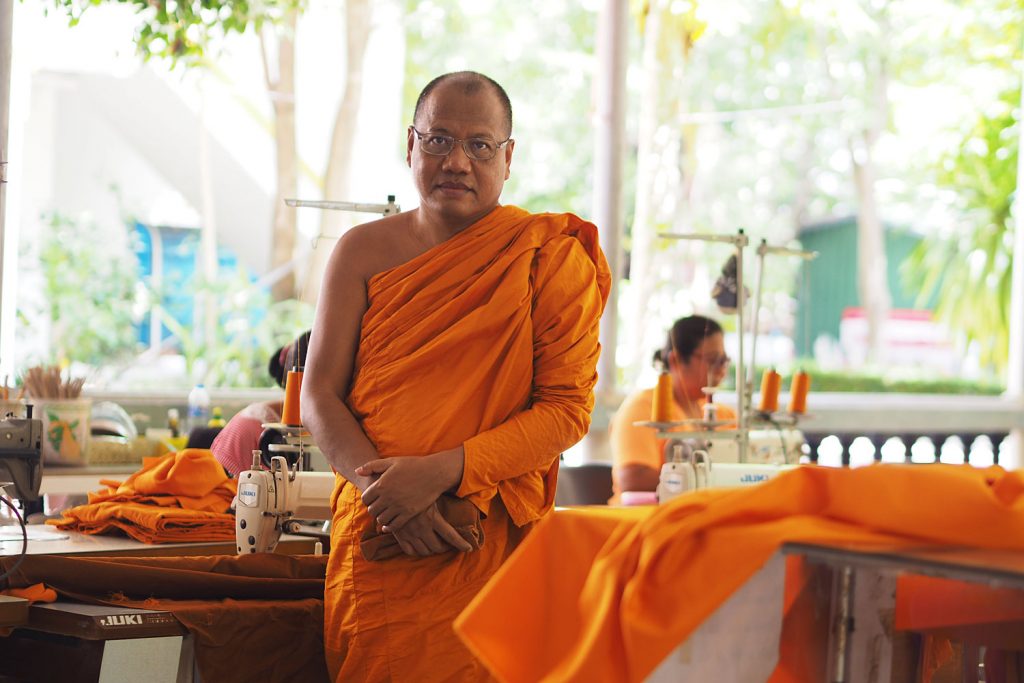
Thailand’s Wat Chak Daeng temple now clothes all of their monks with orange robes made from recycled plastic bottles collected from a nearby river. Abbot Maha Pranom Dhammalangkaro, from Wat Chak Daeng, said other temples across Thailand have also started to make orders for their recycled robes.

Maha Pranom recalls:
We had the idea of turning plastic into robe just from our daily life at the temple. We turned dry leaves into organic fertilizer or fuel and tried to turn plastic into fuel, but it was not efficient. Then we saw one member of staff wearing a recycled t-shirt, so we thought it might be possible to transform plastic into monk’s robes.
Previously, plastic bottles were collected for sale because the temple didn’t have the expertise to transform them into fabrics. However, their luck changed when PTT Global Chemical visited the temple last year. PTT GC has knowledge and technology, which is a perfect match for the monk’s plans. PTT GC worked with Wat Chak Daeng to launch the recycling project, which is currently run by Chak Daeng Community Enterprise.


Maha Pranom, his team of monks and volunteers, collect the bottles from a nearby river. Residents have also donated about 110lbs to 220lbs of bottles to the temple for their cause.
The process of making eco-fabrics involves collecting the bottles, then separating the caps and labels. The bottles are washed and crushed into a cube before being taken to a factory. Then, they are cut into tiny grains and mixed with cotton and nano zinc oxide particles before being stretched into thread. The thread is dyed saffron and delivered back to the temple, where it’s woven into sheets to make the orange monk robes.
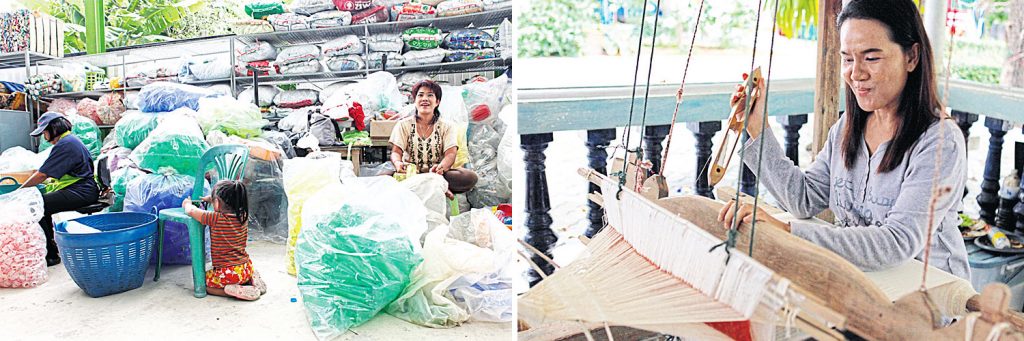
Maha Pranom tested the recycled robe for an entire year to obtain the perfect formula. The robes are made from about 34% recycled plastic, 43% silk, and 23% polyester. Around 15 bottles are needed to make a 2-meter-long cloth for one monk robe.
Maha Pranom explained:
I tried wearing them for one year to see if they were too thick, too hard to dry or too hard to wash, or any other problems. But it was comfortable to wear; it was not smelly or damp. It was easy to wash and dries quickly.
Maha Pranom encourages other parties such as the government to give serious efforts to do something about the plastic pollution problem in Thailand.
He said:
I don’t think our campaign is successful yet; this is just the beginning. I think it will be a success when it raises awareness of recycling among Thai people. If they can collect plastic waste and know how to use it, that’s what I call success. If people don’t neglect the benefit of recycling and start to increase the use of it, if that happens, then the campaign is the success.
Orange monk robes aren’t the only thing that Chak Daeng Community Enterprise is producing out of waste. Some other items include bags, blankets, T-shirts, and sarongs printed with traditional patterns.