
The viability of toxic exposure claims hinges on a single, complex inquiry: Did this substance actually cause this harm? Causation represents the volatile intersection where legal standards, scientific inquiry, and inherent uncertainty collide. Unlike a rear-end collision or a broken contract, toxic torts often involve invisible exposures, long latency periods, and injuries that could have multiple explanations. This creates a landscape where legal teams must act as both historians and scientific translators to bridge the gap between exposure and illness.
Proving causation represents the most significant evidentiary burden for plaintiffs. Conversely, causation often serves as the primary strategic vulnerability for defense counsel to target. Below are the core challenges litigators continue to wrestle with when causation takes center stage in toxic exposure claims. By navigating these hurdles, attorneys can better understand the intricate balance required to present a scientifically defensible case in court.
Success in these cases requires more than just showing an injury occurred. It demands a rigorous reconstruction of events, often spanning decades, to establish a credible link. As scientific standards evolve and courts become more stringent regarding expert testimony, the methods used to prove causation must be equally sophisticated and resilient against scrutiny.

Proven Methods for Establishing Documented Toxic Exposure
Before causation even enters the conversation, plaintiffs must show that exposure actually occurred. While fundamentally clear in theory, establishing exposure presents substantial practical difficulties. Identifying the source of contamination requires an investigation into various environmental vectors. Attorneys must often account for several common evidentiary gaps:
- Hazardous substances often travel through airborne or waterborne pathways.
- Contaminants remain embedded in building materials lacking clear labels.
- Historical workplace exposure records are frequently incomplete or nonexistent.
These systemic documentation failures force legal teams to rely on forensic reconstruction. By identifying these gaps early, litigators can build a more resilient narrative regarding the reality of the exposure.
Investigating residential exposure often requires a painstaking analysis of environmental conditions that have been dormant for decades. Over such long periods, witness memories inevitably begin to fade. Companies may dissolve, and critical documentation often disappears entirely. Without credible proof of exposure, causation becomes irrelevant, and courts won’t let a case proceed on speculation alone.
Scientific Defensibility in Linking Contaminants to Health Injuries
Even when exposure is established, the next challenge is connecting that substance to the alleged injury in a scientifically defensible way. Courts increasingly demand reliable epidemiological evidence, not just anecdotal reports or animal studies. Scientific inquiry rarely produces definitive or binary conclusions, creating a significant hurdle for litigators.
Many chemicals are associated with increased risk, not guaranteed outcomes. A plaintiff must bridge the gap between correlation and causation, often under the Daubert or Frye standards. Defense experts typically challenge the validity of the plaintiff’s evidence by highlighting alternative data interpretations. They focus heavily on small sample sizes or the presence of confounding variables that might skew results.
This tension places a significant burden on the court. Ultimately, judges—rather than scientists—decide whether the presented evidence meets the legal threshold to reach a jury.
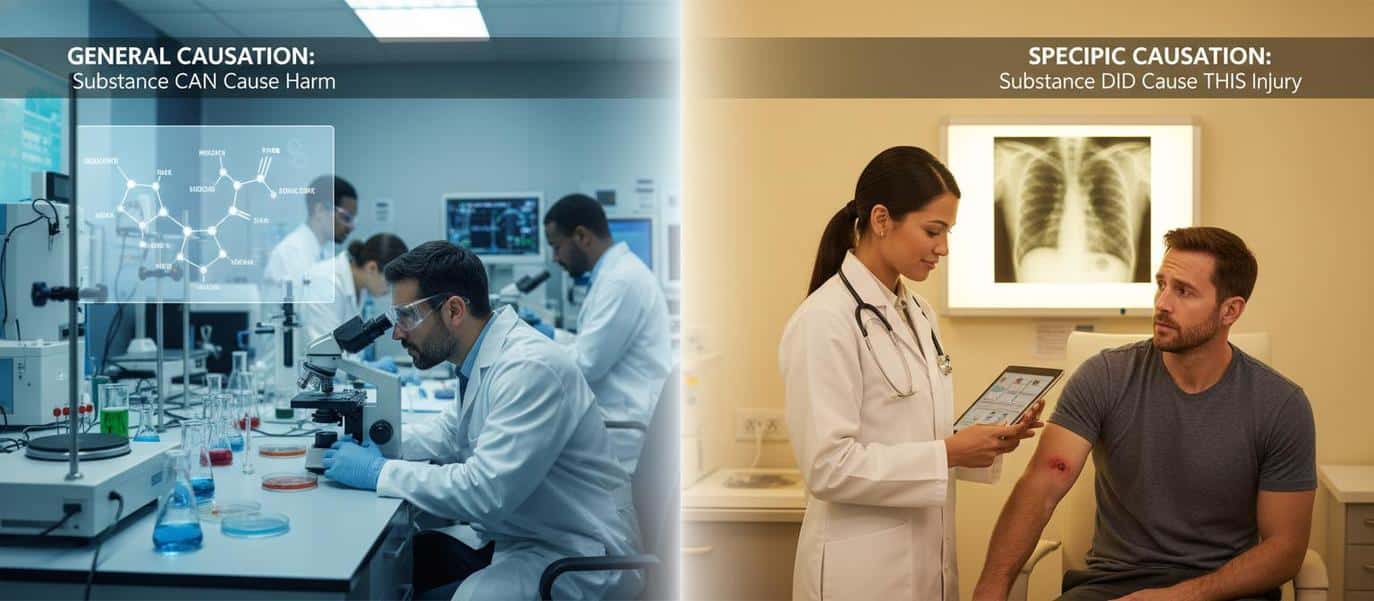
General Causation Versus Specific Causation
Toxic tort cases usually require proof of both general and specific causation. While general causation explores whether a substance is capable of inducing a particular harm, specific causation investigates whether that substance was the actual catalyst for an individual plaintiff’s injury. Navigating this conceptual divide remains a daunting task for even the most seasoned legal practitioners.
To illustrate, while a chemical might be scientifically capable of damaging the liver, the court must determine if it caused the specific damage reported by the plaintiff. This requires a rigorous differential diagnosis process. Medical experts must systematically evaluate several factors:
- Underlying genetic predispositions.
- Specific lifestyle choices and habits.
- Preexisting medical conditions unrelated to the exposure.
By ruling out these variables, a plaintiff can more effectively isolate the toxic substance as the primary cause. This methodical approach is essential for satisfying the court’s requirement for specific causation.
The Impact of Long Latency Periods on Causal Evidence
One of the most persistent challenges in toxic exposure claims is time. Numerous illnesses associated with toxic substances do not manifest until decades after the initial contact. This vast temporal disconnect often erodes the plaintiff’s causal framework while providing fertile ground for defense counter-narratives. Consequently, defense narratives are strengthened as they point to intervening exposures or unrelated health developments.
Plaintiffs must reconstruct a historical narrative that connects past exposure to present injury, often relying on expert testimony to explain latency periods. Asbestos litigation reshaped how courts view delayed-onset diseases, including modern causation standards in cases like a mesothelioma lawsuit, without making causation automatic or presumed.
Analyzing Individual Susceptibility and Dose-Response Data
Toxic substances rarely affect everyone equally. Individual susceptibility complicates causation analysis. One individual might experience profound health complications from minimal contact. Conversely, another person exposed to the same levels may remain entirely asymptomatic.
Because of this variance, courts place immense weight on the concept of the dose. Plaintiffs must show not only exposure but also exposure at a level sufficient to cause harm. Achieving technical precision in these metrics serves as the fundamental anchor for any successful causation theory. Litigators typically rely on several key components:
- Specialized testimony from industrial hygiene experts.
- Sophisticated mathematical modeling of the exposure site.
- Detailed assumptions regarding the duration and intensity of contact.
Even minor inaccuracies in these calculations can jeopardize the viability of the claim. Precision in this data is the cornerstone of a successful causation theory.

Navigating the Future of Toxic Exposure Litigation
Successfully litigating causation requires a meticulous blend of scientific rigor and historical reconstruction. Because the stakes in toxic tort cases are exceptionally high, courts demand evidence that transcends mere correlation. Litigators who master the interplay between epidemiological data and individual medical histories are best positioned to navigate the complexities of modern courtrooms. This balance ensures that the legal system remains a venue for genuine redress while upholding high standards of scientific proof.
The strength of a toxic exposure claim rests on the integrity of its causal chain. Attorneys must adapt to these evolving standards, ensuring every technical detail—from dose-response metrics to latency data—strengthens the overarching narrative of causation.
Frequently Asked Questions About Toxic Tort Causation
What Is the Difference Between General and Specific Causation?
General causation determines if a substance is capable of causing a particular injury in the general population. Specific causation evaluates whether that substance actually caused the specific injury in a particular plaintiff.
Why Are Latency Periods a Problem in Toxic Exposure Claims?
Long latency periods mean that symptoms may not appear for decades after exposure. This creates difficulties in preserving evidence, locating witnesses, and proving that no intervening exposures caused the harm.
What Are the Daubert and Frye Standards?
These are legal standards used by judges to determine the admissibility of expert witness testimony. They ensure that the scientific methods used to prove causation are reliable and widely accepted by the scientific community.
How Is the “Dose” of Exposure Determined in Court?
Experts often use industrial hygiene modeling, historical records, and witness testimony to estimate the intensity and duration of exposure. This helps establish if the level was sufficient to cause the alleged harm.
What Role Does Differential Diagnosis Play in These Cases?
Differential diagnosis is a process where a doctor evaluates all possible causes of an illness and systematically rules them out until the most likely cause—such as toxic exposure—remains.


