
A validated 4D whole-cell simulation of the minimal bacterium JCVI-syn3A now reproduces a complete cell cycle in space and time. The result behaves like a working digital twin of a cell, one researchers can interrogate across metabolism, DNA replication, gene expression, and division. A breakthrough establishes a new standard for genomic digital twins, providing a dynamic map of life that was previously theoretical.
Modeling a single street fails to capture the complexity of a functioning city. A simulation provides that missing systemic view. Clinical laboratory results reinforce a universal truth: clarity arrives when the entire system becomes observable. Digital twin software used in smart cities demonstrates why an interrogatable model revolutionizes systemic problem-solving. Scientists are effectively building the infrastructure for BioCAD (Computer-Aided Biological Design).
Modeling stochastic variability in biological systems ensures that future genomic digital twins can predict cellular unpredictability with measurable precision. Integrating every major biological process into a unified timeline allows the minimal bacterium model to serve as a bridge. Simulating a living cell in 4D requires more than just high-resolution data; it necessitates a mechanistic system model that respects coarse-grained kinetics.

4D Minimal Cell Simulation: Essential Technical Metadata and Study Scope
Key details below are summarized from an NSF overview of the 4D dividing-cell simulation and the peer-reviewed study.
- Organism: JCVI-syn3A, a genetically pared-down bacterium used as a minimal test rig.
- Scope: Whole-cell, 4D simulation that couples metabolism, gene expression, chromosome dynamics, membrane growth, and division.
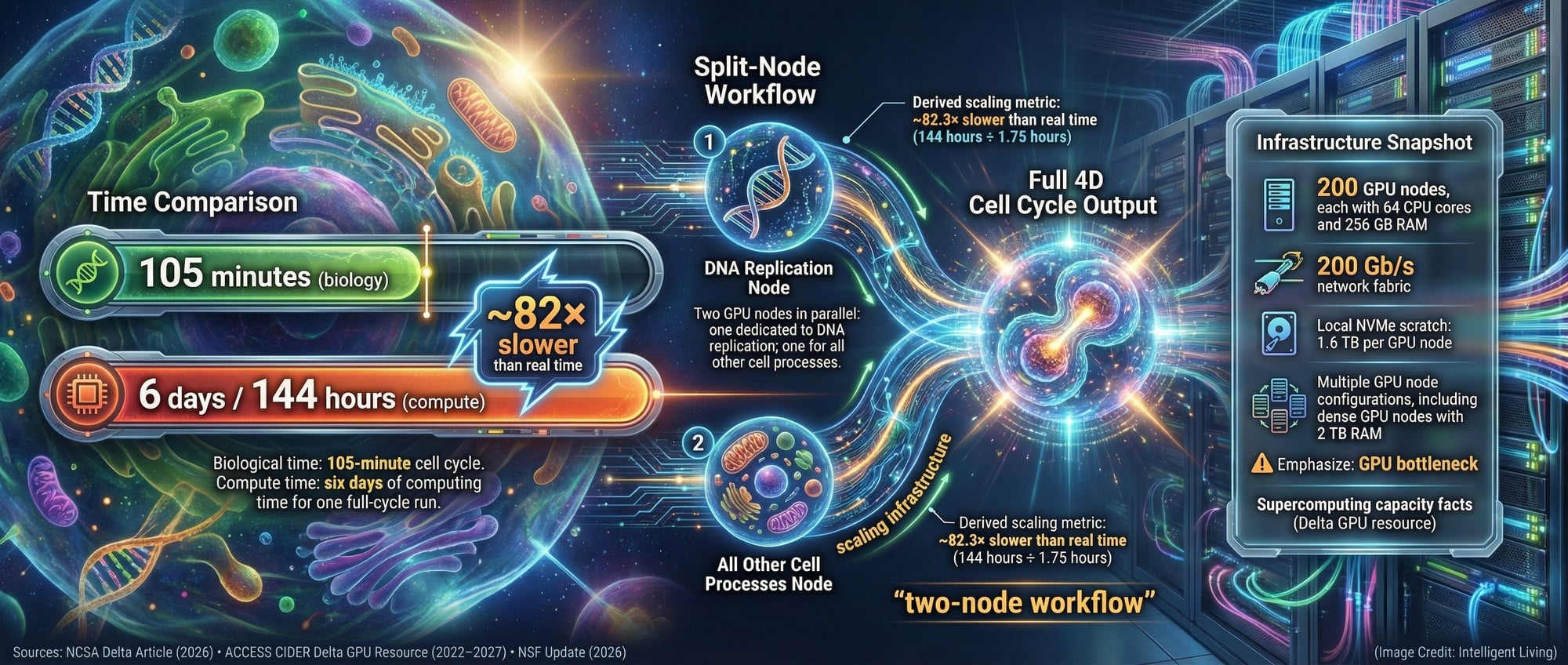
- Cell Cycle Modeled: Roughly a 100-minute cell life cycle, with a full-cycle run reported around 105 minutes in simulated time.
- Compute Cost: Full-cycle runs required days on high-performance GPUs, making compute a practical bottleneck.
- Validation: Outputs were compared against experimental measurements such as doubling time, mRNA lifetimes, ribosome counts, and imaging-based distributions.
- Open Science: A frozen code-and-data snapshot on Zenodo preserves the exact study artifacts for reproducibility.

Defining the Digital Cell: Mechanistic Modeling and Systemic Utility
Mechanistic vs. Atomistic Models: Defining the Limits of Whole-Cell Simulation
Simulating an entire cell often suggests an atom-by-atom copy of life to the casual observer. JCVI-syn3A functions as a mechanistic system instead: the Cell paper details a 4D whole-cell model of JCVI-syn3A that tracks coupled processes across space and time.
Coarse-grained constraints keep the simulation computationally tractable, yet these simplifications leave specific confidence gaps. Read the output as a data-constrained synthesis of current knowledge rather than a perfect mirror of nature.
Visualizing this process mirrors watching a clock and then opening the casing. While the face indicates time, the gears explain fluctuations in rhythm or speed.
Interrogatable Digital Twins: Coupling Cellular Processes Across Space and Time
The leap here is integration at scale. Metabolism, gene expression, chromosome replication and segregation, membrane growth, and division all operate in the same simulated space and time. A University of Illinois summary of the whole-cycle simulation frames this integration as the practical leap that makes linked questions answerable in one coherent run, such as whether shifts in nucleotide availability can change replication timing, or whether ribosome distributions reshape protein gradients inside the cell.
Observing complex system failures often reveals missed dependencies; this simulation resolves that vulnerability. Instead of treating pathways like isolated chapters, the simulation forces the story into one timeline where feedback loops can be tested.

Integrated Modeling Benefits: Surfacing Emergent Biological Behaviors
Integration surfaces emergent behaviors that remain hidden when studying biological components in isolation. Functional whole-cell modeling platforms provide the necessary architecture to test feedback loops and generate concrete hypotheses.
- Emergent interactions become visible across metabolism and gene expression.
- Researchers can rank hypotheses by their systemic impact.
- Model realism improves as parameter coverage expands.
Realism improves as parameter coverage expands, making success dependent on the clarity of gene functions and the precision of the underlying data.
Validating Genomic Digital Twins: Experimental Guardrails and Spatial Data
Rigorous validation distinguishes functional research tools from mere visual animations. The simulation was constrained by experimental measurements and imaging-derived distributions, so the model has guardrails.
The imaging piece is especially important because spatial biology is often where intuition breaks. Modern advanced microscopy in biomedical research is one reason scientists can now constrain models with real spatial patterns instead of relying only on averages.
GPU Computing and Minimal Genomes: Scaling Whole-Cell Simulation Infrastructure
High-Performance Computing Costs: GPU Bottlenecks in 105-Minute Cell Cycles
The compute story is the reality check most readers remember. As mini AI supercomputers shrink in footprint, the long-term direction points toward more research groups running heavier models without living inside a national supercomputing center, although today’s full-cycle runs still demand serious GPU time. Using the NCSA Delta supercomputer workflow for the 105-minute 4D model, the team reported that a single full-cycle run took about six days of computing time, and DNA replication was heavy enough to isolate onto its own GPU node.
Managing a cell mirrors the strain of a browser overloaded with tabs; both demand immense processing power to maintain consistency. A cell is not a tab; it is a city, and the simulation has to keep the whole city consistent at every moment.
DNA Replication Constraints: Identifying Computational Bottlenecks in Systems Biology
Replication couples sequence-level events with polymerase dynamics and topological constraints, creating immense compute costs. The simulation tracks DNA copying alongside the binding, movement, and tangle resolution of molecular machinery.
Scaling Biological Simulations: From Minimal Cells to Multicellular Complexity
Scaling beyond minimal biological systems demands sophisticated algorithms and precise experimental maps alongside raw hardware. Expanded whole-cell models of E. coli physiology illustrate how quickly scope becomes data-limited when complexity rises. Compute infrastructure still has to keep improving, much like the exascale supercomputers being built to handle systems that overwhelm older designs.
Minimal Genomes as Engineering Primers: Accelerating the Path Toward BioCAD
A minimal cell functions like biology’s engineering primer. By paring a genome down toward essentials, researchers reduce the number of unknown interactions they must model. Research into minimal cells as simplified life testbeds explains why this strategy can reveal first principles faster than working only in fully complex organisms.
JCVI-syn3.0 was minimized to 473 genes in 2016, with later variants like syn3A adding specific genes to enhance robustness. That iterative logic is exactly what makes minimal systems good platforms for learning.
Genomic Minimization Logic: Reducing Combinatorial Interactions for Precise Modeling
Reducing gene count minimizes combinatorial interactions. When a system contains a smaller, better-characterized set of components, the model needs fewer assumptions, and predictions become more testable. A minimal bacterial genome design study also highlighted “quasi-essential” genes that are not strictly required for survival but matter for robust growth, which is why minimal cells are engineered iteratively.
BioCAD Infrastructure: Linking Genotype to Phenotype Through 4D Simulation
BioCAD represents the long-term goal of computer-aided biological design, using simulation to prioritize laboratory edits. While the whole-cell computational model published in 2012 established the genotype-to-phenotype connection, this new generation adds unprecedented spatial and temporal detail.
Rapidly cataloging biological unknowns accelerates the transition toward feasible BioCAD tools. When AI indexes protein shapes and DNA regulatory elements at scale, the space of “mystery biology” shrinks, and models gain better priors.

Future Roadmaps for Digital Twin Biology: Capabilities and Current Constraints
Virtual Hypothesis Triage: Accelerating Laboratory Discovery through in Silico Screening
Establishing a faster hypothesis engine provides immediate utility. Computational perturbation screening allows researchers to rank candidates and reserve laboratory resources for survivors of virtual triage. Simulation-driven development logic mirrors this workflow, where a high-fidelity model reduces expensive real-world iteration.
Current findings do not imply readiness for clinical decision-making. The correct way to read the advance is as a research tool that informs experiments rather than replaces them, especially when claims drift toward drug response.
High-Impact Use Cases: Drug Mode-of-Action Exploration and Metabolic Design
Primary use cases focus on accelerating hypothesis generation and mechanism testing:
- Drug Mode-of-Action Exploration: Division disruption hypotheses are tested in silico before laboratory validation.
- Metabolic Design: Small edits to pathway enzymes are screened for impacts on replication timing.
- Systems Biology Research: Stochastic variability is studied as an emergent property of coupled reactions.
The JCVI notes that 4D whole-cell models can predict responses to mutations and environmental changes but those predictions still live or die by validation.
Technical Limitations: Data Gaps and Coarse-Grained Kinetic Assumptions
Limitations stem from reliance on existing data, causing the model to inherit inherent measurement gaps. Confidence levels remain highest where measured constraints are most robust.
The Minimal_Cell_4DWCM codebase on GitHub allows independent groups to inspect assumptions and replicate runs, which is how a simulation becomes a scientific instrument.
Compute constraints also have a supply-chain dimension. When advanced packaging becomes the compute bottleneck, the pace of GPU availability can shape what research becomes feasible.
Prioritizing Precision Metrology: Critical Data Gaps in Cellular Modeling
The simulation identifies critical measurement gaps that currently limit predictive power. Addressing these spatial and temporal gaps allows models to transition from descriptive tools to truly predictive digital twins.
- High-resolution spatial distributions of macromolecules.
- Quantitative time courses for poorly measured mRNA lifetimes.
- Biophysical data regarding membrane growth dynamics.
Precision engineering measurement standards maintain value stability and comparability. Predictive accuracy relies on the repeatability of measurements across diverse laboratory environments.
Governance and Reproducibility: Ethical Standards in Biological Digital Twin Research
Minimal bacterial modeling carries low ethical risk compared with human cell simulation, but reproducibility standards and transparent uncertainty reporting matter more as models begin to influence experimental decisions. Shared artifacts that follow FAIR data principles help keep reuse honest by making data and workflows findable, accessible, interoperable, and reusable.

Next-Generation Systems Biology: Transitioning Toward Complex Organism Modeling
Achieving a 4D whole-cell simulation represents a pragmatic leap toward functional biological digital twins. The longer-term shift will depend on better algorithms, richer measurement, and scalable infrastructure, while projects like the Human Cell Atlas mapping initiative keep turning biology into structured reference maps that models can learn from. A specific 105-minute 4D model proves that the genotype to phenotype connection is no longer a black box but a visible, computable pathway.
Integrating these systems will refine our ability to triage hypotheses in silico, ensuring that the next era of biological discovery is driven by data-constrained synthesis and computational rigor.
Frequently Asked Questions: 4D Biological Modeling and Digital Cells
1. What defines a 4D whole-cell simulation in modern systems biology?
A 4D whole-cell simulation couples mechanistic modules—like metabolism and DNA replication—into a single timeline that accounts for 3D spatial dynamics. It creates a testable digital twin of a minimal bacterium to observe emergent behaviors.
2. Why does the JCVI-syn3A minimal bacterium serve as the ideal test rig?
Reducing the genome to 473 essential genes narrows down unknown interactions. Genomic simplicity allows researchers to validate whole-cell models with fewer assumptions than complex human systems require.
3. Why does it require 105-minute cell cycle days of GPU compute?
Heavy computational loads stem from spatially resolved reactions and genome-scale replication networks. DNA replication acts as the primary bottleneck, demanding dedicated high-performance GPU nodes to maintain consistency.
4. Can genomic digital twins accelerate drug mode-of-action exploration?
Yes. Researchers use these models as a hypothesis engine to screen perturbations computationally. Virtual triage ranks the most promising candidates, reserving lab resources for hypotheses that survive in silico testing.
5. How close is science to achieving a human cell digital twin?
Human cells possess exponentially more complexity than a minimal bacterium. Progress remains incremental, heavily dependent on exascale supercomputers and the stabilization of precision engineering measurement standards.


