
Until recently, much of the inner landscape of life, the countless microscopic structures that determine how our bodies work, remained unseen. Protein shapes curled into architectures far too intricate for traditional taxonomy, while DNA coiled into cryptic motifs that historically defied algorithmic resolution. Now artificial intelligence is charting that unknown territory.
In a series of landmark breakthroughs, researchers utilized AI to cluster more than 2.3 million protein structures, revealing roughly 700,000 previously unclassified groups. Simultaneously, a separate team mapped approximately 360,000 DNA “knots” that appear to regulate gene activation and silencing.
These discoveries are more than statistics. They signal a fundamental shift in how we understand biology, moving from studying life one molecule at a time to building searchable atlases of biological possibility. It is like going from flipping through individual photos to scrolling through an organized image library of life itself. This convergence marks an era where machine learning acts as a cognitive lens, amplifying the biological gaze to perceive architectures once hidden from view.

Quantifying Biological Complexity: Metrics of Algorithmic Protein Clustering
Artificial intelligence has pushed biological research into a new phase of indexing rather than guessing. Both breakthroughs converge on a singular truth: biological discovery now relies as much on organization as it does on observation.
AI serves not as a biological architect but as a master archivist—surfacing deep structural patterns that exceed the throughput of human observation. This mirrors how AI-enabled medical diagnostics apply advanced pattern recognition to patient data, effectively making biology a searchable discipline.
Systematic Indexing: The AlphaFold Database Structural Audit
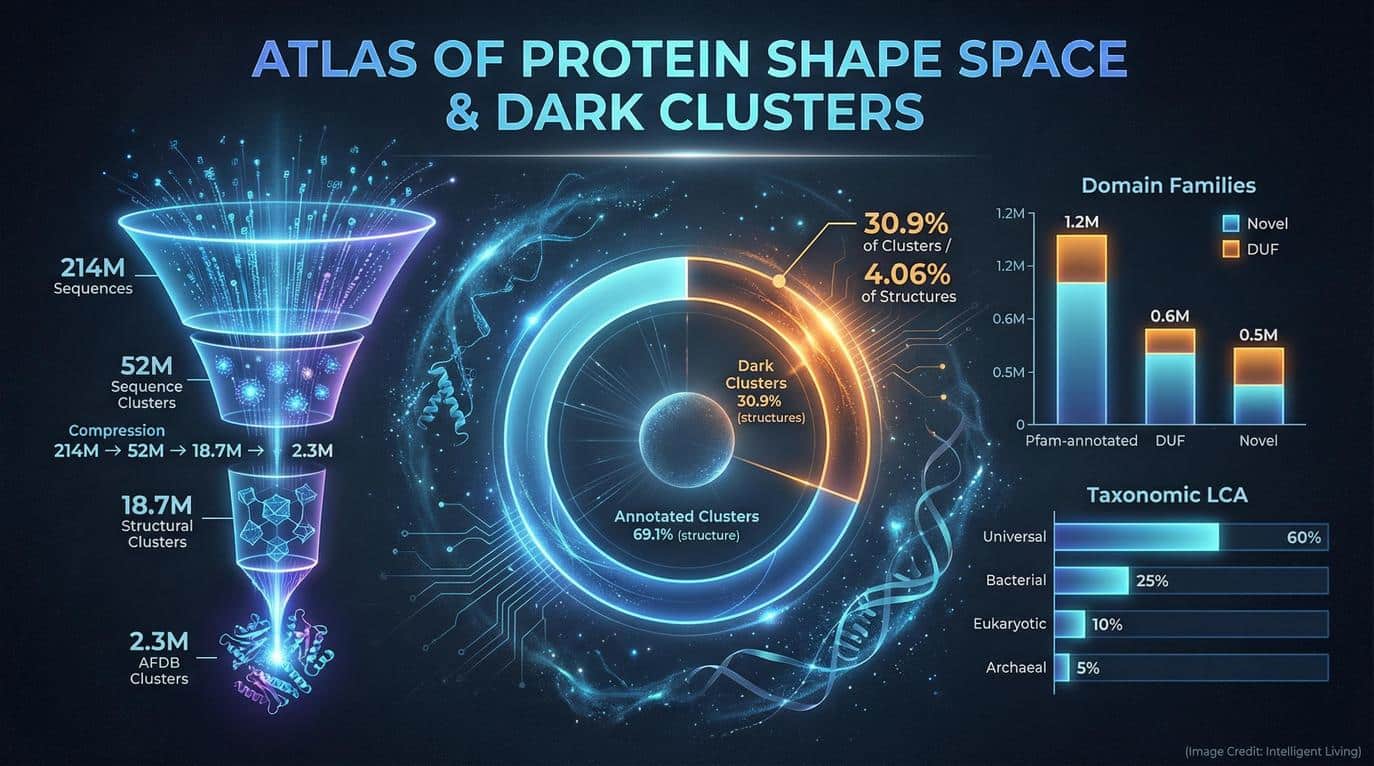
These figures establish that nearly a third of known protein geometries remained unclassified in legacy structural repositories. A 2023 analysis in the Nature news feature on large scale AlphaFold clustering utilized the Foldseek algorithm to categorize the following:
- Categorized over 200 million protein models predicted by the AlphaFold Database.
- Organized the data into 2.3 million non-singleton clusters.
- Identified that 31 percent of models lacked any known annotations.
- Defined roughly 700,000 new structural families with unknown biochemical functions.
These metrics demonstrate that nearly a third of all known protein shapes have previously evaded scientific catalogs. Such findings highlight the massive volume of biological dark matter that researchers must now systematically investigate.
Decoding Four-Stranded Architecture: The GQ DNABERT Genome Map
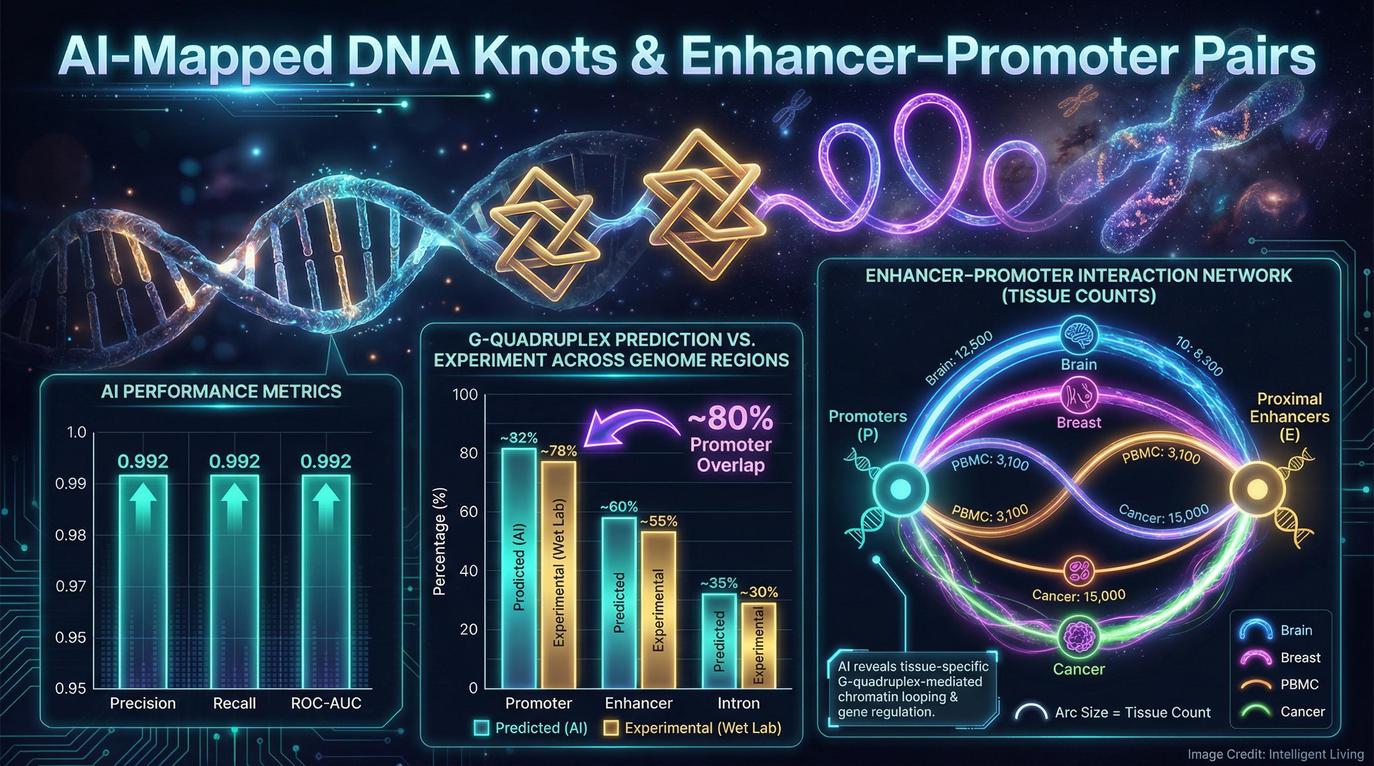
At the same time, a team working with the deep learning model GQ DNABERT mapped G-quadruplex DNA structures across the genome, reporting roughly 360,000 candidate regions in a Nucleic Acids Research study on G-quadruplex DNA structures. These four-stranded DNA formations, sometimes called G-flipons, often appeared near promoters and enhancers, suggesting a potential role in switching genes on or off.
Categorizing Unknown Proteomes: Understanding Hidden Structural Families
When headlines claim that scientists have found hundreds of thousands of new protein groups, it can sound like we have stumbled upon a secret catalog of alien molecules. A more grounded and compelling reality exists beneath the sensationalist headlines. These groups represent clusters of similarity within proteins already modeled by AlphaFold, the Google DeepMind AI system that predicts protein shapes from genetic code.
Searchable Similarity: Navigating the Proteomic Landscape with Foldseek
The researchers used Foldseek to compare every protein model against every other, identifying which ones shared structural features and building on years of distributed protein folding simulations that demonstrated how large-scale computation can probe complex molecular behavior. When two proteins fold into similar three-dimensional shapes, they often share related functions or evolutionary origins.
Structural Families: Mapping the Unknowns of Biological Dark Matter
About one-third of these groups did not match any known family in existing protein databases such as Pfam or CATH. Those are the 700,000 unknowns, not alien life, but biological dark matter hiding in plain sight.
Put simply, if AlphaFold gave scientists a snapshot of what proteins look like, Foldseek is the search engine that helps them find meaning in the flood of data. That organization could accelerate research into everything from enzyme design to drug development, echoing the efficiency of AI-driven pharmacology pipelines that sift through massive functional genomics datasets to prioritize promising molecules much faster than traditional methods.
However, it is important to separate hype from fact. The same study reported 13 protein clusters that appeared unique to humans, but the authors cautioned that most were low-confidence predictions. These clusters may represent subtle differences or statistical noise rather than entirely new biology. That nuance matters because it shows that AI highlights promising research signals, but human validation remains essential.

Architectural Genomics: DNA Folding as a Mechanical Regulatory Signal
If proteins function as the cellular hardware, DNA serves as the underlying firmware—complete with encrypted architectural layers that govern system-wide execution. DNA does not always exist as a tidy double helix. It can fold into complex shapes such as G-quadruplexes, where strands loop back on themselves to form knot-like structures.
Physical Regulation: How DNA Architecture Governs Gene Activation
These shapes can influence which genes activate and when, acting as mechanical switches within the genome. Researchers applied natural language processing to decode the structural ‘language’ of DNA, training the GQ DNABERT model to identify hidden architectural motifs. The study revealed roughly 360,000 potential G-quadruplex sites, noting several critical locations and implications:
- Frequent appearance near promoters responsible for initiating gene transcription.
- Concentration within enhancers that amplify overall gene expression.
- Probable involvement in regulating cell growth and neurological function.
- Potential links to the development and progression of cancer.
These structures function as mechanical switches within the genome, responding to physical architecture rather than just chemical signals. This discovery establishes a new dimension of genetic control that shifts our focus from simple sequences to complex three-dimensional folding. By highlighting the critical connection between DNA knots and cancer risk, researchers demonstrate how structural motifs directly influence disease pathways.
This paradigm shift highlights a new dimension of genetic control where genes respond to physical architecture rather than just chemical signals. DNA folding adds a structural layer to genomics that remains largely unexplored. Furthermore, single-cell genomic research demonstrates how various cell types interpret these genomic instructions in highly specialized ways. Combined with AI-based protein mapping, these discoveries point toward a unified idea that the shape of biological information matters just as much as the sequence itself.
The deployment of advanced biomedical microscopy illustrates how high-resolution instruments track subtle cellular changes over time, while machine learning platforms designed to classify tumor molecular patterns demonstrate how AI connects complex genomic and histology signals to real-world disease behavior.
Reality Check: Why the “13 Human-Only Shapes” Headline Can Mislead
The discovery sparked significant scientific curiosity regarding whether humans possess distinctive molecular architectures that differentiate us from other lineages. The actual findings are much more nuanced.
Statistical Nuance: Separating Signal from Modeling Noise
According to the Nature paper behind those headlines, the 13 clusters were identified in the data, but most of them came with low-confidence predictions. This sparked interest in human uniqueness through large-scale protein classification, though such findings often signal statistical noise rather than verifiable exclusivity.
In biological research, small data errors can ripple into large claims if they are taken out of context. The scientists behind the study were clear that although these clusters are worth investigating, they do not currently prove that humans possess protein folds unseen anywhere else in nature.
Scientific Iteration: Grounding Unique Human Clusters in Peer-Reviewed Data
This clarification serves as a critical reminder that AI tools do not replace the need for experimental verification. Instead, these models serve as investigative compasses, orienting scientific inquiry toward the most promising biological questions.
Science journalism can sometimes amplify the most dramatic possible interpretation of early results. By grounding our understanding in peer-reviewed data instead of viral soundbites, we gain something far more valuable than a striking headline: a realistic picture of how knowledge grows through iteration, testing, and refinement.
Expanding Clinical Frontiers: Applications of Searchable Biological Atlases
The scale and organization of these AI-generated atlases open rich possibilities for science and medicine. The Foldseek protein clustering provides immediate utility for diverse scientific disciplines and facilitates several high-priority research objectives:
- Discovery of previously unknown enzyme families for industrial application.
- Identification of novel drug targets for precision medicine.
- Mapping of complex evolutionary relationships across diverse species.
- Universal access to three-dimensional models via the AlphaFold protein structure database.
Accessing these resources allows labs worldwide to transition from specialized data silos to a shared foundation for hypothesis building. This collaborative framework ensures that structural knowledge becomes a common starting point for the next generation of biological inquiries.
Genomic Precision: Correlating DNA Motifs with Disease Expression
On the DNA side, the GQ DNABERT map provides a view of how genome architecture may shape gene behavior. Researchers can now determine where epigenomic biomarkers facilitate early cancer detection by identifying subtle shifts in DNA packaging long before symptoms appear. Atlases of non-canonical DNA structures add another layer of potential signals to test, expanding the list of biological patterns that might eventually help distinguish healthy tissues from disease.
Equally important, the collaborative mindset behind many of these projects allows scientists worldwide to verify and build on each other’s findings. Applying single-cell immune profiling for precision drug development allows researchers to utilize open structural predictions and regulatory maps to benchmark new tools, strengthening the entire community’s next wave of discovery.

The New Genomic Bottleneck is Human Validation, Not AI Discovery
As AI accelerates the discovery of new patterns, the pressing challenge is making sure those patterns hold up under the microscope. An AI prediction of a protein fold or identification of a regulatory motif serves merely as the computational preamble to the human validation cycle.
Validation Bandwidth: Bridging the Gap Between Prediction and Experimental Proof
Experimental confirmation requires the integration of high-precision methodologies including:
- Cryo-electron microscopy for near-atomic resolution of molecular shapes.
- Spatial transcriptomics to link gene activity to precise tissue coordinates.
- Live cell sensors designed for real-time DNA repair monitoring to capture how genomes respond to damage.
Deploying these high-precision instruments ensures that every predicted structural motif is verified within its natural biological context. While validation remains a resource-intensive phase, these technologies provide the necessary rigor to transform AI signals into confirmed biological facts.
Information Overload: Managing the Computational Surplus in Modern Biology
Biological science now contends with a severe validation lag, as the landscape of structural possibilities expands far beyond the current bandwidth of experimental testing. This bottleneck is likely to reshape scientific priorities, pushing the development of automation and shared data platforms, even as AI compute architectures optimized for protein folding simulations expand the volume of structural predictions researchers must sort through.
Algorithmic Partnership: Integrating Machine Prediction with Human Intuition
At the same time, these developments invite a new philosophy of science in which collaboration between algorithms and human intuition becomes central. Machines can flag intriguing patterns, but people still design the clever experiments, interpret conflicting results, and decide which hypotheses deserve another round of testing. This is evidenced by efforts mapping epigenetic control and transcription factors to identify how multiple signals integrate into characterized control circuits.
The future of biology is therefore not a competition between AI and researchers. It is a partnership in which engines of prediction and engines of explanation work together to build a more complete account of how life operates.

Decoding the Architectural Language of Existence
Biological discovery now hinges on the systemic mapping of structural dark matter, a feat made possible by the rapid evolution of algorithmic clustering. Mapping hundreds of thousands of previously unclassified protein shapes and DNA switches establishes a foundation for predictive medicine that surpasses traditional observational limits. Scientists utilize these searchable structural repositories to isolate high-value drug targets and enzyme families with industrial-scale efficiency.
The synergy between machine precision and scientific intuition redefines the boundaries of genomics and proteomics. Researchers utilize deep learning insights to navigate the hidden architectures of life, ensuring that every predicted structural motif undergoes rigorous biochemical validation. Mastering these intricate patterns accelerates the transition from theoretical modeling to real-world therapeutic application, solidifying a future where life’s most complex formations are no longer invisible.
Vital Inquiries Regarding AI Integration in Biological Science
What does it mean that AI “clustered” 700,000 protein shapes?
Clustering means that algorithms grouped proteins with similar three-dimensional structures into families. Many of these families did not match existing protein databases, which suggests that there are still undiscovered structural relationships hidden in familiar genomes rather than entirely new molecules.
Are the “13 human only” protein clusters real?
They are not yet confirmed. The clusters appeared as human-specific groups in the dataset, but scientists classify most of them as low-confidence findings that require careful experimental validation before anyone can claim that humans have unique protein folds.
What are G-quadruplexes, and why do they matter?
G-quadruplexes are four-stranded DNA formations built from guanine-rich sequences. They often occur near promoters and enhancers, the genomic regions that control how strongly genes are expressed, so they may act as local structural switches that contribute to gene regulation.
Does this research mean we are close to curing diseases such as cancer?
No. These AI models reveal where to look for possible mechanisms and highlight promising structures or genomic regions, but turning those insights into therapies requires years of biochemical work, animal studies, and clinical trials.
How will AI and human scientists work together going forward?
AI will continue to handle large-scale pattern recognition tasks, such as scanning millions of protein models or genomic sites, while human researchers focus on designing experiments, interpreting unexpected results, and integrating new findings with the rest of biology. The collaboration allows discoveries to move from prediction to proof more efficiently.
Where can I learn more about the technologies driving these discoveries?
The Human Cell Atlas utilizes machine learning and single-cell genomics to turn billions of measurements into navigable maps of tissues and organs, showing how cell-level atlases and AI-driven analysis fit together.


