
As awareness of environmental sustainability grows, blockchain technology is experiencing a significant transformation. Traditional blockchain systems, often compared to the power consumption levels of entire countries like Canada or Norway, have drawn heavy criticism for their environmental impact. The energy-intensive nature of Proof of Work (PoW) mechanisms, as used by Bitcoin, results in carbon emissions that add to the growing climate crisis.
The Urgent Need for Eco-Friendly Blockchains
Bitcoin mining alone accounts for an annual electricity consumption of roughly 138 terawatt-hours (TWh), according to the Cambridge Digital Mining Industry Report, or about 0.5% of global electricity use. Crucially, 52.4% of that power now comes from sustainable sources (42.6% renewables and 9.8% nuclear), up from 37.6% in 2022, while coal’s share of mining energy tumbled from 36.6% to 8.9%. Preliminary Cambridge data from late 2025 shows further progress: annualized mining demand climbed to about 190 TWh by December 2025, yet low-carbon sources reached 59.4% of the mix, with hydropower overtaking natural gas as mining’s largest single energy source. But there’s light on the horizon; innovative blockchain projects are paving a new path forward, one that marries the captivating potential of decentralized finance with an urgent call for sustainability.
Eco-friendly blockchains aim to either drastically reduce or completely negate their carbon footprint through progressive technologies and smart energy strategies. These efforts represent more than just a leap forward for technology; it’s a concerted effort to secure the planet for future generations, emphasizing agility in achieving both economic viability and environmental rejuvenation.

Rising Popularity of Sustainable Blockchain Solutions
Why Sustainability Matters in Blockchain
The technology behind blockchain has immense potential for revolutionizing society, from facilitating secure transactions to democratizing access to information. However, its survival and growth depend significantly on overcoming the formidable challenge of energy consumption. With society moving toward greener alternatives, sustainable blockchain solutions are not just a trend but a necessity.
The shortcomings of traditional PoW systems are apparent. PoW methodologies demand high computational power to verify transactions, resulting in substantial energy use and carbon emissions. Excessive energy consumption harms the environment and hinders the growth of decentralized networks. Fortunately, the blockchain industry is undergoing a significant transformation, adopting innovative technologies designed to reduce environmental impact.
Key Innovations in Green Blockchain Technology
Key innovations such as Proof of Stake (PoS) present a greener alternative, offering energy-efficient methods that require significantly less power and computational resources. Unlike its predecessor, PoS selects transaction validators based on the number of coins they hold and are willing to “stake” as collateral, transforming the validation process from an energy drainer to a more eco-friendlier endeavor.
Further advancements include variations like Delegated Proof of Stake (DPoS), used by networks like EOS, which improve efficiency and retain decentralization by electing delegates to verify transactions. Innovative models such as the Directed Acyclic Graph (DAG), leveraged by projects like IOTA and Nano, eliminate mining altogether, ensuring transactions are near-instant and require minimal energy.
The transition to Ethereum’s Proof-of-Stake with its Ethereum 2.0 upgrade exemplifies this shift. This transition alone reduced the network’s energy consumption by roughly 99.95%, according to the Ethereum Foundation, setting a benchmark for others in the industry.
As more projects adopt these less energy-intensive models, the blockchain industry moves closer to aligning technological growth with sustainable development goals. The journey toward eco-friendly blockchains is gaining momentum, reaffirming that a sustainable future for blockchain is not only possible but already underway.

A Top 10 Listing of Eco-Friendly Blockchain Projects
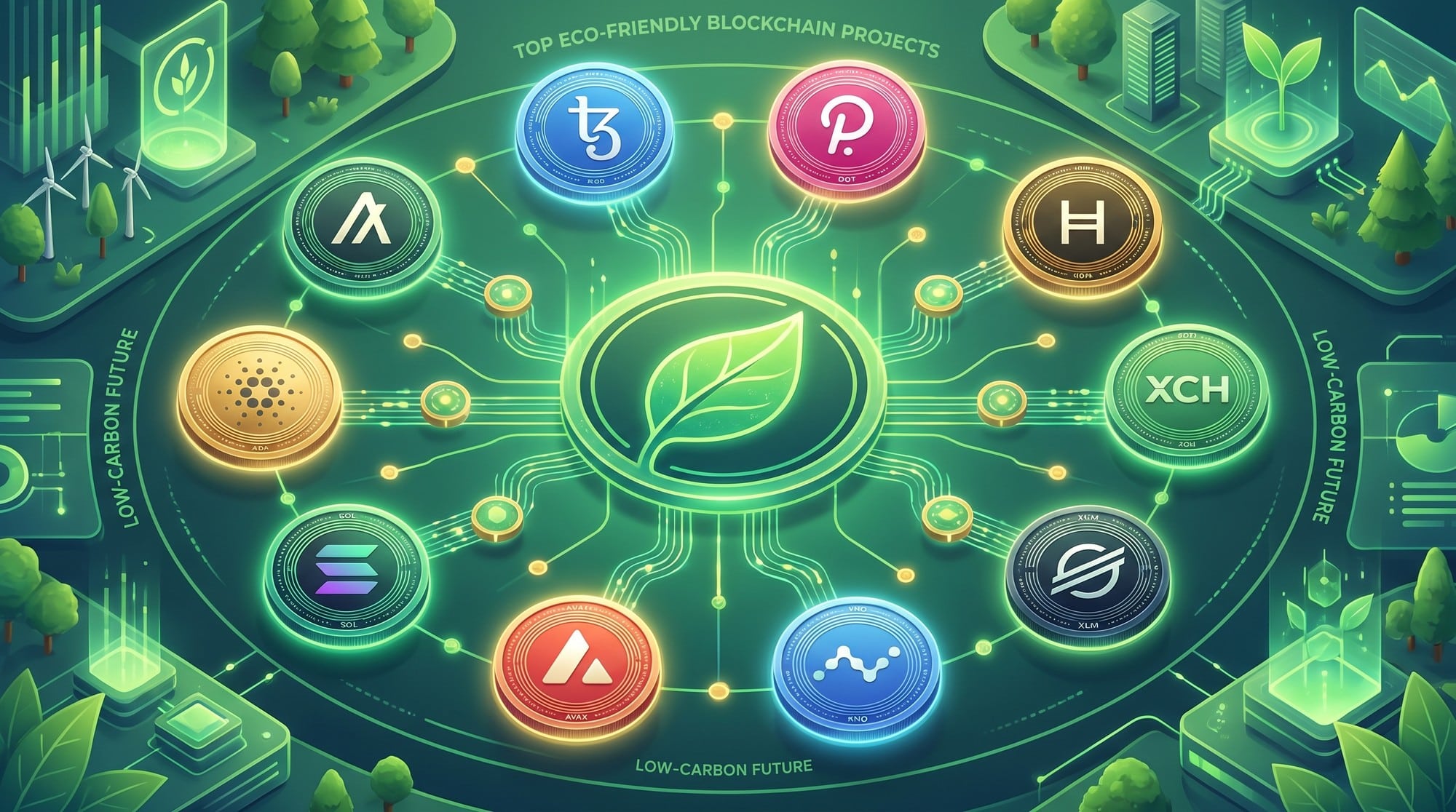
A growing number of projects in the rapidly evolving world of blockchain are embracing the sustainability challenge, proving that environmental responsibility and technological innovation can coexist harmoniously. Let’s look into ten pioneering eco-friendly blockchain projects that are at the forefront of reducing carbon footprints and promoting sustainability. This exploration not only highlights their unique features but also underpins the importance of leveraging blockchain for a greener future.
Here is a quick reference to how each project earns its green credentials:
| Project | Consensus Mechanism | Green Credential |
|---|---|---|
| Pi Network | Stellar Consensus Protocol (SCP) | Smartphone mining, no high-power hardware |
| Algorand | Pure Proof-of-Stake (PPoS) | Carbon-negative; ClimateTrade and UNDP partnerships |
| Tezos | Liquid Proof-of-Stake | Self-amending; low energy per transaction |
| Cardano | Ouroboros Proof-of-Stake | Peer-reviewed, research-driven efficiency |
| Ethereum (post-Merge) | Proof-of-Stake | Roughly 99.95% energy reduction |
| Solana | Proof-of-History + PoS | High throughput with low energy use |
| Avalanche | Snowball (PoS-based) | Scalable, low-energy smart contracts |
| Hedera | Hashgraph consensus | ~0.00017 kWh per transaction; carbon-negative |
| Nano | Block-lattice (ORV) | No mining; feeless transactions |
| Energy Web Chain | Proof-of-Authority | Decarbonizing the energy sector |
1. Pi Network: Revolutionizing Mobile Mining
Overview & Sustainable Credentials:
Pi Network impacts the way we think about crypto by moving away from energy-intensive mining methods common among traditional cryptocurrencies. By allowing users to mine coins directly from their smartphones, Pi Network reduces the reliance on powerful hardware and dramatically lowers energy consumption.
Innovative Technological Features:
Using the Stellar Consensus Protocol (SCP), Pi Network relies on a model that forgoes the need for complex mathematical puzzles central to PoW systems. Instead, it utilizes a web of trusted nodes to efficiently validate transactions.
Impact and Future Potential:
With tens of millions of users worldwide, Pi Network stands as a model of sustainability, accessibility, and inclusivity in blockchain technology. Its focus on community engagement and eco-friendly practices sets a standard for future projects aiming to democratize cryptocurrency.
2. Algorand: The Carbon-Negative Blockchain
Overview & Sustainable Credentials:
Algorand, known for its Pure Proof-of-Stake (PPoS) protocol, positions itself as a leading carbon-negative blockchain. By collaborating with ClimateTrade, it actively offsets its emissions, and its partnership with the United Nations Development Programme (UNDP) shows how networks can go carbon-neutral at scale.
Innovative Technological Features:
Algorand’s PPoS system requires minimal energy for transaction validators, drastically reducing its carbon footprint. This efficiency is further backed by its partnerships aimed at promoting renewable energy.
Impact and Future Potential:
With a focus on green projects and a rapidly expanding eco-conscious developer base, Algorand is poised to remain a frontrunner in the sustainable blockchain movement.
3. Tezos: A Self-Amending Blockchain
Overview & Sustainable Credentials:
Tezos uses a unique on-chain governance mechanism, allowing it to seamlessly upgrade and minimize disruptions while prioritizing energy efficiency. Its lower energy consumption per transaction enhances its appeal as a sustainable blockchain option.
Innovative Technological Features:
The blockchain’s self-amending feature allows it to evolve, integrating improvements without the need for hard forks, thus saving additional energy.
Impact and Future Potential:
Tezos is a good choice for applications in NFTs and DeFi because it is flexible and committed to using eco-friendly methods. It continues to attract eco-friendly developers and users.
4. Cardano: Research-Based Sustainability
Overview & Sustainable Credentials:
Renowned for its commitment to scientific rigor, Cardano operates on the Ouroboros Proof-of-Stake protocol, emphasizing energy-efficient consensus that does not compromise security.
Innovative Technological Features:
Ouroboros, backed by peer-reviewed research, achieves sustainability by reducing the computational need for transaction validation.
Impact and Future Potential:
Cardano continues to drive blockchain innovation, underscoring its potential with ongoing projects aimed at global financial inclusivity and green technology applications.
5. Ethereum Post-Merge: Setting New Standards
Overview & Sustainable Credentials:
Following its shift from PoW to PoS, Ethereum has slashed its energy use by roughly 99.95%, reinforcing its position as a sustainable blockchain leader, a shift detailed in our guide to Ethereum’s energy reset.
Innovative Technological Features:
The Merge represents a pivotal transformation in Ethereum’s operation, significantly reducing energy demands and positioning the network for future scalability.
Impact and Future Potential:
As a cornerstone of decentralized applications, Ethereum’s commitment to sustainability sets a benchmark, encouraging large-scale implementation of PoS networks.
6. Solana: Speed Meets Sustainability
Overview & Sustainable Credentials:
Combining proof-of-history with PoS, Solana delivers an impressive throughput of over 65,000 transactions per second, maintaining a low-energy profile.
Innovative Technological Features:
Solana’s architectural design enhances transaction speed and efficiency without increasing its carbon footprint.
Impact and Future Potential:
As a go-to platform for NFTs and DeFi, Solana’s sustainability efforts are core to its strategy of attracting more developers and users within the space.
7. Avalanche: Scalable and Sustainable
Overview & Sustainable Credentials:
Avalanche’s innovative consensus protocol, Snowball, uses a PoS-based system designed to minimize energy usage while ensuring scalability.
Innovative Technological Features:
By optimizing for low-energy operations, Avalanche supports complex smart contracts while maintaining environmental responsibility.
Impact and Future Potential:
Avalanche is well-positioned to challenge legacy blockchains in both speed and energy efficiency, thanks to its lower transaction fees and focus on long-term sustainability.
8. Hedera Hashgraph: The Green Ledger
Overview & Sustainable Credentials:
Hedera’s unique hashgraph consensus offers a sustainable alternative to traditional blockchains, achieving high data throughput with minimal energy use. The network consumes roughly 0.00017 kWh per transaction and operates carbon-negative, making it one of the most eco-efficient distributed ledgers in production.
Innovative Technological Features:
Through its low-energy design, Hedera stands out as one of the most eco-efficient distributed ledger platforms currently available.
Impact and Future Potential:
Hedera’s focus on end-user and enterprise adoption signals potential growth in sectors seeking sustainable digital solutions.
9. Nano: The Energy-Efficient Transactor
Overview & Sustainable Credentials:
Nano employs a block-lattice architecture, erasing the need for traditional mining and enabling feeless, environmentally friendly instant transactions.
Innovative Technological Features:
Its architecture allows each account its own blockchain, leading to significantly reduced transaction times and energy usage.
Impact and Future Potential:
Nano positions itself as a transformative force in the space of micropayments, catering to eco-conscious digital users.
10. Energy Web Chain: Blockchain for the Energy Sector
Overview & Sustainable Credentials:
Tailored specifically for energy applications, Energy Web Chain supports renewable energy initiatives, focusing on decentralizing the global energy system.
Innovative Technological Features:
By integrating renewable energy initiatives and enabling peer-to-peer energy trading, Energy Web Chain maximizes environmental gains.
Impact and Future Potential:
With a significant role in the push toward energy sustainability, the Energy Web Chain’s model offers a blueprint for future energy decentralization efforts.
Green Blockchain Tech Delivers Major Socioeconomic Impacts
These blockchain projects demonstrate that innovation can thrive without harming the planet. They collectively showcase how technology can be leveraged to achieve both economic growth and environmental sustainability, creating a promising blueprint for the digital future.
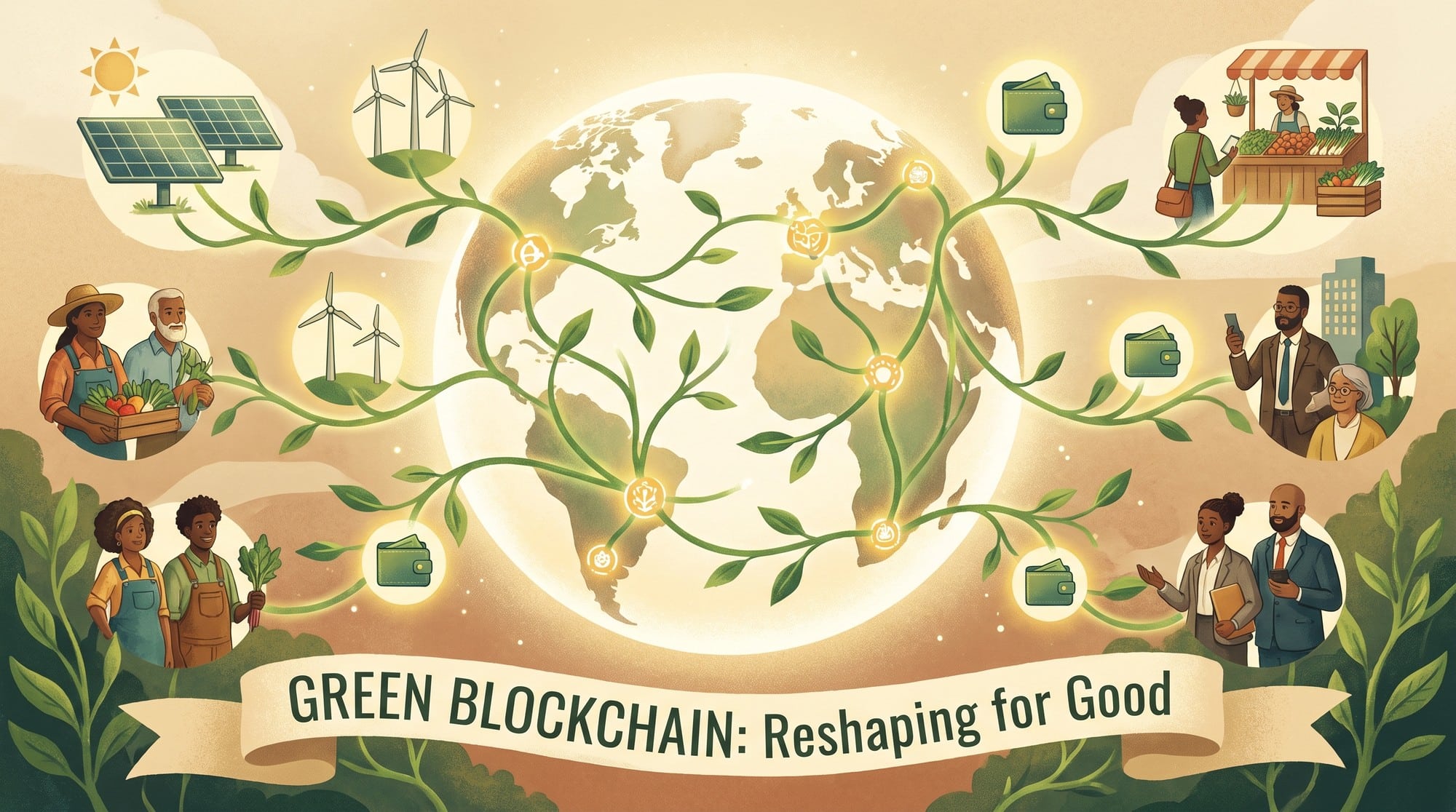
Green blockchain technology is not just reimagining how digital transactions are processed; it’s reshaping societal structures and economic frameworks on a global scale. By merging innovation with sustainability, green blockchains are creating a world where economic growth and environmental stewardship align seamlessly.
This shift extends to everyday finance. As consumers and businesses look for greener ways to move money, the carbon footprint of digital payments is coming under scrutiny, and eco-friendly blockchains are emerging as part of the answer.
Democratization of Blockchain Reverberates through Society
Enhancing Financial Inclusivity:
One of the awe-inspiring impacts of green blockchain technology is its ability to democratize access to financial services. Projects like Pi Network allow users to mine cryptocurrency right from their smartphones without excessive energy use. This accessibility allows individuals from lower-income backgrounds or those in remote regions to participate in and benefit from the digital economy.
Promoting Transparency and Trust:
Historically, supply chains across industries have been notorious for their lack of transparency, leading to questionable practices and consumer mistrust. Blockchain technology, with its immutable record-keeping features, introduces new transparency, enabling consumers and businesses to verify product origins and ensure ethical practices.
Diversifying Local and Global Economies
Stimulating New Economic Opportunities:
By fostering technologies that lower the threshold for digital engagement, green blockchains enable the creation of novel economic activities. Projects powered by sustainable blockchains support a range of applications from decentralized finance (DeFi) to tokenized green investments. These opportunities generate new business models that provide an economic boon while aligning with global environmental goals.
Fostering Collaboration Through Decentralization:
Decentralized technologies introduce collaborative economic systems that empower users, granting them more control over their digital assets and data. Such systems promise to bridge existing socioeconomic gaps by encouraging participation from previously marginalized groups. Binance, for example, supports green blockchain projects aimed at bridging the gap between financial growth and ecological sustainability.

Benefits of Adopting Eco-Friendly Blockchains
The shift toward eco-friendly blockchains isn’t merely a technical evolution; it’s a wholesale embrace of solutions that promise profound benefits. These advantages extend beyond the environment, offering compelling reasons for industries and individuals alike to champion sustainable blockchain technologies.
Environmental and Operational Gains
Reducing Carbon Footprint:
Traditional cryptocurrency operations, predominantly driven by PoW mechanisms, contribute to significant carbon emissions. By contrast, sustainable blockchains like those using Proof of Stake (PoS) or innovative alternatives lower this impact drastically, helping to combat climate change.
Cost Efficiency and Scalability:
Sustainable blockchain systems are known for their energy efficiency, which translates into cost savings on operational expenses. As blockchains like Algorand and Tezos illustrate, using less energy enables networks to scale without escalating costs, making them an attractive option for businesses seeking to maximize profitability while minimizing their environmental footprint.
Social and Economic Advantages
Empowering Sustainable Economic Models:
Green blockchains catalyze new opportunities by enabling technologies like decentralized finance (DeFi) and supporting tokenized energy markets. Such innovations redefine financial paradigms by promoting investments in renewable energy initiatives that align profit with ecological benefit.
Attracting Green Investors:
As environmental, social, and governance (ESG) criteria become more vital for investors, eco-friendly blockchain projects are well-positioned to attract investment from individuals and institutions committed to sustainability. Projects that lead with green credentials not only meet ESG standards but also resonate with consumer values, thus enhancing brand loyalty and market viability.
Industry Redefined by Eco-Friendly Blockchain Tech
By harnessing the untapped potential of sustainable blockchain technology, industries can transform their operational models and contribute to a healthier planet. Embracing eco-friendly blockchain solutions goes beyond mere technological advancement; it introduces a vital ethical dimension to our interaction with the digital economy. This inclusive approach, rooted in environmental awareness, envisions a future where technology enhances nature rather than challenges it.

Blockchain’s Green Revolution: AI and DeFi Leading the Charge
As global awareness of environmental impacts grows, the blockchain industry finds itself at the intersection of innovation and sustainability. The future of blockchain is not solely about speeding up transactions or enhancing security; it focuses on integrating cutting-edge technologies that promote ecological resilience.
A Vision of Sustainable Continuity
Embracing AI and Machine Learning:
Artificial intelligence (AI) is reshaping numerous industries by improving efficiencies and lowering costs. In the realm of eco-friendly blockchains, AI-driven cryptocurrencies are at the forefront, offering scalability and security enhancements without the energy drain typically associated with older technologies. Blockchain projects utilizing AI can more effectively predict security breaches and optimize transaction processes.
Unlocking Decentralized Finance (DeFi) Potential:
DeFi platforms, which operate independently of traditional banking systems, are poised to drive the next wave of financial inclusivity by making financial services accessible to anyone with internet access. As DeFi grows, its reliance on green blockchain technology will ensure these services are sustainable, democratizing finance while keeping environmental impacts in check.
Importance of Technological Reform
Advancements in Consensus Mechanisms:
Innovations in consensus algorithms continue to break away from energy-heavy practices. Newer methods like Directed Acyclic Graph (DAG) and Federated Byzantine Agreement (FBA) promise faster, more energy-efficient operations, reflecting a laser focus on reducing blockchain’s environmental impact. These mechanisms ensure that blockchains can support a variety of applications without compromising sustainability.
Expanding Real-World Use Cases:
The future will see a rise in blockchain applications that solve real-world problems, from tracking carbon credits to securing identity verification in digital environments. Projects focused on sustainability will expand into sectors like renewable energy and conservation, showing that blockchains can do more than just process financial transactions, they can engineer a sustainable future.

What Changed in 2025 and 2026: A Green Blockchain Update
The sustainability story keeps moving. Three developments from 2025 and 2026 have sharpened the picture for eco-friendly blockchains.
- Regulation is now mandatory. The European Union’s Markets in Crypto-Assets (MiCA) regulation began applying in full on 30 December 2024. It requires crypto-asset white papers to disclose the main climate and environmental impacts of their consensus mechanism, moving sustainability reporting from voluntary to legally enforceable.
- Bitcoin’s grid is greener but busier. Preliminary Cambridge data shows annualized mining demand rose to about 190 TWh by December 2025, while low-carbon sources climbed to 59.4% of the mix, with hydropower overtaking natural gas as the leading fuel.
- Rollups are compounding efficiency. Ethereum’s Pectra (May 2025) and Fusaka (December 2025) upgrades expanded data capacity for Layer-2 rollups, which now carry roughly 95% of Ethereum transactions and push per-user energy use about two orders of magnitude below mainnet.
These shifts are turning sustainability from a marketing claim into a measurable, regulated benchmark, and Regenerative Finance (ReFi) is converting carbon offsets into investable, on-chain assets.
How to Verify a Green Blockchain’s Claims
With so many networks marketing themselves as “green,” it pays to look past the label. A credible sustainability claim rests on measurable data, not marketing. Here is a practical checklist:
- Check the consensus mechanism. Proof-of-Stake, DAG, and similar models use far less energy than Proof-of-Work.
- Look for an independent energy audit. Third-party assessments, such as those from the Crypto Carbon Ratings Institute (CCRI), quantify real energy use and emissions.
- Confirm carbon offsetting. Networks like Algorand and Hedera publicly report offset purchases through partners such as ClimateTrade and Terrapass.
- Review the energy source mix. A genuinely green network discloses how much of its power comes from renewables versus fossil fuels.
- Check for on-chain transparency. The most credible projects publish real-time energy and emissions dashboards that anyone can audit.
Frequently Asked Questions About Eco-Friendly Blockchains
What are the most eco-friendly blockchains?
Several networks consistently rank among the greenest. The standouts include:
- Algorand: carbon-negative with Pure Proof-of-Stake.
- Hedera: about 0.00017 kWh per transaction, carbon-negative.
- Tezos: self-amending with Liquid Proof-of-Stake.
- Cardano: peer-reviewed Ouroboros consensus.
- Ethereum (post-Merge): roughly 99.95% energy reduction.
- Nano: no mining and feeless transactions.
Is blockchain still relevant in 2026?
Yes. Blockchain has moved beyond speculation into real-world applications, from tokenized carbon credits and renewable energy certificates to transparent supply chains. The tokenized carbon credit market is projected to grow from about $414.8 billion in 2023 to $1.6 trillion by 2028, and sustainable cryptocurrencies have already crossed $2 billion in market capitalization.
What are the four types of blockchain?
Blockchains are commonly grouped into four categories: public, private, consortium (or federated), and hybrid. Each balances decentralization, access, and control differently, and each can be built on energy-efficient consensus mechanisms to minimize environmental impact.
Eco-Blockchain Tech as a Catalyst for Harmony
As blockchain technology evolves, it showcases the power of innovation in achieving sustainability. The transition to eco-friendly blockchain systems paves a new path, a direction where technological progress supports environmental preservation instead of harming it.
This shift reflects not only a commitment to advancing blockchain tech but also to humanity’s responsibility to protect our global home. From adopting renewable energy-powered blockchains to integrating AI for smarter decision-making and developing solutions that lower energy use, sustainable blockchain initiatives demonstrate that economic growth and environmental protection can thrive together.
Looking ahead, all stakeholders, developers, investors, policymakers, and communities, must champion eco-friendly practices within the blockchain space. By participating in this green revolution, a future can be fostered where digital finance flourishes responsibly. Each step toward sustainability builds a foundation for a blockchain ecosystem that promises a positive legacy for future generations.
In shaping this greener digital economy, active engagement with these technologies is vital. Advocates should promote robust green initiatives and inspire others to adopt environmentally conscious blockchain solutions. By aligning efforts, a sustainable crypto ecosystem can be created, a harmonious blend where innovation and nature work together for the benefit of our world.


