
Smartphones have been marketed as “AI-powered” for years, yet many people still notice lag when translating speech in real time, editing high-resolution photos with generative tools, or running on-device voice assistants without a strong internet connection. This recurring lag suggests a deep-seated hardware bottleneck rather than a mere software glitch.
A standalone smartphone NPU with 3D DRAM is now being discussed as a Qualcomm project involving China’s CXMT and GigaDevice for future Android phones targeted around late 2026 or early 2027. With roughly 40 TOPS of AI compute and 4GB of stacked memory, this design aims to move data faster than conventional mobile setups, finally matching raw power with the bandwidth required for true responsiveness.
Prioritizing local-first processing secures your privacy and device reliability. When your smartphone summarizes a confidential meeting or translates a dialogue in a dead zone, the hardware handles the heavy lifting without relying on a remote server. This rumored 3D DRAM NPU breakthrough allows your device to process complex prompts locally, keeping your AI assistant a personal, private tool rather than a cloud-dependent interface. By shortening the physical distance between memory and the processor, Qualcomm and CXMT could be solving the “silent lag” that currently limits how we use generative tools on the go.

AI Phone Hardware Breakthrough: Quick Facts About Qualcomm’s 3D DRAM NPU Plan
The fastest way to understand this rumor is to treat it like a “what, who, and why” brief for AI phone hardware. If the claim holds up, it suggests that on-device AI performance in 2027 smartphones may depend as much on memory bandwidth as it does on headline NPU TOPS.
Here are the key points that matter for everyday readers asking what a 3D DRAM smartphone NPU is and why it could change future Android phones.
- Qualcomm is reportedly exploring a standalone smartphone NPU paired with customized 3D DRAM, with early talk pointing to about 40 TOPS of AI performance and 4GB of stacked memory.
- First devices could appear in late 2026 or early 2027, reportedly aimed at Chinese smartphones in the RMB 4,000–4,500 range.
- Qualcomm’s current flagship platform already centers on-device AI, with the Snapdragon 8 Elite Gen 5 NPU performance figures pointing to faster throughput and better performance per watt.
- CXMT has positioned itself as a mobile memory supplier and has described LPDDR5X speeds up to 10,667 Mbps for flagship-class devices.
The most important caveat is simple: none of this is confirmed product information yet, and the details should be treated as reported claims until Qualcomm or a device maker says otherwise. The most useful way to track progress is to watch for concrete signals such as shipping targets, partner announcements, and real device demonstrations that show faster translation, camera AI, and local assistant features under normal phone heat and battery limits.

The Impact of 3D DRAM Memory Architecture on On-Device AI Performance
Advancing Smartphone AI through Dedicated 3D DRAM NPU Integration
Analyzing the Evolving Roles of CPU, GPU, and NPUs in AI Tasks
Modern smartphones operate like a busy digital concierge juggling too many requests. The CPU manages general work, the GPU handles the visuals, and the NPU focuses on machine learning tasks like live captions or photo edits. When these engines fight for the same memory bandwidth, your phone begins to struggle, leading to heat spikes and battery drain that interrupt your experience.
Beyond TOPS: Understanding Real-World AI Performance Metrics
While TOPS serves as a popular industry yardstick, the figure represents theoretical capacity rather than a guarantee of instantaneous app performance. A quick way to keep expectations realistic is that what TOPS measures in AI chips is closer to “potential capacity under certain conditions” than “how fast your phone finishes an AI task in the real world.”
Optimizing On-Device AI Responsiveness through Hardware Architecture
Have you ever noticed your live captions start perfectly only to begin dropping words as the device gets warm? That friction occurs when background apps crowd the memory pathways, forcing your hardware to make difficult compromises that ruin the flow of your AI features.
Consider a common frustration: a live caption feature that starts fluidly but begins dropping words as the device heats up. This happens when background apps pile on and the network becomes unreliable, forcing the hardware to make compromises.

The Real Breakthrough is Faster Memory
Why Memory Bandwidth Becomes the Limiter
Artificial intelligence performance is no longer defined only by how many operations a chip can execute per second. The real hurdle is no longer raw power; it is the frantic speed at which data must race between memory and the processor.
The wider packaging throughput crunch makes this constraint visible at scale. The hardest part to expand is the physical integration of logic and high-bandwidth memory.
TSV and Hybrid Bonding in Plain Language
Utilizing through-silicon vias (TSVs) and hybrid bonding lets memory layers sit directly atop the processor for near-instant access. Stacking this memory vertically works like adding a high-speed elevator to a tall building, drastically reducing the physical distance data must travel to get the job done.
Why Vertical Stacking Keeps Showing Up
That design philosophy echoes broader industry research. A monolithic 3D AI chip approach shows why vertical stacking matters even outside smartphones, because shorter data travel can translate into major efficiency and throughput gains. Huawei has already commercialized the idea in phones: the Kirin 9050 Pro LogicFolding chip stacks logic with hybrid bonding for a claimed 55% density gain. While the rumored Qualcomm design is not the same technology, the principle remains similar: shorten the distance, speed up the task.
A small delay illustrates the difference. When a short 4K clip gets an AI color pass, the result can either feel like a quick adjustment or like waiting for a spinner that breaks the flow. Faster memory pathways are what turn those micro-moments from friction into something closer to instant.

Practical Benefits: Transforming the User Experience with 2027 AI Phones
If a 3D DRAM NPU reaches production, you will notice the difference in your daily habits rather than just on benchmark charts. This architecture delivers lower latency and reduced heat, ensuring your AI features work smoothly without constantly gasping for a cloud connection.
The common theme is lower latency, less heat, and fewer moments where an AI feature feels like it needs the cloud to breathe.
Real-Time Translation with Less Cloud Lag
Local processing eliminates the delay of cloud round-trips. By handling complex speech translation directly on the NPU, conversations feel fluid and natural, even without a stable data connection.
Faster AI Camera Editing and Generative Tools
AI camera editing and background generation may respond more quickly, especially as mobile generative photo edits become a daily habit rather than an occasional novelty. Features such as removing unwanted objects, enhancing night shots, and generating stylized portraits rely on rapid model inference, and those models can feel dramatically different when the phone is not waiting on memory.
More Private On-Device Voice Assistants
On-device speech recognition and voice assistants could operate with improved privacy, because on-device AI inference keeps more sensitive signals on the hardware that captured them before anything is sent elsewhere. That matters for voice notes, contacts, and location context, where many people prefer local processing over constant round trips to remote servers.
Better Battery Behavior in AI-Heavy Apps
You could see significant battery gains in AI-heavy apps, as purpose-built NPUs handle local AI tasks with much higher efficiency than standard processors. This means your phone stays cool and lasts longer, even during heavy generative photo editing or voice assistant use.
There is also a broader expectation shift. Everyday users now want AI that works while walking, commuting, or traveling, and those expectations are being shaped by hands-free assistant wearables that normalize live captions and fast voice responses without pulling out a phone.
Analyzing the China-Based Supply Chain and Cost Factors for 3D DRAM AI Phones
Why China and CXMT are Part of the Story
A China-First Target in a Premium Price Band
Focusing on the Chinese premium market allows manufacturers to field-test hardware experiments before a global rollout. This price segment demands top-tier cameras and innovative generative AI, making it the ideal proving ground for 3D DRAM technology.
Memory Shortage Pressure Meets On-Device AI Demand
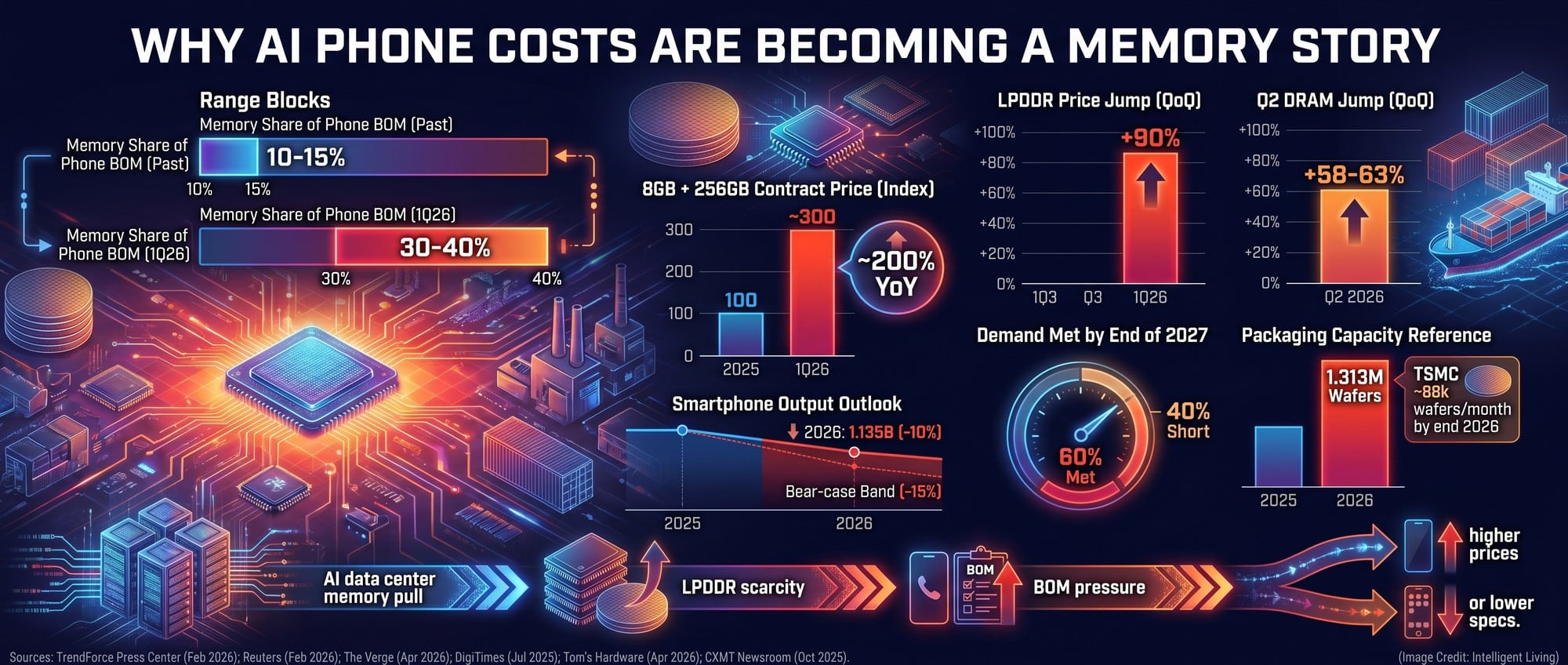
This rumor arrives during a major global supply crunch. As memory shortages constrain smartphone production, manufacturers are struggling to build new devices even when their chip designs are ready. A dedicated 3D memory partnership could help stabilize this volatility.
Policy Friction as Background Noise
Semiconductor sourcing also carries policy sensitivity. Policy language around Section 5949 semiconductor procurement restrictions focuses on U.S. government acquisition rules, but it is a reminder that supplier choices can ripple into compliance, perception, and long-term supply-chain strategy, even when a product is aimed primarily at a non-U.S. market.
The Catch: Cost, Apps, and Unconfirmed Details
Why This Is Still Unconfirmed
Despite the intriguing hardware narrative, this remains an analyst-reported development, and separate supply-chain discussion of custom smartphone DRAM with CXMT hints at why a memory partnership would appeal to a chipmaker trying to stabilize costs and availability.
Qualcomm has not publicly confirmed a 3D DRAM NPU project with CXMT. The biggest unknown remains whether real-world applications will make the hardware feel essential rather than just a decorative spec.
Cost and Materials Are Not a Small Detail
Stacked memory and advanced packaging techniques are rarely inexpensive. The chiplet packaging and mineral pressure add another layer to the cost question, because denser interconnects and tighter manufacturing tolerances can increase complexity even when they improve performance, and virtual chip design agents are emerging partly because modern chips are too interconnected to design and verify with slow, manual loops alone. If customized 3D DRAM raises the bill of materials, smartphone makers may pass some of that cost to buyers, especially in a segment where margins and marketing expectations are already high.
Software Readiness Can Make or Break the Hardware
The final hurdle is ensuring the software is ready to take advantage of the new power. Many platforms currently use privacy-preserving AI compute enclaves to handle tasks that are too heavy for a phone to run alone. For a 3D DRAM NPU to succeed, apps must be redesigned to keep those tasks entirely on your device.

Why Future AI Performance Depends on Innovative Memory Architecture
Qualcomm’s rumored 3D DRAM NPU concept reflects a broader shift in artificial intelligence hardware, where the local AI memory ladder determines which features can run on-device without a cloud connection. Performance gains are no longer tied solely to processor clock speed; they now depend on memory architecture, packaging innovation, and data movement efficiency. This pivot suggests that the next generation of 2027 AI smartphones will be judged by how intelligently they manage the frantic race of data between storage and machine learning engines.
As generative AI becomes embedded in our daily communication, photography, and productivity, the invisible pathways inside your phone will determine whether these features feel seamless or strained. Solving the smartphone memory bottleneck means your device can finally keep up with your creative flow, whether you are live-editing a cinematic video or relying on a real-time voice translator in a crowded terminal. Innovative 3D DRAM NPUs mark a turning point for mobile hardware—moving beyond flashy names to deliver a phone that is truly capable by design.
AI Phone Hardware FAQ: 3D DRAM, NPUs, and On-Device AI Explained
What is a 3D DRAM NPU?
A 3D DRAM NPU is a dedicated neural processing unit paired with vertically stacked dynamic random-access memory. The goal is to shorten the distance between compute and memory, improving data flow for AI tasks.
Why Does a Smartphone Need a Dedicated NPU?
A dedicated NPU accelerates machine learning workloads such as image recognition, speech transcription, and generative AI. It allows the CPU and GPU to focus on other tasks, improving efficiency and responsiveness.
Is Qualcomm’s CXMT 3D DRAM NPU Confirmed?
No. The current details originate from analyst reporting and have not been formally announced by Qualcomm or CXMT.
How Could this Improve On-Device AI?
Faster memory bandwidth and specialized AI hardware could reduce latency, enhance battery efficiency, and enable more advanced generative AI features to run locally on the phone.
Will AI Phones Become More Expensive?
Potentially. Custom stacked memory and advanced packaging techniques may increase component costs, depending on production scale and software demand.


