
Huawei has unveiled the Kirin 9050 Pro, its first high-performance flagship mobile chip in six years, and the first commercial processor built on its LogicFolding architecture. The chip debuted on September 8, 2026, inside the Mate XT 2 tri-fold phone in Guangzhou, delivering what Huawei says is 42% higher overall performance than its predecessor while cutting NPU power consumption by 66% at equal performance.
The headline claim is striking: transistor density jumps from about 155 million to 238 million transistors per square millimeter, roughly 55% higher than the previous generation Kirin 9030 Pro, without moving to a new manufacturing process. Instead of shrinking transistors, Huawei folded the logic itself.
What Is the Kirin 9050 Pro?
The Kirin 9050 Pro is Huawei’s new flagship smartphone processor and the launch chip for the second-generation Mate XT tri-fold. Huawei positions it as its most powerful Kirin processor to date and the first high-performance chip to use Huawei’s stacked-chip strategy in a commercial mobile product.
Key Kirin 9050 Pro specs reported at launch include:
- Nine-core, four-cluster CPU in a 1+2+4+2 layout with 16 threads, peaking at 3.1 GHz
- Single-core speed up 24% and multi-core throughput up 52% versus the Kirin 9030 Pro, according to Huawei
- Overall device performance up 42% versus the previous Mate XT generation
- New Maleoon GPU with hardware ray tracing, claimed 142% graphics rendering improvement
- Da Vinci NPU capable of running on-device multimodal AI models up to 30 billion parameters
- 16GB of RAM paired with the chip in the Mate XT 2, with up to 2TB storage options
One important caveat runs through all of these figures: every performance and density number published so far comes from Huawei itself. As of launch week, no independent auditor had verified the benchmarks, and third-party Kirin 9050 Pro benchmark and AnTuTu scores have yet to appear.
How LogicFolding Works: Stacking Instead of Shrinking
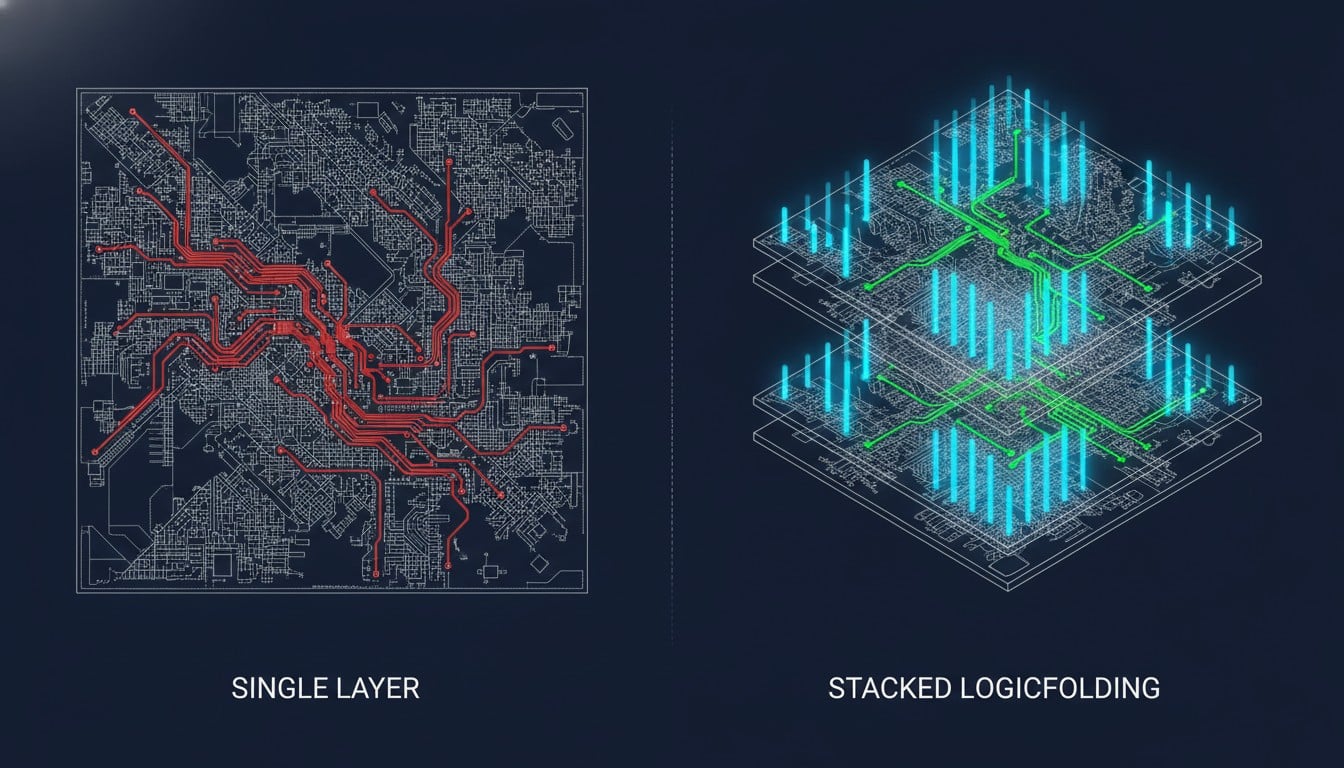
Conventional chips spread logic, analog, and memory blocks across a single flat plane. LogicFolding instead distributes those blocks across two active layers stacked face-to-face inside the same chip, joined by low-temperature hybrid bonding.
Huawei likens the change to upgrading from a single-story apartment to a two-story duplex, with vertical interconnect channels acting as data elevators between floors. Because circuits that used to sit far apart are now directly above one another, signals travel shorter distances. Shorter wires mean lower resistance, lower capacitance, less delay, and less energy per operation.
Huawei says it used the latency margin gained from shorter paths to lower operating voltage, which is how density rises while power falls. The company also reports a 55% area reduction for the high-speed global Network-on-Chip datapath built across both active layers, alongside more stable power delivery and a post-silicon clock skew adjustment scheme.
55% Density Gain and 66% Lower NPU Power Explained
The numbers Huawei published in its launch materials and in the September 4 scientific paper by semiconductor chief He Tingbo tell a consistent story:
| Metric | Kirin 9030 Pro (planar) | Kirin 9050 Pro (LogicFolding) |
|---|---|---|
| Transistor density | About 155 million per mm2 | 238 million per mm2, up about 55% |
| NPU power at equal performance | Baseline | Down 66% |
| GPU power at equal performance | Baseline | Down 58% |
| CPU performance-core power | Baseline | Down 41% |
| Die area | Baseline | Down about 37.5% |
| Peak P-core frequency | 2.75 GHz | 3.1 GHz, up about 13% |
| SRAM operating frequency | Baseline | Up 40% or more |
The distinction that matters most is that these gains do not come from a smaller transistor. SemiWiki’s analysis notes that the improvement comes largely from shorter wires and vertical space, not from manufacturing smaller features. That is precisely the point of Huawei’s approach: performance scaling without waiting for the next lithography node.
The Tau Scaling Law Behind the Chip
LogicFolding is the engineering implementation of a broader theory Huawei calls the Tau scaling law. Presented by He Tingbo at the IEEE International Symposium on Circuits and Systems in May 2026, the framework proposes replacing geometric scaling with time scaling as the guiding principle for semiconductors.
In simple terms, system performance is limited by the propagation delay between flip-flops on the critical path, which depends on logic depth and interconnect resistance and capacitance. As described in technical coverage of the Tau framework, folding compresses that delay by rearranging circuits in three dimensions rather than shrinking each transistor.
The follow-up 23-page paper accepted by Science China and posted in early September expanded the May keynote with production-scale validation, including chip-level power, area, frequency, SRAM, and clock-tree measurements, plus a CPU frequency roadmap running to 2029. The same paper outlines a three-layer AI system stack around a unified bus, near-packaged optical engine, and 3D folding.
The First Phone to Use It: Huawei Mate XT 2
The Kirin 9050 Pro launches exclusively in the Huawei Mate XT 2 Ultimate Design, the company’s second tri-fold phone. The device switches from the original Mate XT’s outward Z-fold to an inward G-shaped hinge that protects the flexible panel when closed.
Standout Mate XT 2 features include a 10.2-inch internal 3K LTPO OLED display, a 6.5-inch outer LTPO OLED cover screen peaking at 6,500 nits, a 5,600mAh battery with 66W wired and 50W wireless charging, and HarmonyOS 7. The chassis measures 3.5 mm at its thinnest edge, weighs 299 grams, and carries IP58 and IP59 ratings.
Imaging centers on a triple RYYB camera system with a 50MP variable-aperture main sensor, a 50MP periscope telephoto with 3.5x optical zoom, and a 40MP ultra-wide lens. An optional hardware privacy display uses a dual-pixel structure to block off-axis viewing. Pricing in China starts at CNY 19,999 for 16GB plus 256GB, rising to CNY 29,999 for a collector edition with 2TB of storage.

Why LogicFolding Matters Beyond One Phone
Huawei has faced restricted access to leading-edge lithography for years, so a path to higher density without a new process node carries strategic weight. If the production data holds up under independent testing, LogicFolding would represent a genuine post-Moore scaling route: compress time instead of geometry.
The implications extend to AI hardware, where Huawei’s paper positions 3D folding alongside interconnect and optical I/O advances for large-scale compute pods. More efficient on-device NPUs also matter for phones, since multimodal models up to 30 billion parameters running locally could reduce cloud dependence for AI features.
Still, healthy skepticism is warranted. French technical press has noted that the 55% density and 42% performance figures exist on paper only for now, pending teardowns and third-party measurement. Yield, cost of hybrid bonding at volume, thermals in a 3.5 mm foldable, and sustained versus peak performance all remain open questions until reviewers get hardware.
Frequently Asked Questions
Which Kirin processor is the most powerful?
The Kirin 9050 Pro is Huawei’s most powerful announced mobile Kirin to date, based on the company’s stated 42% overall performance gain over the previous generation and its new nine-core 3.1 GHz design. Independent rankings will depend on third-party benchmark results once devices ship broadly.
Are Kirin processors good?
Recent Kirin flagship chips are competitive on efficiency, imaging, and on-device AI, though they have historically trailed the very latest rival flagship silicon on peak CPU and GPU throughput. The 9050 Pro aims to close that gap through stacking rather than a process shrink, but verdicts should wait for independent testing.
Which phones have a Kirin processor?
The Kirin 9050 Pro debuts in the Huawei Mate XT 2 tri-fold. Prior Kirin 9000-series chips appear across Huawei’s Mate and Pura flagship lines sold primarily in China.
Is the Kirin 9000 series good for gaming?
Huawei claims the 9050 Pro’s new GPU with hardware ray tracing delivers a large graphics rendering uplift, which would help gaming. Real-world gaming performance will depend on sustained thermals, driver support, and game optimization, so wait for hands-on gaming tests before judging.
What process node is the Kirin 9050 Pro built on?
Huawei has not framed the chip around a new nanometer node. The company emphasizes that the density gain comes from the LogicFolding stacked architecture at a fixed device node, not from moving to smaller transistors.
Conclusion
The Kirin 9050 Pro is more than a spec bump. By stacking logic vertically with hybrid bonding, Huawei claims 55% higher transistor density, up to 66% lower NPU power at equal performance, and 42% higher overall device speed, all without a new lithography node. The Tau scaling theory behind it reframes progress as compressing signal delay rather than shrinking features.
Whether LogicFolding truly replaces a generation of Moore’s law scaling now depends on verification: teardowns, independent power measurements, and sustained real-world performance in the Mate XT 2. If those confirm Huawei’s figures, the industry’s post-Moore roadmap just gained a working commercial example.

