
According to the WHO, malaria (a mosquito-borne infectious disease that affects humans and other animals) causes over 400,000 deaths annually worldwide, mostly among children in Sub-Saharan Africa.
New malaria vaccine trials found that UK scientists have developed the world’s most effective malaria vaccine yet. The jab (R21/Matrix-M), which was tested on 450 children (aged five to 17 months) in West Africa (in the area of Nanoro, central Burkina Faso), showed a 77% efficacy over 12 months and has been hailed as a breakthrough in the fight against the deadly disease.
Malaria spreads by mosquito bites. It killed at least four times more people in Africa last year than COVID-19 did.
Co-author Adrian Hill, the director of the Jenner Institute, and Lakshmi Mittal, and a University of Oxford professor of vaccinology, led the research behind the Oxford-AstraZeneca coronavirus vaccine. He said:
Malaria killed at least four times as many more people in Africa last year as COVID did. And nobody for a moment questioned whether COVID should have an emergency use review and authorization in Africa – of course, it did, very quickly.
So why shouldn’t a disease that firstly kills children rather than older people, certainly killed an awful lot more, be prioritized for emergency use authorization in Africa? Nobody’s really ever asked that question before COVID, but we’re going to do so and have been doing so, and regulators sound interested.
Normally, this would take three to five years to do a phase three trial – in that time, 300,000 children in Africa will die every year of malaria. Why should it take that long? We think that there is a similar case for deploying malaria vaccines early to save lives that there is for deploying COVID vaccines.
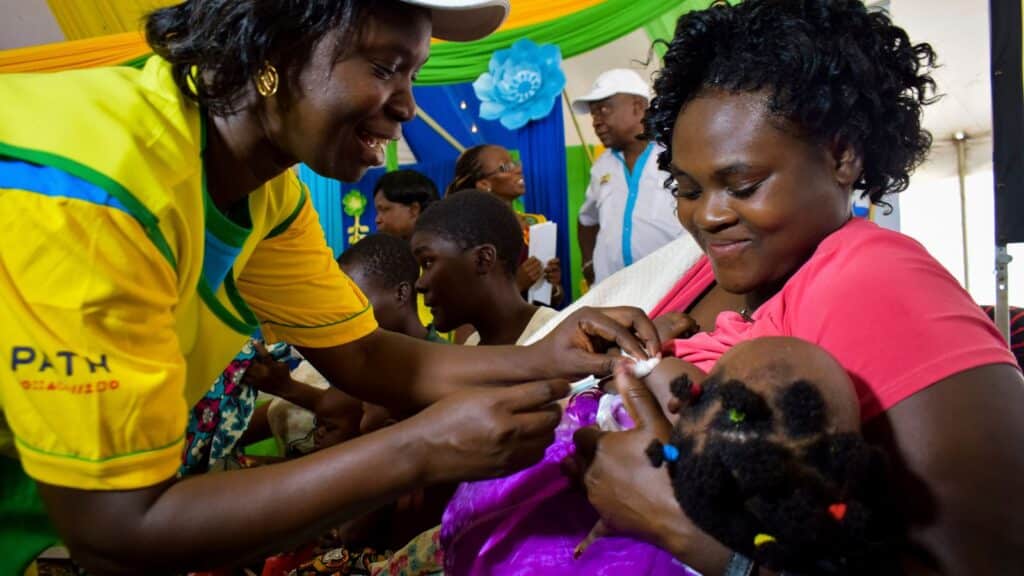
The R21/Matrix-M vaccine is the first malaria vaccine to reach the 75% efficacy target set by the WHO. The team hopes it can be approved for use within the next two years.
Prof Hill said:
With the commitment by our commercial partner, the Serum Institute of India, to manufacture at least 200 million doses annually in the coming years, the vaccine has the potential to have a major public health impact if licensure is achieved.
Official figures show that last year Burkina Faso (the country where the trial is taking place) recorded over 11 million malaria cases and nearly 4,000 malaria-related deaths, including children and pregnant women.
A larger Phase III trial – the final stage of clinical trials – will begin in May. It will involve 4,800 children from four countries, aged five to three years. The researchers hope that by testing the vaccine on a more significant number of subjects in different contexts, its efficacy will be confirmed and considered for registration.
Epidemiologist Gauthier Tougouri, the National Malaria Control Programme coordinator in Burkina Faso, said:
I hope that the forthcoming results will confirm phase two of the study so that we can reach the 2030 target for the elimination of malaria.
The team plans to report the results of the final trial stage next year. If it’s successful, it will represent a substantial step towards the 2030 goal of malaria elimination.


