
A new study from scientists at the Vagelos College of Physicians and Surgeons at Columbia University (VP&S) is the first to present quantitative evidence linking psychological stress to accelerating hair graying in people.
While previous research in mice suggested that stressed-induced gray hairs are permanent, the team at VP&S discovered the contrary – that hair color could be restored when stress is eliminated. “The study has broader significance than confirming age-old speculation about the effects of stress on hair color,” pointed out the study’s senior author Martin Picard, an associate professor of behavioral medicine at VP&S.
Picard explained:
Understanding the mechanisms that allow ‘old’ gray hairs to return to their ‘young’ pigmented states could yield new clues about the malleability of human aging in general and how it is influenced by stress. Our data add to a growing body of evidence demonstrating that human aging is not a linear, fixed biological process but may, at least in part, be halted or even temporarily reversed.
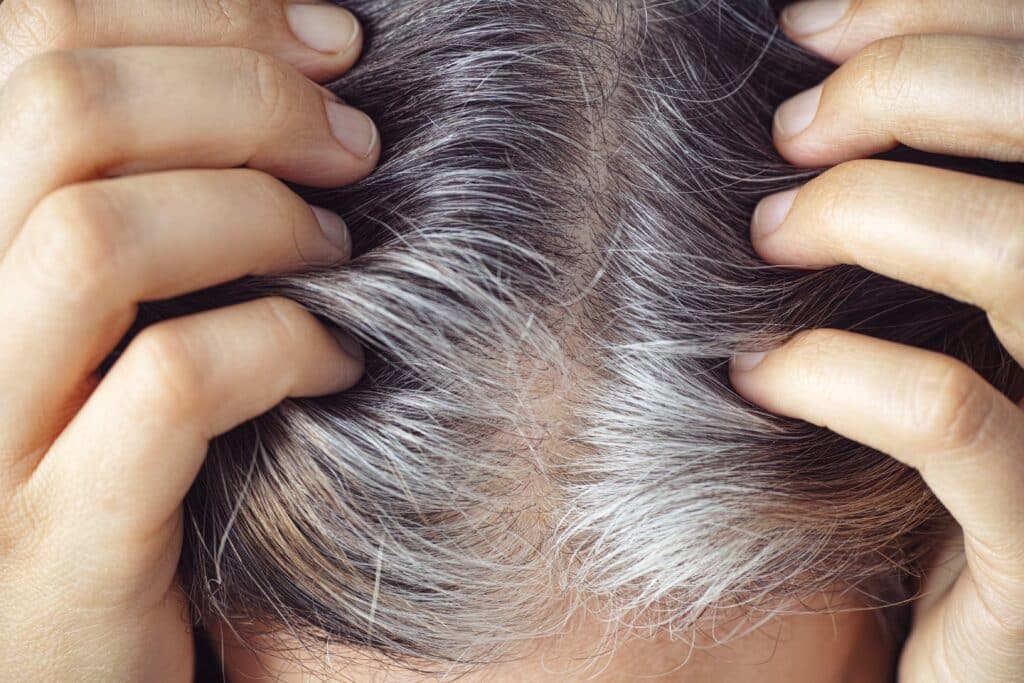
Studying Hair To Investigate Aging
People have long believed that stress can accelerate gray hair. However, scientists have debated the connection due to insufficient sensitive methods that can accurately correlate times of stress with hair pigmentation down to a single-follicle level.
Picard said:
Just as the rings in a tree trunk hold information about past decades in the life of a tree, our hair contains information about our biological history. When hairs are still under the skin as follicles, they are subject to the influence of stress hormones and other things happening in our minds and body. Once hairs grow out of the scalp, they harden and permanently crystallize these exposures into a stable form.
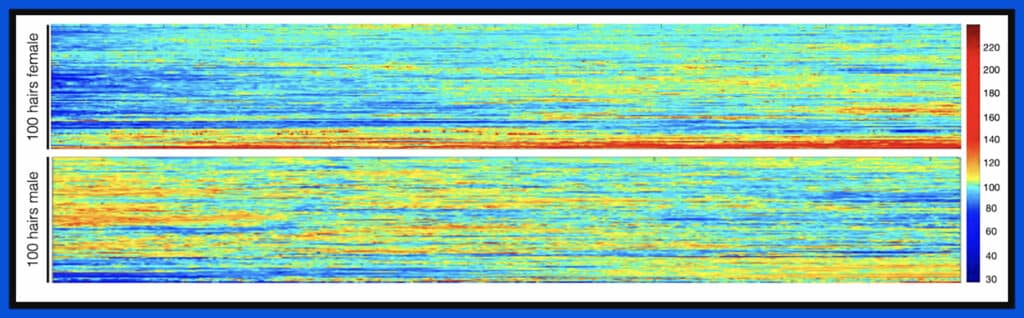
Ayelet Rosenberg, the study’s first author and a student in Picard’s laboratory, began splitting hairs to document hair pigmentation. As a result, Rosenberg developed a new method for capturing highly detailed images of tiny slices of human hairs to measure the level of pigment loss (graying) in each of those slices. Each slice measures around 1/20th of a millimeter wide and represents approximately 60 minutes of hair growth.
Picard added:
If you use your eyes to look at a hair, it will seem like it’s the same color throughout unless there is a major transition. Under a high-resolution scanner, you see small, subtle variations in color, and that’s what we’re measuring.
In the study, published on June 22 in eLife, the researchers analyzed individual hairs from fourteen volunteers, who were asked to review their calendars and rate each week’s stress level in a diary. The results from the hair analysis were then compared with each volunteer’s stress diary. The VP&S team immediately noticed that some gray hairs naturally regained their original color. According to Picard, this phenomenon had never been quantitatively documented before.
Outstanding associations between stress and hair graying were revealed when strands were aligned with stress diaries by Shannon Rausser, second author on the paper and a student in Picard’s laboratory. In some cases, the greying of hair was even reversed when stress was out of the picture. “There was one individual who went on vacation, and five hairs on that person’s head reverted to dark during the vacation, synchronized in time,” Picard said.
The Mitochondria Connection
The VP&S team measured thousands of protein levels in the hairs and how these protein levels changed over the length of each strand to understand how stress leads to gray hair. They found changes in 300 proteins when hair color altered.
The researchers developed a mathematical model that suggests stress-induced changes in mitochondria could shed light on how hair turns gray from stress. “We often hear that the mitochondria are the powerhouses of the cell, but that’s not the only role they play. Mitochondria are actually like little antennas inside the cell that respond to a number of different signals, including psychological stress,” explained Picard.
However, the mitochondria connection between hair color and stress contrasts from the findings of a recent study of mice, which found stress-induced graying was caused by an irreversible loss of stem cells in the hair follicle. Regardless, Professor Ralf Paus, Ph.D., from the University of Miami Miller School of Medicine and co-author of the study, argues: “Our data show that graying is reversible in people, which implicates a different mechanism. Mice have very different hair follicle biology, and this may be an instance where findings in mice don’t translate well to people.”
Hair Re-Pigmentation Isn’t Possible For Everyone
While reducing stress in your life is a worthy goal, it won’t necessarily turn your hair to its original color; it all depends on your age.
Picard explained:
Based on our mathematical modeling, we think hair needs to reach a threshold before it turns gray. In middle age, when the hair is near that threshold because of biological age and other factors, stress will push it over the threshold and transition to gray. But we don’t think that reducing stress in a 70-year-old who’s been gray for years will darken their hair or increasing stress in a 10-year-old will be enough to tip their hair over the gray threshold.
Foods To Combat Stress
We are living through some stressful times because of the coronavirus pandemic. Perhaps now, more than ever, it’s critical you do everything you can to combat stress levels, not just to prevent gray hairs but also for your health and happiness. Surprisingly, the things you eat can affect that significantly.
Some foods help relieve tension more than others, while the lack of some stress-fighting foods can make you feel worse (like anxiety, depression, and panic attacks). So maybe you think the COVID-19 situation is why you’ve got anxiety, but if you ate the right foods, you wouldn’t feel as bad. Of course, occasional bouts of stress are usual. But chronic stress isn’t, and it can lead to severe health problems not only mentally but physically too (like heart disease).
Some of the best things to eat that will keep your stress levels to a minimum include green leafy vegetables, beets (beetroot), sweet potatoes, artichokes, broccoli, blueberries, acerola cherries, organ meats, turkey breast, eggs, shellfish, fatty fish (like herring, mackerel, salmon, and sardines), Kimchi, seaweed, parsley, garlic, sunflower seeds, chickpeas, dark chocolate, milk, matcha, and chamomile tea.


