
In collaboration with industrial designer Grace Knight and artist and researcher Orkan Telhan, American scientist Andrew Pelling has developed a grow-your-own steak kit using human cells and blood. The DIY kit concept was designed to question the ethics of the cultured meat industry.
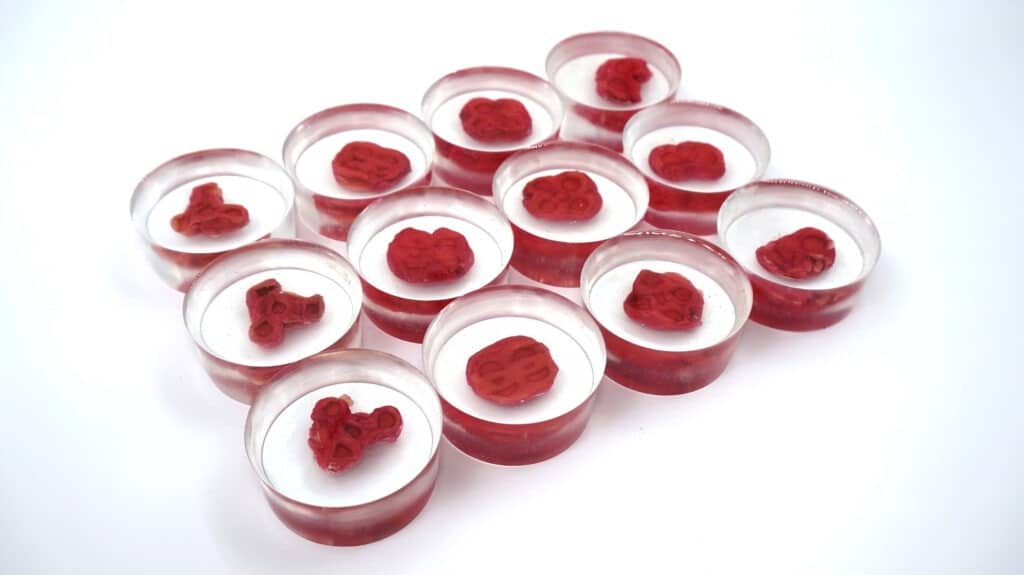
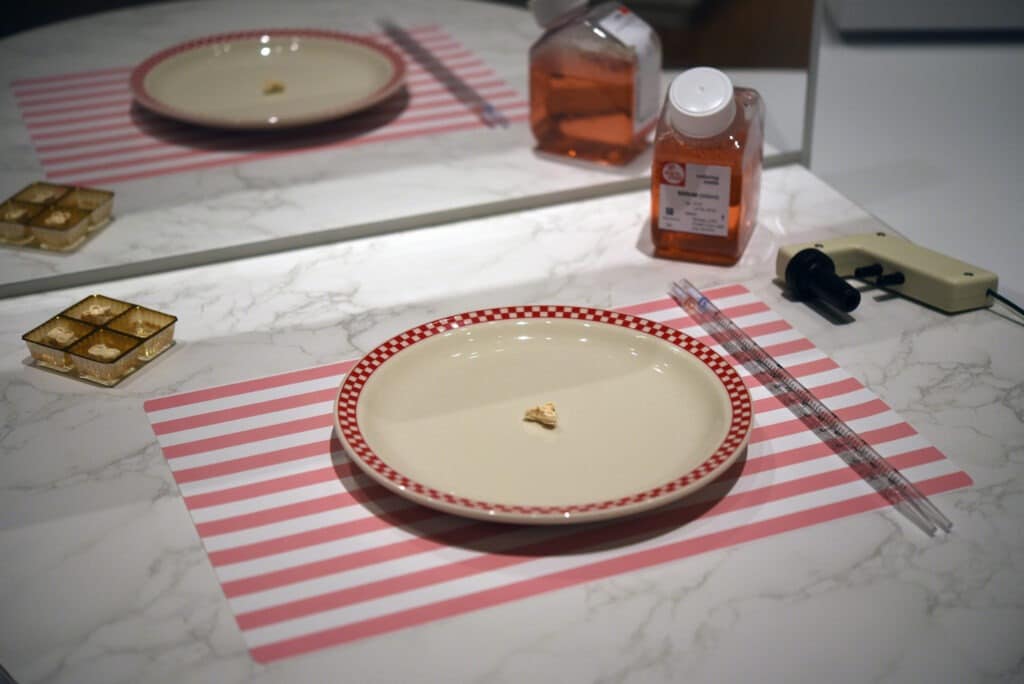
Bite-sized pieces of the meat – preserved in resin and laid out on a plate complete with a placemat and silverware – are on display at the Beazley Designs of the Year exhibition at the Design Museum in London.
Eventually, consumers could grow Ouroboros Steak at home using their own cells, collected from the inside of their cheek and feeding it human serum from expired blood donations. Ouroboros Steak is created entirely without harming animals. Though, the same cannot be said about cultured meat made from animal cells.

Knight said:
Expired human blood is a waste material in the medical system and is cheaper and more sustainable than FBS, but culturally less-accepted. People think that eating oneself is cannibalism, which technically, this is not.
The lab-grown meat industry claims to offer a more sustainable, cruelty-free alternative to factory farming, but it’s not. The process still depends on fetal bovine serum (FBS), which costs around $400 to $950 per liter, as a protein-rich growth supplement for animal cell cultures.
FBS is derived from calf fetus blood after their pregnant mothers are slaughtered by the meat or dairy industry. Therefore, lab-grown meat is a by-product of polluting agricultural practices.
Pelling explained:
Fetal bovine serum costs significant amounts of money and the lives of animals. Although some lab-grown meat companies are claiming to have solved this problem, to our knowledge, no independent, peer-reviewed, scientific studies have validated these claims. As the lab-grown meat industry is developing rapidly, it is important to develop designs that expose some of its underlying constraints in order to see beyond the hype.
Ouroboros Steak gets its name from the ancient symbol of the snake eating its own tail. The preserved meat on display at the Design Museum was produced using human cell cultures, which can be purchased exclusively for research purposes from the American Tissue Culture Collection.
The creators envision the DIY kit involving users collecting cells from the inside of their cheek using a cotton swab, then placing them onto pre-grown scaffolds made from mycelium. These would be stored in a warm environment (like a low-temperature oven) and fed with human serum until the steak is fully grown, which would take around three months.

Telhan concluded:
Our design is scientifically and economically feasible but also ironic in many ways. We are not promoting ‘eating ourselves’ as a realistic solution that will fix humans’ protein needs. We rather ask a question: What would be the sacrifices we need to make to be able to keep consuming meat at the pace that we are? In the future, who will be able to afford animal meat and who may have no other option than culturing meat from themselves?
Among the companies striving to bring cultured meat to the industry is Israeli start-up Aleph Farms, the world’s first company to produce a lab-grown steak. Aleph Farms also conducted an experiment at the International Space Station to test if beef could grow in space, and it did! The experiment took place inside a 3D bioprinter, developed by 3D Bioprinting Solutions in collaboration with two U.S.-based food companies.
Others include a group of Harvard John A. Paulson SEAS researchers who made edible gelatin scaffolds that have the texture and consistency of real meat. Then, they grew rabbit and cow muscle cells on that scaffolding. The results were fully lab-grown meat, which has a texture similar to the real deal.
Meanwhile, the EU is taking action to reduce meat consumption and fight the climate crisis by adopting a sustainability charge on meat to cover its environmental damage. The tax would increase the cost of a steak by roughly 25%.


