
A new clean energy solution in town is more trustworthy than its competition! It’s called a Blue Cell Power Capacitor, and it’s a high-density carbon-based hybrid power capacitor. Unlike its rival, the classic lithium-based battery, these marvels can:
- Withstand temperatures ranging from -40°C to +80°C (meaning no thermal risk)
- Require no battery management systems (BMS)
- Are simple to use
- Can last for up to 10,000 to 50,000 full charge-to-discharge cycles
All these features make it the most cost-efficient and long-life solution for energy storage on the market. It also has a much higher energy density, meaning it packs more power in a smaller package.

The device is a new niche in battery technology. Being a hybrid, it bridges the gap between a traditional supercapacitor (usually lithium-based) and a lithium-ion battery cell. It uses activated carbon as its active ingredient, and unlike the batteries in stores now, no chemical reaction is involved when charging or discharging – hence why it’s safer.

These Carbon-based Power Capacitors store electric charges at an energy density that is on par with Lithium-ion cells (from 80 to 230 Wk/kg) but with a power density of supercapacitors (a few 100 to 1000’s W/kg). In other words, a system equipped with these cells can store as much energy as Lithium-ion cells but can deliver it up to twenty times faster! This means that they can charge a lot faster.
The company writes on its website:
“Using clean electric energy has always been hampered by the limitations of how to save and store it in batteries, how to use the energy from it, and especially on how to charge these batteries. With Carbon-based Power Capacitors, many applications become practical again and they enable them to reach clean energy sustainability as never before.”
Power capacitor battery packs are a secure solution because the technology offers inherent safety and reliability. Here’s how:
- The cells contain only a small amount of electrolyte, and its function is that of a filler – it is only the pathway through which the charge can move. The nano-carbon material soaks up all the electrolytes, so even if the cell breaks open, a minimal (if any) amount of it will leak out.
- It functions as a capacitor; therefore, the electric energy is stored as electrical charges. No active chemical reactions are involved.
- The capacitance is increased thanks to the nano-carbon materials – they increase the surface of the electrodes enabling them to store as much energy as traditional lithium batteries.
- The cells’ fault-tolerant quality lies in the fact that its power pack involves connecting the capacitors with a small grid mesh. This prevents dendrites from forming and creating short circuits between the electrodes. And even if the cell is damaged, the failure mode becomes an open circuit where the battery continues to function and only loses some capacitance.
- The combination of low internal resistance with the meshing connections means the power capacitor pack warms up very little, even when high currents are used.
- Because no BMS is needed to balance the cells when charging or discharging, the design is much simpler, meaning less opportunity for something to go wrong. A failing BMS, after all, is the main trigger for battery fire.
- NO active cooling is needed since the cells operate at extreme temperatures and barely warm up. Again, this results in a more straightforward design as it doesn’t need supporting subsystems.
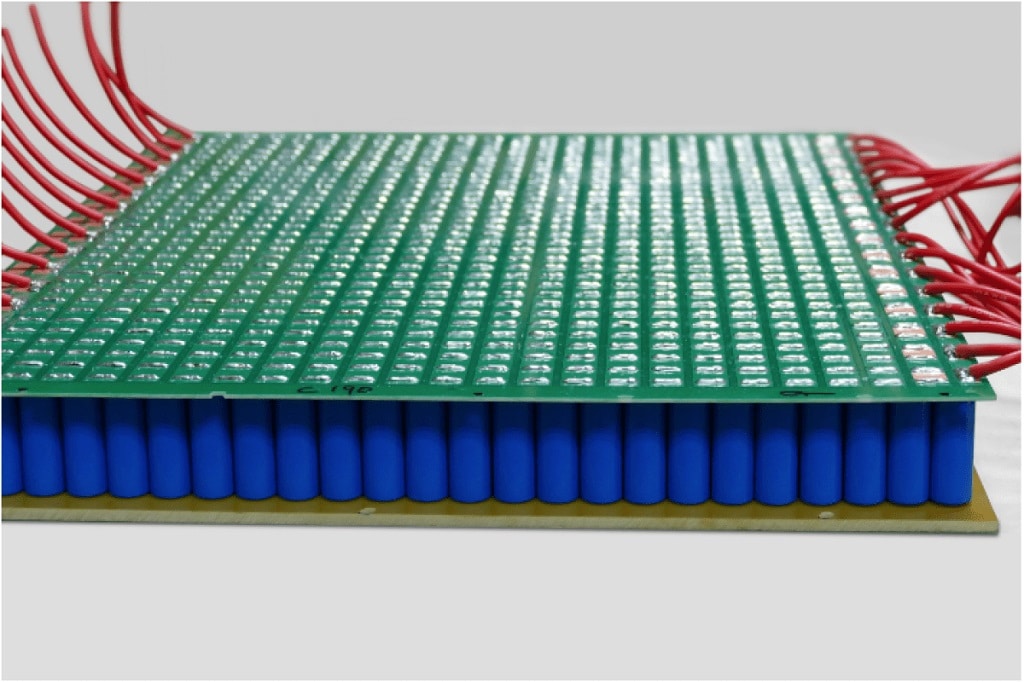
The company performed extensive stress and abuse tests, including short circuits, forced discharging, overcharging, drop proof, fire, nail puncture (internal short circuit), and even shooting it with a gun. All the destructive tests showed no fire and no explosion, thus demonstrating the cells’ extreme robustness. They even subjected them to load conditions far exceeding the permissible values, and the batteries kept functioning.
Belgian electronic engineer Eric Verhulst is responsible for getting Toomen’s cells to the market through his company Altreonic – Kurt.Energy, told New Atlas:
“They’ve tested hundreds of variations combining a supercapacitor with carbon and one lithium electrode like you’d find in a lithium battery, and I can see through the test reports they’ve had a gradual improvement in performance. I’m pretty sure we can push it even further.”

For the future, Verhulst is planning volume production while a team at Munich University is evaluating the cells for a possible role in deep space, where temperatures can reach -200ºC (-328ºF). As of today, his company is already producing high-powered cells and selling them in the automotive, solar, and energy storage markets. His selling point has been the Toomen cells’ ability to work flawlessly across such a wide span of temperatures.


