
One-third of the world’s tropical rainforests are found in Indonesia. These forests are home to Indigenous tribes, birds, gibbons, rhinos, leopards, and tigers. Thankfully, current protections are helping these vital forests thrive.
Indonesian President Joko Widodo’s administration has achieved four consecutive years of deforestation declines via land-use reforms and re-establishing a logging moratorium. This significant work culminated in 2020 when the country gained its lowest deforestation rates since monitoring began, reaching a 75% drop year-over-year.
Before this moratorium, Indonesia was open for business to anyone looking to open a plantation. The country is the world’s biggest palm oil producer, a commodity used in a broad range of everyday products, from soap, shampoos, and deodorant to lipstick, nuts, bread, margarine, and even ice cream.
Palm oil is the world’s most consumed vegetable oil and most productive, yielding ten times more oil per hectare than soybeans. However, much of that production has come at the expense of forests, greenery, and Indigenous and community lands cleared out and replaced by vast industrial plantations.
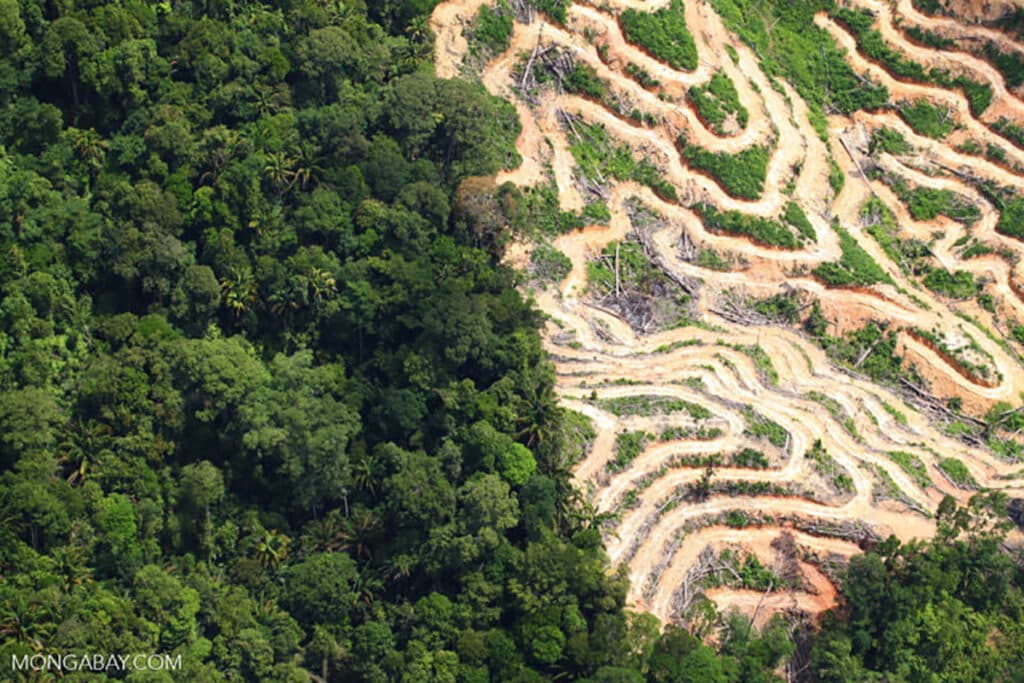
In 2018, President Joko Widodo, elected in 2014, issued a moratorium on new permits for palm oil plantations, combined with record-low prices for the product to slow its once-persistent advance. The suspension, which became permanent in 2019, responds to widespread concerns about environmental violations, labor rights abuses, and land conflicts within the palm oil industry.
Half of Indonesia’s 17,500 islands are currently covered in peatlands, forests, swamps, or mangroves. According to FAO, 52.1% (roughly 94,432,000 ha) of Indonesia is forested; of this, 50.0% (47,236,000) is classified as primary forest, the most biodiverse and carbon-dense form of forest that exists. Within those regions are some incredible and iconic animals that depend on forests to survive. These include:
- The Komodo dragon on Komodo
- The orangutan on Sumatra
- The rhinos on Java
- The starlings on Bali
- The dwarf buffalo on Sulawesi
- The Sunda clouded leopard on Kalimantan
Recent policies have provided hope that the country can restore its remaining forests, protect its habitat, and reduce emissions on par with her commitments to the Paris Agreement. These policies included returning 30 million acres (12M hectares) to Indigenous governance, increased penalties and enforcement of environmental laws, forest fire mitigation strategies, and more.

Ruandha Agung Suhardiman, the ministry’s director-general of planning, told Mongabay, “This drop in deforestation shows that various efforts made by the Ministry of Environment and Forestry lately have produced significant results. Their impact on reducing deforestation is tremendous.”
The Norwegian government is supporting this positive change in forestation practices. Norway itself has achieved near-zero deforestation rates at home, demonstrating that conservation and economic development can coexist. Almost ten years after signing an agreement that would compensate government agencies if they reduced forest loss, Norway sent the first installment of a €1 billion (around US$1.2 billion) reward to Indonesia. “It is a big deal because it reflects the fact that Indonesia has turned (a corner), and that is great news for all of us,” director Oyvind Eggen, from Rainforest Foundation Norway, told Reuters.
The moratorium is slated to expire on September 19. However, last week, activists and officials in Indonesia called for the renewal of the ban on issuing new licenses for oil palm plantations. With less than three weeks before the moratorium ends, the government has yet to announce whether or not it will extend it. However, it looks promising as senior officials have also called for it to remain in place.

Alue Dohong, environment and forestry deputy minister, highlights that the sustainability aspect of the moratorium contributes to Indonesia’s long-term goal of reducing GHG emissions. This is because Indonesia’s leading source of emissions is land-use change and deforestation, unlike most significant emitters, where transportation and electricity generation account for most emissions.
The Indonesian government has set an admirable target to turn the country’s forests into a net carbon sink by 2030 by slowing down deforestation, planting more trees, and going carbon neutral by 2070. “So, it’s relevant to continue the moratorium to achieve the target of the net sink by 2030,” Alue said.
Environmentalists warn that ‘not extending’ the moratorium will have terrible consequences for Indonesia’s remaining rainforests and all the species living among their lush canopies.


